How to grow snowdrops? A step-by-step guide to the growing method
1. Light
Snowdrops do not have high light requirements. In spring, autumn and winter, let them receive direct sunlight often. In summer, when temperatures are high, provide a small amount of appropriate shade to benefit the plant's growth.
2. Temperature
The suitable temperature for snowdrop growth is 15-28°C. They are relatively cold-tolerant but not heat-tolerant, so pay attention to cooling in summer. When the winter temperature drops below 10°C, they enter dormancy.
3. Water and fertilizer
Generally, apply a certain amount of base fertilizer when planting, and often apply a dilute fertilizer during the growing period so that nutrients are evenly supplied. In summer the plant grows slowly, so water and fertilizer need to be reduced; watering must be done properly, and can be done in the early morning or evening to ensure sufficient moisture. When temperatures are high, also pay attention to spraying water mist.
That is all we have to share about the flower language of snowdrops. With such a pure and lovely flower, everyone should hurry and try growing a few.
How to grow snowdrops
Snowdrop, Leucojum vernum, also known as snow bellflower, lily-of-the-valley daffodil and snowflake lily, belongs to the Amaryllidaceae family, genus Leucojum. It is native to central Europe and the Caucasus region.
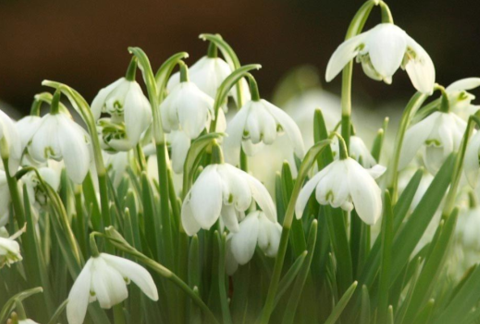
The plant height is 20-30cm, with small spherical bulbs. The leaves are clustered and strap-shaped, about 20cm long. The flower scape is short and hollow, flattened and round, with a single flower or a few gathered into an umbel at the top, drooping, broadly bell-shaped, with 6 tepals, white flowers, and a yellow-green spot at the tip. The flowering period is March to April.
It has strong adaptability and can overwinter in the open field in the middle and lower reaches of the Yangtze River. It likes a cool and humid environment and prefers fertile soil rich in humus. It can grow in both sunny and semi-shady spots. It sprouts in early spring and blooms from March to April. The bulbs remain dormant in the soil.
Propagation. Mainly by dividing bulbs, carried out during the bulb dormancy period from September to October. The planting depth is 5 cm; after one planting, the bulbs can be left for 3-4 years before being dug up and divided again.
Cultivation. For ground planting, apply sufficient base fertilizer and add a small amount of bone meal. If the bulbs are not planted immediately after being dug up, they should be buried in moist sand for temporary storage. Pot planting is done in November. After planting, place the pot outdoors, and once roots have formed and sprouts begin to appear, move it indoors and place it in a spot with plenty of sunlight. It will bloom in about 50 days. The storage temperature for the bulbs is 15°C.
Pests and diseases. Leaf spot disease mainly occurs; spray with a 700-fold dilution of 50% thiophanate-methyl wettable powder. Among insect pests, nematodes can cause damage; drench with a 1500-fold dilution of 90% trichlorfon technical material.
Uses. Snowdrops are low-growing with lush flowers and leaves, unafraid of spring cold and blooming proudly. They are suitable for clump planting under semi-shady woodland or in lawns, and are also suitable for accenting flower borders and rock gardens. They can also be potted for indoor display or used as cut flowers.
How to grow snowdrops and points to note
How to grow snowdrops
Light and temperature
Snowdrops do not have high light requirements and have a certain tolerance for shade. They can grow in both sunny and semi-shady spots. However, in spring, autumn and winter, they should receive direct sunlight often to get sufficient light, while in the hot summer, appropriate shading is needed to avoid affecting the growth of snowdrops.
The suitable growing temperature for snowdrops is between 15°C and 28°C. Snowdrops are naturally fond of cool conditions and afraid of heat, making it relatively difficult for them to get through summer, and they also lack resistance to frost. If the temperature is below 10°C, the plant will enter dormancy.
Humidity
The best relative air humidity for snowdrop growth is between 40 and 65%, and the environment is best kept slightly dry. The growing environment for snowdrops must not be too humid; they are relatively afraid of rain. If rainy weather lasts too long, pests and diseases are easily triggered. Keeping the snowdrop leaves dry at night is more conducive to the growth of snowdrops.
Water and fertilizer management
Snowdrops do not have high requirements for fertilizer and water. Basically, when planting, first apply a certain amount of base fertilizer, then during the growing period pay attention to applying dilute fertilizer frequently to ensure a complete range of growth elements. Do not apply fertilizer that is too concentrated, and do not let snowdrops lack any certain element, so as to avoid various problems in their growth.
Watering should also be done reasonably. Generally, when the weather is clear, there should be sufficient water, while on rainy days, water less or not at all. In summer, when growth is slow, water and fertilizer should be appropriately controlled, but misting should be done when temperatures are high.
Propagation method
Snowdrops are bulbous plants, and when propagating, the main method used is dividing the bulbs.
Points to note when growing snowdrops
Diseases
The main disease of snowdrops is outbreaks of leaf spot disease.
Pests
Snowdrops sometimes suffer from nematode damage.