How to grow Sandersonia aurantiaca? Cultivation methods and precautions
1. Soil
Choose loose, fertile soil with good drainage. If the soil is low in acidity, improve it with quicklime, which both improves the soil and kills some soil-borne pathogens and underground pests. If the soil is relatively alkaline, improve it with phosphoric acid added to peat; the amount depends on the specific situation.
2. Fertilizing
When preparing the soil for Sandersonia aurantiaca, broadcast fully decomposed organic fertilizer. Apply 375-600 kg/hectare of compound fertilizer + 30,000 kg/hectare of organic fertilizer, or other decomposed organic fertilizer, as a base fertilizer and then mix it evenly into the top 30 cm of soil. For plots where other bulbous flowers have been grown, also add 800x dicofol to prevent damage from root mites. It does not require a very high nutrient level; generally no fertilizer is applied during the first three weeks of cultivation, and ensuring good root development during this period is most important.
3. Temperature
The most suitable soil temperature during the growing period of Sandersonia aurantiaca is 18-24°C. During the first three weeks, or at least before stem roots emerge, the temperature should be low. When the temperature is above 20°C, rooting quality declines; especially in summer, keeping or promoting cool soil temperature is essential. Too high a daytime temperature will reduce plant height, decrease the number of flower buds per stem, and produce blind flowers. Night temperatures below 15°C will cause bud drop, leaf yellowing, and reduce ornamental value.
4. Light
Insufficient light is unfavorable for flower bud formation in Sandersonia aurantiaca, while excessive light can also affect cut flower quality. During the growing period, shading and supplemental lighting measures are needed to change the adverse effects of light factors on plant growth. Shading in the early growth stage helps increase plant height, especially in summer. Use shade nets inside and outside the greenhouse and around its perimeter to prevent the temperature inside from getting too high and damaging the plants and flower buds. From the flower bud differentiation stage to when the buds emerge is a leaf-burn-sensitive period; note that light and humidity changes must not be too great.
5. Water
Sandersonia aurantiaca is susceptible to high salinity, especially sodium salts. Too high a salt content leads to water deficiency. It is recommended to irrigate for 20-30 minutes daily from the 17th week after planting, and to use a conductivity meter to regularly test soil electrical conductivity. During the first 8 weeks after planting, water from the top; for the next 9 weeks, change the bulb-seat zone; after 17 weeks of planting, stop watering. Harvest the bulbs 4-6 weeks after stopping watering. When watering, be sure to pay attention to the amount of water, which must not exceed 20 cm.
The above is an introduction to the question of how to grow Sandersonia aurantiaca. Next, let us learn how Sandersonia aurantiaca is propagated.
Sandersonia aurantiaca Hook. Sandersonia aurantiaca illustrated guide: how to grow Sandersonia aurantiaca / how to propagate Sandersonia aurantiaca
Sandersonia aurantiaca profileSandersonia aurantiaca Hook.
Aliases: Christmas bells, Christmas bell, Chinese lantern lily, Chinese lantern flower, golden lily, lily of the valley, Christmas wind chime, Chinese palace lantern flower
Classification: perennial herbaceous flower
Family and genus: Plantae
Full bloom period: summer
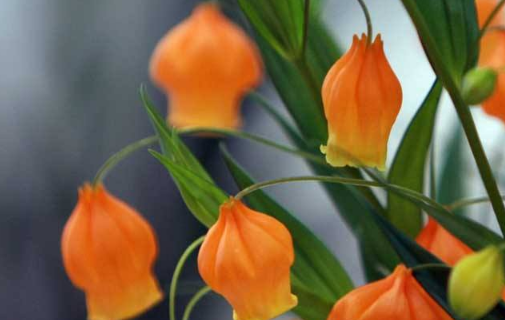
Sandersonia aurantiaca is a perennial bulbous herb. It gets its name because its flower shape and color closely resemble Chinese palace lanterns. When in bloom, it looks like strings of lanterns hanging all over the flower stems, standing out among the green leaves, graceful and full of character. Sandersonia aurantiaca is delicately shaped and exquisitely lovely; its orange-yellow bell-shaped flowers paired with bright green, glossy stems and leaves make it very appealing. It is an excellent cut flower material and bridal bouquet material. Its natural germination rate is low, its growth period is long, and its environmental requirements are high, so it has always been a high-priced flower. It is currently an internationally popular trendy cut flower, especially grown most extensively in New Zealand. Sandersonia aurantiaca bears golden-yellow bell-shaped flowers, and it can adapt to a relatively wide range of temperatures...
Cultivation methods and precautions for Sandersonia aurantiaca: an introduction to Sandersonia aurantiaca
Sandersonia aurantiaca is a perennial bulbous herb. It gets its name because its flower shape and color closely resemble Chinese palace lanterns. When in bloom, it looks like strings of lanterns hanging all over the flower stems, standing out among the green leaves, graceful and full of character. Sandersonia aurantiaca is delicately shaped and exquisitely lovely; its orange-yellow bell-shaped flowers paired with bright green, glossy stems and leaves make it very appealing. It is an excellent cut flower material and bridal bouquet material. Its natural germination rate is low, its growth period is long, and its environmental requirements are high, so it has always been a high-priced flower. It is currently an internationally popular trendy cut flower, especially grown most extensively in New Zealand.
Sandersonia aurantiaca bears golden-yellow bell-shaped flowers, and it can adapt to a relatively wide range of temperature and light changes, so in temperate and subtropical regions it can grow normally both indoors and outdoors. From planting to flowering takes 9-12 weeks; from planting to bulb harvest takes 21-25 weeks.
Its form is graceful and its flowering period is long, with a vase life of up to 2-3 weeks. Practice has shown that whether for bulb production or cut flower production, considerable benefits can be obtained. Sandersonia aurantiaca is a relatively unique variety, and its golden-yellow bell-shaped flowers are excellent proof of that. Sandersonia aurantiaca originated in moist grasslands with rainy summers and relatively low winter temperatures (during which the lily is in natural dormancy) and relatively little rain.
Morphological characteristics of Sandersonia aurantiaca
Perennial bulbous herb, semi-climbing, about 1 m tall.
Leaves whorled and alternate, sessile, smooth on the surface, willow-leaf-shaped, about 5-10 cm long and about 2-3 cm wide, with 3 deep veins.
Flowers dish-shaped, resembling palace lanterns, bright orange-yellow, broad at the top and narrow at the bottom, about 2 cm at the widest part; flower stalk about 5 cm, drooping, axillary, with 6 short lobes, 6 stamens, T-shaped anthers, and a three-cleft style.
From July to January of the following year, from midsummer to autumn and winter. Vase life can reach 2-3 weeks. Capsule 3-valved, dehiscing along the back. The rhizome contains colchicine and is toxic.
Ecological habits of Sandersonia aurantiaca
Sandersonia aurantiaca is native to areas of South Africa at altitudes of 600 to 1,200 m with summer rain and winter drought. Wet and rainy summers are its growing season, while dry winters without rain are its dormant period. Because Sandersonia aurantiaca is not very strict about temperature and sunlight requirements, it is very suitable for greenhouse and field cultivation in temperate and subtropical regions.
The most suitable soil temperature for Sandersonia aurantiaca is 18°C-24°C, and it is best cultivated in a greenhouse with rain protection and shading facilities. If the temperature is above 30°C, growth will be inhibited and the flower stems will become twisted. When planted in summer, high temperatures will shorten the growth period, causing flowering in less than 45 days, and the flower stems will also be shortened. Under normal conditions, Sandersonia aurantiaca flowers 60 days after planting. In northern Taiwan, China or mid-altitude areas, because the winter low-temperature period is longer and the temperature does not get too high to affect the growth of Sandersonia aurantiaca, cut flower quality is good and bulb yield is high; in summer, however, because the high-temperature period is longer, the growth period of Sandersonia aurantiaca is shorter, which is less favorable for cut flower and bulb production.
Bulbs are planted in spring, and when the soil temperature is above 16°C, they sprout in 2-3 weeks. If the climate is cool or dormancy is less than 16 weeks, we recommend pregermination. Under suitable conditions, plants can flower in 45-60 days. The natural dormancy period of Sandersonia aurantiaca bulbs requires at least 12 weeks, but cold storage can break dormancy. Overall, the entire growth cycle takes about 20-25 weeks; if the temperature during this period is relatively low, the growing period will be extended.
Under environmental conditions of relatively high soil temperature (18-24°C) and protection from wind, rain, and direct sun, Sandersonia aurantiaca grows best. Research shows that excessively high temperatures affect growth and flowering; for example, high summer temperatures can shorten the growth cycle, but the stem length will also be correspondingly shortened, thereby reducing the number of flowers. Therefore, it is recommended to harvest after at least 60 days. If planting in late winter or early spring, be sure to ensure the substrate temperature in the greenhouse.
Sandersonia aurantiaca is a temperate crop; the growing substrate should have good water permeability, and watering should be regular. The substrate should be disinfected regularly with fungicides, and it is best to grow it in a well-ventilated greenhouse. The optimum soil temperature for growth is 15-22°C, and the optimum air temperature for growth is 12-28°C.
Cultivation techniques for Sandersonia aurantiaca
Ensure suitable temperatures, arrange regular watering, fungicides, insecticides, and spraying schedules. Use support netting 35 cm above the ground to prevent plants from lodging, and at intervals apply poison bait to trap and kill underground pests.
Soil and fertilizing
Choose loose, fertile soil with good drainage. If the soil is low in acidity, improve it with quicklime, which both improves the soil and kills some soil-borne pathogens and underground pests. If the soil is relatively alkaline, improve it with phosphoric acid added to peat; the amount depends on the specific situation. When preparing the soil, broadcast fully decomposed organic fertilizer. Apply 375-600 kg/hectare of compound fertilizer + 30,000 kg/hectare of organic fertilizer, or other decomposed organic fertilizer, as a base fertilizer and then mix it evenly into the top 30 cm of soil. For plots where other bulbous flowers have been grown, also add 800x dicofol to prevent damage from root mites. Lilies do not require a very high nutrient level; generally no fertilizer is applied during the first three weeks of cultivation, and ensuring good root development during this period is most important. For relatively small bulbs, during the early growth stage when seedlings are 10-30 cm tall, spray fertilizer containing humic acid and some trace elements to increase stress resistance and promote rooting. Before seedlings reach 30 cm in height and before stem roots reach 5 cm in length, do not apply soil topdressing. After stem roots emerge, apply calcium nitrate once at 75 kg/hectare, or apply compound fertilizer once at 150 kg/hectare. If nitrogen deficiency during the growing period often makes the plants insufficiently robust, then apply quick-acting nitrogen fertilizer, generally 20-150 kg/hectare. Soil topdressing is best done 2-3 times, and foliar topdressing can be done once a week. After topdressing, spray the plants once with clean water to prevent leaf burn.
Planting density
The planting bed soil should be at least 15 cm deep, with a soil layer below the rhizome of more than 11 cm, and the stems covered in the surface 4 cm soil layer. For bulbs smaller than 1 g, 300-400 per square meter; 1-3 g, 200-250 per square meter; 3-5 g, 150-180 per square meter; 5-7 g, 130-150 per square meter; 7-10 g, 100-130 per square meter; above 10 g, 80-100 per square meter.
Temperature management
Soil temperature is the key to early-stage management. The most suitable soil temperature during the growing period of Sandersonia aurantiaca is 18°C-24°C. During the first three weeks, or at least before stem roots emerge, the temperature should be low. When the temperature is above 20°C, rooting quality declines; especially in summer, keeping or promoting cool soil temperature is essential. Too high a daytime temperature will reduce plant height, decrease the number of flower buds per stem, and produce blind flowers. Night temperatures below 15°C will cause bud drop, leaf yellowing, and reduce ornamental value. In summer, cool the temperature through ventilation, misting, and shading; in winter, pay attention to heating and insulation.
Light management
Insufficient light is unfavorable for flower bud formation, while excessive light can also affect cut flower quality. Generally speaking, during the growing period, shading and supplemental lighting measures are needed to change the adverse effects of light factors on plant growth. Shading in the early growth stage helps increase plant height, especially in summer. Use shade nets inside and outside the greenhouse and around its perimeter to prevent the temperature inside from getting too high and damaging the plants and flower buds. From the flower bud differentiation stage to when the buds emerge is a leaf-burn-sensitive period; note that light and humidity changes must not be too great. More than 90% light can make stems and leaves robust and the golden bell-shaped flowers more vivid.
Water management
Sandersonia aurantiaca is susceptible to high salinity, especially sodium salts. This situation is more likely to occur in artificial substrates than in soil. Too high a salt content leads to water deficiency. It is recommended to irrigate for 20-30 minutes daily from the 17th week after planting, and to use a conductivity meter to regularly test soil electrical conductivity. The symptoms of high salinity in plants are yellow leaves, weak growth, browning of leaves, and even complete chlorosis. Chlorotic plants are often mistaken for being diseased. This chlorosis is more likely caused by excessively high ion concentration and is not disease. During the first 8 weeks after planting, water from the top; for the next 9 weeks, change the bulb-seat zone; after 17 weeks of planting, stop watering. Harvest the bulbs 4-6 weeks after stopping watering. When watering, be sure to pay attention to the amount of water, which must not exceed 20 cm.
Ventilation management
In spring, summer, and autumn, temperatures are guaranteed and midday temperatures are relatively high, so the greenhouse film and roof windows can be opened in the morning for ventilation, adjusting humidity in a slightly cooler environment to avoid drastic humidity changes during high-temperature periods. In winter, temperatures are low, so insulation measures should be taken; air exchange must be carried out at noon when the outside temperature is higher, with intermittent ventilation.
Cut flower harvest
When the lowest 3 flowers on the flower stem have fully opened and turned golden yellow, the cut flowers can be harvested. Usually after cutting, leave 2-3 leaves at the base of the plant. Harvested cut flowers should be promptly placed in clean water to absorb water for more than 2 hours, then placed in preservative solution and kept in a low-temperature cold storage room at 6°C-8°C; after 4-6 hours, grade and package them.
Cultivation methods for Sandersonia aurantiaca
Bulbs are planted in spring, and when the soil temperature is above 16°C, they sprout in 2-3 weeks. If the climate is cool or dormancy is less than 16 weeks, we recommend pregermination. Under suitable conditions, plants can flower in 45-60 days. The natural dormancy period of Sandersonia aurantiaca bulbs requires at least 12 weeks, but cold storage can break dormancy. Overall, the entire growth cycle takes about 20-25 weeks; if the temperature during this period is relatively low, the growing period will be extended.
Environmental conditions
Under environmental conditions of relatively high soil temperature (18-24°C) and protection from wind, rain, and direct sun, Sandersonia aurantiaca grows best. Recent research shows that excessively high temperatures affect growth and flowering; for example, high summer temperatures can shorten the growth cycle, but the stem length will also be correspondingly shortened, thereby reducing the number of flowers. Therefore, we recommend harvesting after at least 60 days. If planting in late winter or early spring, be sure to ensure the substrate temperature in the greenhouse.
Planting requirements
Sandersonia aurantiaca is a temperate crop; the growing substrate should have good water permeability, and watering should be regular. The substrate should be disinfected regularly with fungicides, and it is best to grow it in a well-ventilated greenhouse. The optimum soil temperature for growth is 15-22°C, and the optimum air temperature for growth is 12-28°C.
Light
More than 90% light can make stems and leaves robust and the golden bell-shaped flowers more vivid.
Water
Sandersonia aurantiaca is susceptible to high salinity, especially sodium salts. This situation is more likely to occur in artificial substrates than in soil. Too high a salt content leads to water deficiency. It is recommended to irrigate for 20-30 minutes daily from the 17th week after planting, and to use a conductivity meter to regularly test soil electrical conductivity. The symptoms of high salinity in plants are yellow leaves, weak growth, browning of leaves, and even complete chlorosis. Chlorotic plants are often mistaken for being diseased. This chlorosis is more likely caused by excessively high ion concentration and is not disease. During the first 8 weeks after planting, water from the top; for the next 9 weeks, change the bulb-seat zone; after 17 weeks of planting, stop watering. Harvest the bulbs 4-6 weeks after stopping watering.
Growth cycle
From planting to flowering takes 9-12 weeks; from planting to bulb harvest takes 21-25 weeks.
The above planting guide was compiled based on experience in New Zealand and is for reference only. Because climate conditions vary from place to place, please adapt measures to local conditions.
Propagation methods for Sandersonia aurantiaca
Sandersonia aurantiaca can be propagated by seed and then grow into small bulbs or forked corms.
After pollination, each flower stem of Sandersonia aurantiaca can bear 8-12 capsules, and each capsule contains about 50-70 seeds. Because its seeds have a deep dormancy mechanism, the germination rate is extremely low; treatment with gibberellin can increase the germination rate to 20%. After seed germination, after one growing season, it can grow into small bulbs of 1-2 g, and the small bulbs then need another 1-2 years to be cultivated into commercial bulbs for cut flower cultivation.
Usually, seed propagation is more troublesome and takes about two years, because the seed coat is hard and dormancy is deep, requiring layer-by-layer shell breaking in order to grow. Moreover, in the first growing season, the bulbs grown from seed propagation are generally very small (only 2-3 g), and they cannot be used for growing export cut flowers.
Bulbs
Sandersonia aurantiaca bulbs that can grow normally need to be at least 5 g. Generally, the heavier the bulb, the taller the plant grows and the greater the number of bell-shaped flowers produced (on average 8-12 flower stems per plant).
When Sandersonia aurantiaca is propagated by bulbs, each bulb has two growth points and can produce two new daughter bulbs. Bulbs produced by this method are larger, but the propagation rate is relatively low. During the growth and development of daughter bulbs, secondary bulbs often grow, and these secondary bulbs easily detach from the daughter bulbs during digging or manual handling, causing the daughter bulbs to lose growth points and sprouting ability. Because the propagation rate by bulbs is low, seed propagation is currently the main method to achieve mass production of high-quality bulbs.
Flowers
Practice has shown that bulbs of 1-2 g can develop normally and produce smaller flowers. However, for sales purposes, growers usually plant bulbs of at least 5-7 g and 7-10 g or more, and the plants can grow to 80 cm. When the lower 3-4 bell-shaped flowers on the plant have colored, harvesting can begin; the immature green flowers above can still grow and color normally through vase holding. If not cut, after the flowers fully mature, they can set seed (about 50-70 seeds per flower). It is worth noting that pollination of flowers will be affected in a greenhouse or under closed shading conditions.
Disease control of Sandersonia aurantiaca
Ensure suitable temperatures, arrange regular watering, fungicides, insecticides, and spraying schedules. Use support netting 35 cm above the ground to prevent plants from lodging, and at intervals apply poison bait to trap and kill underground pests.
Pest and disease control
Soil and substrate must be disinfected, and perennial weeds and residual roots removed. Mix and apply herbicide (rizolex) and fungicide (ridomil). From 14 weeks after planting, regularly spray herbicide (ridolex or terraclor).
Common diseases include gray mold, leaf spot, and root rot, mainly controlled through bulb and soil disinfection. If disease occurs during the growing period, alternately spray fungicides such as amobam and carbendazim at regular intervals of 7-10 days. Common pests are mainly underground pests such as root mites and aphids, controlled with phoxim and dicofol.
Distribution area of Sandersonia aurantiaca
Native to South Africa, in areas at altitudes of 600 to 1,200 m with summer rain and winter drought. It can adapt to a relatively wide range of temperature and light changes, so in temperate and subtropical regions it can grow normally both indoors and outdoors.
It is currently an internationally popular trendy cut flower, especially grown most extensively in New Zealand.
Uses of Sandersonia aurantiaca: cut flower and floral arrangement material
Because of the characteristics of its color and shape, Sandersonia aurantiaca has become a material favored by floral artists. In bouquet design or floral arrangement styling, it is often used as a symbol emphasizing texture.
When the lowest 3 flowers on the flower stem have fully opened and turned golden yellow, the cut flowers can be harvested. Usually after cutting, leave 2-3 leaves at the base of the plant. Harvested cut flowers should be promptly placed in clean water to absorb water for more than 2 hours, then placed in preservative solution and kept in a low-temperature cold storage room at 6°C-8°C; after 4-6 hours, grade and package them.
Floral arrangement and bouquet material
It gets its name because its flower shape and color closely resemble Chinese palace lanterns. When in bloom, it looks like strings of lanterns hanging all over the flower stems, standing out among the green leaves, graceful and full of character. Sandersonia aurantiaca is delicately shaped and exquisitely lovely; its orange-yellow bell-shaped flowers paired with bright green, glossy stems and leaves make it very appealing. It is an excellent cut flower material and bridal bouquet material.
Cultural background of Sandersonia aurantiaca: origin of the name
Sandersonia aurantiaca was first discovered in 1851 by Scottish journalist and amateur botanist John Sanderson in KwaZulu-Natal (eastern South Africa), and was later published and named by William Jackson Hooker in 1853 in the Curtis's Botanical Magazine. The species epithet aurantiaca comes from Latin, meaning orange-colored flowers (between yellow and red). Because its flowering period in the Southern Hemisphere coincides with Christmas, its English name is "Christmas bells," and because its golden-yellow flowers resemble lanterns, it is also called "Chinese Lantern Lily."
Flower-giving etiquette
Make 2-3 flowers into a mini bouquet, wrap it in white silk gauze, and tie it with a thin yellow satin ribbon. After placing it in a gift box, you can also decorate the box lid with a yellow satin ribbon bow.
Market
Sandersonia aurantiaca is an emerging flower in China. Bulbs can be imported from New Zealand. At present in Yangmingshan, Qingjing, Puli, Houli and other places in China, some flower farmers have already been able to propagate it successfully on their own. Imported goods are mainly from the Netherlands, sold in bunches of five stems, with a wholesale price of 180 yuan. The difference between domestic and imported goods is that Dutch Sandersonia aurantiaca stems are thicker and shorter.
In view of the fact that the bulbs used for domestic cut flower production of Sandersonia aurantiaca are mostly imported from abroad and are expensive, resulting in relatively high production costs, the Council of Agriculture's Seed Improvement and Propagation Station began research on seedling and bulb production of Sandersonia aurantiaca, exploring the problems causing seed dormancy and low germination rates.
After long-term research, the propagation station found that treating Sandersonia aurantiaca seeds with chemical agents and stratification methods can increase the germination rate of seedling seeds to 20%, helping to increase propagation speed, and also allowing Sandersonia aurantiaca, originally a winter bulbous flower, to extend its growth period and flowering period in summer, helping its market promotion.
Although the locally produced Sandersonia aurantiaca stems are soft, in midsummer the flowering period can still reach one week. When purchasing, it is best to choose those with bright green branches and leaves and flower buds that have not shriveled.
Flower language of Sandersonia aurantiaca
Because of the characteristics of its color and shape, Sandersonia aurantiaca often becomes a symbol emphasizing texture.
Sandersonia aurantiaca pictures
How to grow Sandersonia aurantiaca
Care conditions for Sandersonia aurantiaca
Temperature
The suitable soil temperature during the growing period of Sandersonia aurantiaca is about 18-24°C. It should be noted that when the air temperature is above 20°C, the rooting quality of Sandersonia aurantiaca will decline, so the soil temperature should be kept cool and cooling work should be done well, especially in summer. On the other hand, if daytime high temperatures persist, it will cause reduced plant height, fewer flower buds, and the adverse effect of blind flowers. Night temperatures should preferably not be below 15°C, otherwise it will cause bud drop and leaf yellowing, thereby reducing ornamental value.
Light requirements
Insufficient light will affect flower bud formation in Sandersonia aurantiaca, but excessively strong light will also affect cut flower quality. Therefore, reasonable and appropriate light must be maintained.
During the growing period of Sandersonia aurantiaca, corresponding shading work and supplemental lighting measures are needed according to the specific situation to promote healthy plant growth. Generally, shading is needed in the early growth stage, which can help increase plant height to a certain extent; especially in summer, shading work is essential.
Shade nets can be placed around the greenhouse to block excessively strong light, so as to prevent the temperature inside from getting too high and harming the plants.
Ventilation work
In spring, summer, and autumn, midday temperatures are relatively high, so the greenhouse film and roof windows can be opened in the morning for ventilation, adjusting humidity in a slightly cooler environment to avoid drastic humidity changes during high-temperature periods. In winter, certain insulation measures should be taken, choosing noon when the temperature is relatively high for air exchange, with intermittent ventilation.
Watering
Sandersonia aurantiaca is susceptible to high salinity, and too high a salt content leads to water deficiency. It is best to irrigate for 20-30 minutes daily starting from the 17th week after planting. During the first 8 weeks after planting, water from the top; for the next 9 weeks, change the bulb-seat zone; after 17 weeks of planting, stop watering. When watering, pay attention to controlling the amount of water to prevent waterlogging.
Soil and fertilizing
Choose a fertile, loose soil substrate with good drainage, and disinfect the substrate regularly with fungicides, which helps prevent pests and diseases.
When preparing the soil, broadcast fully decomposed organic fertilizer. After applying it as a base fertilizer, mix it evenly into the soil surface, generally 30 cm thick. If the plants are not robust enough during the growing period, it is very likely caused by insufficient nitrogen fertilizer; in this case, apply quick-acting nitrogen fertilizer. Soil topdressing is generally done 2-3 times, and foliar topdressing can be done once a week. After topdressing, remember to wash the plants to prevent burning the leaves.
Propagation methods for Sandersonia aurantiaca
Generally, two methods are used: seed propagation and bulb propagation.