How to propagate Buddleja? Detailed introduction to common propagation methods
For Buddleja we usually choose three propagation methods: container seedling propagation, hardwood cutting propagation and softwood cutting propagation.
1. Container seedling raising
For container seedling raising, we usually choose to raise seedlings in spring. Mix peat, decomposed sheep manure and fine sand evenly in a 2:1:1 ratio, disinfect the mixture, then put it into plug trays or nutrition bags. Sow the seeds evenly in the containers and spray water to keep them moist. When the seedlings grow to 20 cm tall, divide and transplant them for final planting.
2. Hardwood cuttings
For the cutting medium, choose perlite with strong water permeability. In early spring, select 1-year-old branches that are robust and free of pests and diseases, cut them into 15-20 cm long cuttings, soak them in water for a day and a night, then insert them for rooting, spraying water in good time to keep them moist, along with seedling-stage care and management.
3. Softwood cuttings
For softwood cuttings we usually choose the vigorous growth period in July. Select robust branches free of pests, cut them to about 10 cm, and insert them into soil that has been disinfected and mixed evenly with fine sand, perlite and peat in a 1:1:2 ratio. After cutting, spray water 4-5 times a day. After rooting, reduce spraying, and harden the seedlings about 1 week before they are ready for sale. Softwood cuttings have the advantages of a short cycle and a high rooting rate.
The above is the editor's introduction to Buddleja, and I hope it is helpful to flower lovers! Thank you for your support of TheNaturePlanet!
Habits of Buddleja and how to grow Buddleja
The habits of Buddleja are that it likes a warm and humid climate and deep, fertile soil. It is highly adaptable, but it does not tolerate waterlogging. Buddleja is easy to cultivate and convenient to manage. Whether planted in groups or scattered, it can form a good naturalistic landscape. Below let us look at how to grow Buddleja and related knowledge.
Introduction to Buddleja
Buddleja (Buddleja lindleyana Fortune) is a plant in the order Gentianales and the family Loganiaceae. It is native to tropical and subtropical regions of the world. The leaves of most species in the genus Buddleja have down or chaff-like matter, and the flowers are clustered, purple, white, yellow or orange.
Buddleja, also known as Yuwei grass and Zuiyuer grass, is a plant in the order Lamiales, the family Scrophulariaceae and the genus Buddleja. It is a deciduous shrub, 1-2.5 m tall. The bark is tea-brown, much branched, and the branchlets are four-angled with narrow wings. The flowering period is April to July, and the fruiting period is October to November.
Buddleja is a semi-evergreen shrub in the family Verbenaceae and the genus Buddleja. It is relatively cold hardy (in the Shanghai area it tolerates an absolute minimum temperature of -8°C, the suitable growth temperature is 25-30°C, and it can also tolerate a high temperature of 39°C). It has strong drought resistance, is not strict about soil quality, and is extensively managed. It likes full sunlight, and blooms most luxuriantly in fertile, well-drained places. After flowering each year it should be pruned to ensure vigorous growth the following year. From late spring until before frost it blooms continuously. The inflorescences are large and gorgeous, the flowering period is long, and the blooming is abundant, making it an excellent summer and autumn flowering shrub. Buddleja is easy to cultivate and convenient to manage. Whether planted in groups or scattered, it can form a good naturalistic landscape.
Habits of Buddleja
It likes a warm and humid climate and deep, fertile soil. It is highly adaptable, but it does not tolerate waterlogging. Buddleja has strong stress resistance, tolerates severe cold and intense heat, and saves water and resists drought. At temperatures as high as 40°C and -15°C, it can grow normally and overwinter safely, and it can endure a low temperature of -30°C. The temporary wilting coefficient of the leaves of Buddleja alternifolia is 1.292%, and it is extremely drought tolerant. In areas with annual rainfall of 180-400 mm, irrigating 3 to 4 times a year, and in areas with about 400 mm, watering 1 to 2 times a year, allows it to grow and bloom. It is a good water-saving and drought-tolerant ornamental plant.
Morphological characteristics of Buddleja
Buddleja is a shrub, 1-3 m tall. The stem bark is brown; the branchlets are four-angled, and the angles have slightly narrow wings; the young branches, the underside of the leaves, the petioles, the inflorescences, the bracts and the bracteoles are all densely covered with stellate short tomentum and glandular hairs.
The leaves are opposite; the leaves on sprouting branches are alternate or nearly whorled. The leaf blades are membranous, ovate, elliptic to oblong-lanceolate, 3-11 cm long and 1-5 cm wide, with a gradually pointed tip, a broadly wedge-shaped to rounded base, and an entire or wavy-toothed margin. The upper surface is dark green, covered with stellate short pubescence when young and becoming hairless later, and the lower surface is grayish-yellow-green; there are 6-8 lateral veins on each side, flat on the upper surface and sunken after drying, and slightly raised on the lower surface; the petiole is 2-15 mm long.
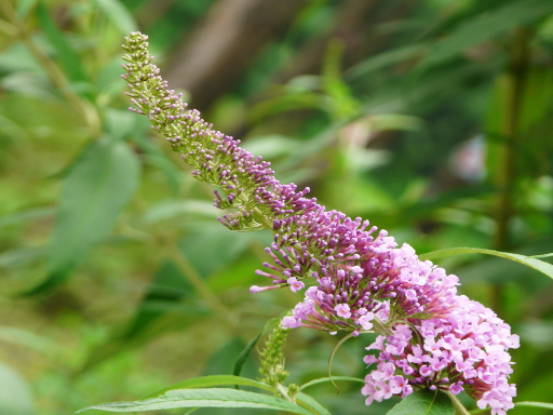
The spicate cyme is terminal, 4-40 cm long and 2-4 cm wide; the bracts are linear, up to 10 mm long; the bracteoles are linear-lanceolate, 2-3.5 mm long; the flowers are purple and fragrant; the calyx is bell-shaped, about 4 mm long, and the outside, like the outside of the corolla, is covered with stellate hairs and small scales, while the inside is hairless. The calyx lobes are broadly triangular, about 1 mm long and wide; the corolla is 13-20 mm long, pubescent inside, the corolla tube is curved, 11-17 mm long, 2.5-4 mm in diameter in the upper part and 1-1.5 mm in diameter in the lower part, and the corolla lobes are broadly ovate or nearly round, about 3.5 mm long and about 3 mm wide; the stamens are inserted at the lower part or near the base of the corolla tube, the filaments are very short, the anthers are ovate with a pointed tip and an ear-shaped base; the ovary is ovate, 1.5-2.2 mm long and 1-1.5 mm in diameter, hairless, the style is 0.5-1 mm long, and the stigma is ovate-round, about 1.5 mm long.
The bark of Buddleja is tea-brown, much branched, and the branchlets are four-angled with narrow wings. Both sides of the angles are covered with short white soft hairs, which fall off when old.
The simple leaves are opposite; they have petioles, and the petioles are densely covered with tomentum; the leaf blades are papery, ovate to oblong-lanceolate, 3-8 cm long and 1.5-3 cm wide, with a pointed tip, a wedge-shaped base, and an entire or sparsely serrate margin; when the young leaves are tender, both surfaces are densely covered with yellow tomentum, and the hairs fall off when old.
The spike is terminal, 18-40 cm long, and the flowers lean to one side; the calyx is tubular, with 4 or 5 shallow lobes, densely covered with scales; the corolla is slender and tubular, slightly curved, purple, about 15 mm long, with white glossy fine scales on the outside and white fine pubescence on the inside, and 4 lobes at the tip, the lobes being ovate-round; there are 4 stamens; the filaments are short and adnate; there is 1 pistil, the style is linear, the stigma is 2-lobed, and the ovary is superior. The capsule is oblong, about 5 mm long, scaly, and splits into 2 valves when ripe, with a persistent calyx at the base.
The seeds are tiny and brown.
The infructescence is spicate; the capsule is oblong or elliptic, 5-6 mm long and 1.5-2 mm in diameter, hairless, scaly, and often with a persistent calyx at the base; the seeds are light brown, small, and wingless.
The flowering period is April to October, and the fruiting period is August to April of the following year.
How to grow Buddleja
Buddleja has graceful branches and leaves, abundant flowers, and an elegant fragrance. It is suitable for planting on slopes, at bridgeheads, and by walls, or as a medium-sized hedge, or planted in groups on lawns or densely planted as a flower hedge or flower border.
1. Cultivation method
Propagate by sowing, cutting or division. Because the seeds are relatively small, it is suitable to broadcast them on raised beds, taking care to keep them moist and to build a shed for shade. When the seedlings reach about 10 cm tall, divide and plant them out.
Cuttings of Buddleja can be done in spring, using dormant branches as cuttings. Division is carried out together with transplanting and takes root easily. During cultivation, the aboveground parts can be cut off during the dormant period to encourage the growth of new branches the following year and more flowers.
2. Propagation method
Buddleja has strong adaptability, tolerates poor soil, and resists salinity and alkalinity: it is not strict about soil and grows well in loam, sandy loam, sandy soil, gravelly soil and so on with good soil permeability.
It tolerates poor soil. When the soil organic matter content is above 0.3%, the annual growth can still reach 33 cm. It can grow and bloom normally below pH 9 and with a salt content below 0.3%. It has strong stress resistance, tolerates severe cold and intense heat, and saves water and resists drought: at temperatures as high as 40°C and -15°C, it can grow normally and overwinter safely, and it can endure a low temperature of -30°C. The temporary wilting coefficient of the leaves of Buddleja alternifolia is 1.292%, and it is extremely drought tolerant. In areas with annual rainfall of 180-400 mm, irrigating 3 to 4 times a year, and in areas with about 400 mm, watering 1 to 2 times a year, allows it to grow and bloom. It is a good water-saving and drought-tolerant ornamental plant.
Photo supplied by Xue Jinze. The branches of Buddleja are tough and strong, and it grows vigorously, with abundant flowers and brilliant flower colors. It tolerates pruning, is suitable for shaping, and has strong ornamental value: Buddleja alternifolia that has been reasonably pruned not only has a compact plant shape but also a long flowering period. It can be used in solitary planting, hedge planting, belt planting and block planting, and applied on a large scale in parks, roadside green spaces and along both sides of highways, creating a kind of imposing beauty.
Buddleja is easy to propagate, and cultivation and management are simple and extensive: Buddleja alternifolia can be propagated by sowing, cutting and tissue culture. Softwood cuttings in particular are easy to root, and bloom 2-3 years after cutting, with quick results.
Management during the growing period is extensive, and no overwintering protection measures such as cold protection are needed; there are few pests and diseases, which can reduce control costs and environmental pollution; it has strong branching ability and tolerates pruning, and pruning is generally best done after flowering; it rarely needs fertilizing, and applying decomposed base fertilizer before planting is enough.
Propagation methods of Buddleja
1. Propagation method
Softwood cuttings in the growing season of May and June are preferable. The survival rate is high, growth is fast, and propagation is rapid.
Before cutting, first build a shade shed. Disinfect the river sand in the cutting bed with potassium permanganate or carbendazim. Cut semi-lignified branches into 10 cm long sections, remove all the lower leaves, and cut off two-thirds of the upper 2-3 leaves. Make the upper cut flat, 1 cm from the bud, and make the lower cut obliquely on the back of the bud in a horseshoe shape.
Use a wooden strip to open a 5 cm deep furrow in the river sand. Place the cuttings that have been dipped in rooting agent neatly, then cover with sand, pat firm and spray water. The cutting density should be such that the leaves do not touch each other and are evenly distributed. After the whole bed is planted, spray once more with thorough water, then build an arched shed and cover it with plastic film, sealing all around well.
Before rooting, spray water twice a day to cool and keep moist, maintaining a temperature inside the shed of about 28°C and a relative humidity above 90%. In May and June they root in about 20 days, and in July and August they begin to root in 2 weeks. After rooting, control moisture, pay attention to ventilation, and remove the arched shed according to the rooting situation. Transplant after one week of hardening off.
2. Final planting
Transplant the sprouted seedlings after cutting and rooting with bare roots, and the nursery land must be carefully plowed and harrowed. To prevent the occurrence of pests and diseases, when preparing the nursery land apply 3 kg to 4 kg of phoxim granules and 50 kg of ferrous sulfate per mu. When transplanting, follow the word "fast": transport quickly and plant quickly, and irrigate quickly after finishing a bed. Because Buddleja grows fast, the row spacing should not be too small; 35 cm × 50 cm is suitable. After transplanting, cover the young seedlings directly with shade netting for 2-3 days, remove the shade netting in the afternoon 3 days later and water thoroughly once more, and when the soil surface is slightly dry, shallowly hoe once to preserve soil moisture. After 7-10 days the transplanted seedlings will have survived, and after 2 months a scene of brilliant colors will appear before your eyes.
How to grow Buddleja albiflora and points to note
Chinese scientific name: Badong BuddlejaLatin scientific name: Buddleja albiflora Hemsl.Alternative name: White-flowered BuddlejaKingdom: PlantaePhylum: AngiospermsClass: DicotyledoneaeSubclass: SympetalaeOrder: GentianalesSuborder: GentianineaeFamily: LoganiaceaeSubfamily: BuddlejoideaeTribe: BuddlejeaeGenus: BuddlejaSubgenus: BuddlejaSection: BuddlejaSeries: RectifloraeBuddleja albiflora (scientific name: Buddleja albiflora) is a plant in the family Scrophulariaceae and the genus Buddleja, and is endemic to China. It is distributed in Henan, Shaanxi, Gansu, Hunan, Hubei, Guizhou, Sichuan, Yunnan and other places in mainland China, growing at altitudes of 500 m to 2,800 m, often in mountain shrub thickets and at forest edges. It has not yet been introduced and cultivated artificially.1. Morphological characteristics
Shrub, 1-3 m tall. The branches are cylindrical or nearly cylindrical; the branchlets, petioles, inflorescences, the outside of the calyx and the outside of the corolla are all covered with stellate hairs and glandular hairs when young, and become hairless later. The leaves are opposite, the leaf blades are papery, lanceolate, oblong-lanceolate or long elliptic, 7-25 cm long and 1.5-5 cm wide, with a gradually pointed or long gradually pointed tip, a wedge-shaped or rounded base, and a doubly serrate margin. The upper surface is dark green and nearly hairless, and the lower surface is covered with grayish-white or pale yellow stellate short tomentum; there are 10-17 lateral veins on each side, flat on the upper surface and slightly sunken after drying, and slightly raised on the lower surface; the petiole is 2-15 mm long. The paniculate cyme is terminal, 7-25 cm long and 2-5 cm wide; the pedicels are short and covered with long stiff hairs; the calyx is bell-shaped, 3-3.5 mm long, hairless inside, the calyx tube is about 2 mm long, and the calyx lobes are triangular, 1-1.5 mm long; the corolla is light purple, later turning white, with an orange-yellow throat, fragrant, 6.5-8 mm long, with long bearded hairs inside only above the middle of the inner wall of the corolla tube or in the throat, the corolla tube is about 5 mm long, and the corolla lobes are nearly round, 1-1.5 mm long; the stamens are inserted at the throat of the corolla tube, the filaments are very short, and the anthers are oblong, 0.6-1.3 mm long, with a heart-shaped base; the ovary is ovate, 1-1.5 mm long, hairless, the style is 1-1.5 mm long, hairless, and the stigma is club-shaped, 0.7-1 mm long. The capsule is oblong, 5-8 mm long and 2-3 mm in diameter, hairless; the seeds are brown, strip-shaped and spindle-shaped, with long wings at both ends. The flowering period is February to September, and the fruiting period is August to December.2. Origin and habitat
Produced in Shaanxi, Gansu, Henan, Hubei, Hunan, Sichuan, Guizhou and Yunnan, growing in mountain shrub thickets or at forest edges at altitudes of 500-2,800 m. The type specimen was collected in Badong, Hubei.3. Main value
Medicinal part:Flower buds (Buddleja flowers)Medicinal function:Can relieve cough and resolve phlegm
Medicinal indications:Treats eye pain