How to grow and care for African violets
Temperature
African violets very much like to grow in a warm environment. Their optimal growing temperature is between 16-24°C; from April to October the temperature should be kept between 18-24°C, while from October to April of the following year it should be maintained between 12-16°C. African violets do not like hot weather, so daytime temperatures should generally be below 30°C, otherwise it will be detrimental to the plant's growth, while winter nighttime temperatures should stay above 10°C, otherwise the plant may suffer frost damage and, in serious cases, die.
Light
African violets are not very demanding about sunlight; they like to grow in semi-shaded environments, and you should not place them under direct sunlight. Generally, placing them where they can receive diffused light is enough. In summer, when temperatures are too high and light is especially strong, you should provide the plant with appropriate shading to avoid scorching its leaves, but you must also give the plant sufficient light, otherwise it will be detrimental to its growth.
Watering
African violets like a humid environment, so their soil should be kept in a moist state. In early spring, because temperatures are too low, water less to prevent the plant's stems and leaves from rotting. In summer, when daytime temperatures are too high, you should generally water in the evening when temperatures are lower. In summer, water more; in autumn, as temperatures begin to drop, reduce watering; in winter, when it is cold, reduce watering even more to prevent the plant from suffering frost damage or dying.
Fertilizing
African violets are not very demanding about fertilizer either. Generally, give them dilute fertilizer, but during the growing season take note: apply fertilizer once every 10 days on average. A thin, well-rotted liquid fertilizer combining nitrogen and phosphorus, or a compound chemical fertilizer, is suitable. By no means apply too much nitrogen fertilizer, otherwise the leaves will be lush but few flowers will appear. Generally, the ratio of nitrogen, phosphorus and potassium fertilizer should be 1:1:1.
Soil
African violets are fairly demanding about soil; they like loose, airy, fertile and well-drained soil, and you can mix this kind of soil yourself. Mix leaf mold and sandy loam, or mix leaf mold, peat soil and sand evenly.
The above is an introduction to how to grow African violets. Below, let us look at growing African violets from seed!
How to grow African violets
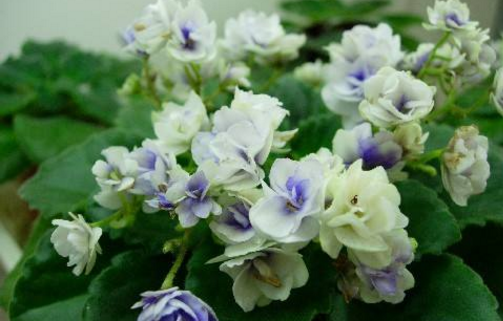
[Overview] African violet, also known as African violet (Saintpaulia), is a plant of the genus Saintpaulia in the family Gesneriaceae. African violets are small and delicate, with colorful flowers and great poetic charm, and are a famous potted flower internationally, especially popular in Europe and America. After a Frenchman discovered African violets in Africa in 1893, it was not until the early 20th century that it was discovered that in a suitable environment they can bloom continuously all year round and also adapt to air-conditioned environments. In the 1930s, African violets were already very popular in the United States, and by the 1940s many bicolor and double-flowered varieties had been bred. To date, African violets have become a major potted flower in production in the United States, are very commonly grown in homes, and many new varieties are created by hobbyists. In Europe, the Netherlands, Denmark, Germany and France all have mass production; in 1995 the Netherlands ranked seventh in potted flower production, with an output value reaching 21.4 million USD. African violets have become a windowsill plant in Europe and America and can be bought at any time in supermarkets. China has a short history of cultivating African violets; only since the 1980s were tissue-culture plantlets introduced from the United States and the Netherlands. At present, only a small number of Chinese-foreign joint venture horticultural companies have small-scale production, and cultivation is not yet widespread, but the development prospects are still very good.[Morphological characteristics and varieties] African violet is a perennial herb. Stemless, the whole plant covered with hairs. Leaves ovate, petioles thick and fleshy. Flowers 1 or several together, light purple. In recent years, there have been many cultivated varieties, including large-flowered, single, semi-double, double, and variegated-leaf types, with flower colors including purple-red, white, blue, pink and bicolor. Common cultivated varieties include the single-flowered Snow Prince, with white flowers; Pink Miracle, with pink flowers and rose-red edges; Ruffled Queen, with purple-red flowers and ruffled edges; Pocone, a large-flowered type, with a flower diameter of 5 cm and light purple-red flowers; Diana, with dark blue flowers. Semi-double varieties include Fuchsia Red, with purple-red flowers. Double varieties include Corinne, with white flowers; Flash, with red flowers; Blue Peak, with blue flowers and white edges; Double Delight, with blue flowers; Blue Caprice, with light blue flowers; Blushing Bride, with pink flowers. Foliage varieties include Show Queen, with blue flowers, ruffled edges and yellow-white markings on the leaf surface; Blue Boy in the Snow, with light purple flowers and white striped patches on the leaves. Related ornamental species in the same genus include white-flowered African violet and large-flowered African violet.
[Biological characteristics] African violet originates from the tropical regions of eastern Africa. It likes warm, humid and semi-shaded environments. In summer it fears strong light and high temperatures. The suitable production temperature is 16-24°C, from April to October 18-24°C, and from October to April of the following year 12-16°C. Daytime temperatures should not exceed 30°C; high temperatures are unfavorable for African violet growth. Winter nighttime temperatures should not be lower than 10°C, otherwise they are prone to cold damage. A relative humidity of 40%-70% is more suitable; if the pot is too wet, roots easily rot. If the air is dry, the leaves lack luster. African violets need shading in summer; the leaf color is then fresh and green; in winter, sufficient sunlight is needed for continuous blooming; on rainy and snowy days, supplemental light is very beneficial to the growth and flowering of African violets.
[Propagation methods] Commonly propagated by sowing, cuttings and tissue culture.
Propagation by sowing: Can be done in spring or autumn. For greenhouse cultivation, autumn sowing from September to October is better, with a high germination rate, and the seedlings grow robustly and bloom in the following spring with large plants and many flowers. Sown in February, they bloom in August, but the growth vigor is somewhat poorer and there are fewer flowers. African violet seeds are tiny, so the sowing soil should be fine; after sowing, do not cover with soil, just press flat. The suitable germination temperature is 18-24°C; they germinate 15-20 days after sowing and are transplanted after 2-3 months. During the seedling stage, note that the potting soil should not be too wet. Generally, it takes 6-8 months from sowing to flowering.
Propagation by cuttings: Mainly by leaf cuttings. After flowering, choose healthy, plump leaves, cut them off leaving a 2 cm petiole, let them dry slightly, insert them into a sand bed, maintain relatively high air humidity, and keep the room temperature at 18-24°C; they root 3 weeks after insertion, and after 2-3 months will produce young plants, which are moved into 6 cm pots. During the cutting process, treatment with vitamin B is beneficial to the growth of young plants after African violets root; treating the petioles with 25 mg/liter kinetin for 24 hours is beneficial to the formation of adventitious buds. From cutting to flowering takes 4-6 months. If large offshoots are used for cuttings, the effect is also good; generally, cuttings made in June-July bloom in October-November, and if cuttings are made in September-October, they bloom in March-April of the following year.
Propagation by tissue culture: In recent years, tissue culture propagation of African violets has become relatively common. Leaf blades, petioles and epidermal tissue are used as explants. Use MS medium plus 1 mg/liter 6-benzylaminopurine and 1 mg/liter naphthaleneacetic acid. After inoculation, adventitious buds grow out in 4 weeks, and after 3 months rooted plantlets can be planted. The plantlets are transplanted into a substrate of half leaf mold and half peat moss soil, with a survival rate of 100%. At present, the United States, the Netherlands, Israel and other countries all have African violet test-tube plantlet production.
[Cultivation management] In cultivating African violets, watering is very important. In early spring, when temperatures are low, watering should not be excessive, otherwise the stems and leaves easily rot and flowering is affected. In summer, when it is hot and dry, water more and spray water to increase air humidity, otherwise the flower stalks droop and the flowering period shortens. However, when spraying water, if too much water splashes on the leaves, it can also cause leaf rot. In autumn and winter, as temperatures drop, watering should be appropriately reduced. African violet is a semi-shade plant, and 8 hours of light per day is most suitable. If light is insufficient on rainy and snowy days, artificial light should be added. If light is insufficient, the petioles elongate, flowering is delayed, and flower colors become dull. In midsummer, if light is too strong, it will scorch or whiten the tender leaves, so shade protection is needed. It requires nighttime temperatures higher than daytime; with nighttime at 24°C and daytime at 16°C, the stems and leaves grow luxuriantly and the flowers are large and numerous. During growth, fertile, loose leaf mold is most ideal; fertilize once every half month. If fertilizer is insufficient, flowering decreases and flowers become smaller. After flowering, remove spent flowers at any time to prevent them from molding and rotting.
[Pest and disease control] Under high temperature and high humidity conditions, wilt disease, powdery mildew and leaf rot easily occur; a 1000-fold dilution of 10% fungicide 401 acetic acid solution can be sprayed or poured into the potting soil. Scale insects and red spiders often harm African violets during the growing season and can be killed by spraying a 1000-fold dilution of 40% omethoate emulsifiable concentrate.
[Post-production handling] African violet is a small potted ornamental plant, especially suitable for middle-aged and elderly people to cultivate. It has a long flowering period, is easy to move, and is easy to grow. A potted flower decorating a desk, writing table or windowsill is very elegant and beautiful, and giving it to relatives and friends is also tasteful.
How to grow African violets: how to grow potted African violets
African violets originate from Africa and are a purple flower with yellow spots in the center, much loved by people, and many gardening enthusiasts grow African violets. So how do you grow potted African violets, and what points should be noted in growing African violets? Below, this article will introduce in detail how to grow African violets. If you are a beginner at growing flowers, do not be nervous either; African violets only need basic care and are not difficult to grow.
Methods/Steps
Ensure sufficient light
Light is very important for promoting flowering. Please place the plant next to a window so that an appropriate amount of sunlight shines in through the glass. Placing it next to an east-facing window is best, because the plant can receive the morning sun. If placed in front of a south- or west-facing window, use a thin curtain to shade it. In addition, so that all parts of the plant receive sunlight evenly, turn the flowerpot 1/4 turn every week.If natural light cannot be found, you can also use fluorescent lamps to illuminate the plant. The lighting used for growing African violets needs to come from a two-tube electric lamp, one with a cool white tube and the other with a full-spectrum tube. The electric lamp should shine down from 20-25 cm above the plant, with a light duration of 12-14 hours per day. If the plant grows too compactly and needs to stretch out a little, then reduce the light duration to 8-10 hours per day.
Water at the appropriate time
The most common cause of death in growing African violets is overwatering. The correct amount of water should keep the soil just slightly moist, not soaked through. Water only when the surface layer of the soil feels very dry. In addition, use warm water for watering.Pay attention to the watering method
You can water from the top down, or from the bottom up, or use automatic watering devices such as a cotton wick. However, at least once a month you should water from the top down, so as to wash away the fertilizer salts that gradually accumulate. In addition, never let the flowerpot soak in water (unless a cotton wick is set up or an Oyama self-watering pot is used). If water gets on the leaves, wipe it off immediately with a paper towel to prevent spots from appearing on the leaves.Use a suitable potting medium
The potting medium used for growing African violets must be sterilized, light in weight, and able to breathe, to facilitate root growth. Soilless nutrient medium is most ideal, containing sphagnum peat, vermiculite and perlite.Create a favorable growing environment
Temperature and humidity are both important factors to consider in cultivating African violets. Most African violets can grow in an environment of 16-27°C, but the most ideal temperature is 22-24°C during the day and 18°C at night. The optimal humidity is 40%-60%. In hot seasons, you can place a humidifier or a bowl of water next to the African violet to increase humidity.Fertilizing
Failure to supplement nutrients in time is one of the common reasons African violets do not bloom. The simplest solution is to mix liquid fertilizer into the water each time you water, that is, put 1/8-1/4 teaspoon of liquid fertilizer into every 4.5 liters of water. 20-20-20 and 12-36-14 are both relatively balanced water-soluble fertilizers. In addition, the fertilizer used should contain less urea nitrogen, because urea can cause root burn. Substances such as formaldehyde, copper sulfate and nitroglycerin, if used in appropriate amounts and with careful attention, can greatly improve plant health. Turpentine, iodine and ordinary table salt are also good soil additives and can be used to prevent weed growth.Tips
Do not wet the leaves, because water droplets on the leaves will cause yellow-brown spots. The soil should always remain moist, but must not be soaked through, otherwise it will cause root rot or crown rot. Generally, watering once a week is enough, or water each time after more than 2.5 cm of the soil has become dry. If there is a hole in the bottom of the flowerpot, you can place the flowerpot in a basin of water to water from the bottom up. In addition, the most ideal potting medium should consist of 25% air, 25% water and 50% soil.
African violets need frequent attention.