What are the care methods for a Camellia sasanqua bonsai?
1. Sunlight
Camellia sasanqua loves shade and moisture, and semi-shade with partial sun suits it best. Strong summer light may scorch its leaves and buds, causing the leaves to curl and drop. But it also needs appropriate light to bloom abundantly and brightly.
2. Soil
It is suited to fertile, loose, well-drained acidic sandy soil; alkaline soil and clay soil are not suitable for growing Camellia sasanqua. It is best grown in moist, slightly acidic soil rich in humus, with a pH of 5.5 to 6.
3. Temperature
It is relatively cold-hardy, but for potted plants it is generally best not to go below -2°C, and the optimum temperature is 18 to 25°C. It has strong resistance and few pests and diseases. It can be propagated by sowing, cuttings, grafting and other methods.
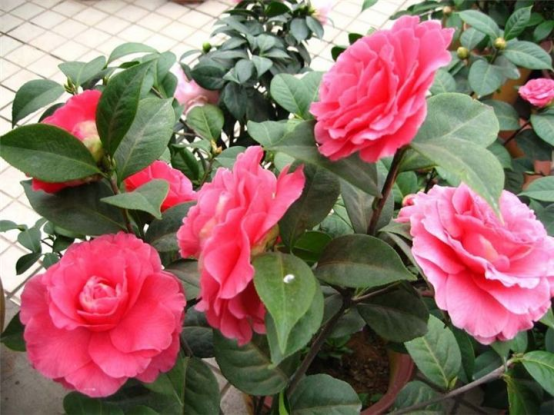
4. Pest and disease control
Camellia sasanqua has relatively few pests and diseases. The main diseases include gray blight, sooty mold and anthracnose, which should be prevented and treated early. Once disease occurs, it can be sprayed with 300 times diluted equal-part Bordeaux mixture. If there are pests such as scale insects or red spider mites, they can be removed by brushing by hand. If red spider mites appear, spraying with soaked tobacco leaf water mixed with chili water is also very effective. Generally, do not use pesticides, to avoid polluting the environment.
5. Pruning
Timely pruning not only makes the Camellia sasanqua bonsai tree shape beautiful, but also reduces excess nutrient consumption, concentrating the nutrients so that flowers are large and foliage is lush. Generally, leave one flower bud per branch and cut off the rest without hesitation; branches that have already bloomed and branches that affect the bonsai's appearance should also all be cut off.
II. Precautions for caring for a Camellia sasanqua bonsai
1. Avoid leaving too many flower buds
2. Avoid too high a room temperature
3. Avoid poor air circulation
4. Avoid frequently changing its position
How to make and care for a Camellia sasanqua bonsai, and appreciation of fine Camellia sasanqua bonsai pictures
Although Camellia sasanqua is a shrub or small tree, its beautiful appearance has attracted many flower lovers, who choose to use Camellia sasanqua to make bonsai. But making and caring for a bonsai also requires skill, otherwise it will harm the plant's growth. Today, wed114 wedding website brings you how to make and care for a Camellia sasanqua bonsai, and shares appreciation of fine Camellia sasanqua bonsai pictures.
How to make and care for a Camellia sasanqua bonsai:
1. Material selection
Camellia sasanqua that is short in stature, slow-growing, with smaller leaves and softer branches is more suitable for shaping, such as the spreading, low-growing winter Camellia sasanqua.
More upright varieties of common Camellia sasanqua can also be tried as tall-type bonsai, but it is best not to use varieties that are tall in stature, fast-growing, or have large flowers and leaves.
2. Material sources
It is best to use 2—3-year-old cuttings or seedlings, because the branches and trunks of young plants are easier to shape, and during cultivation they can be continuously reshaped, pruned, tied and wrapped according to the shaping requirements to develop into various tree forms.
You can also dig up old plants such as wild golden-centered camellias and oil camellias with curved trunks and twisted branches, and use the trunk-cutting grafting method, or use old remnant plants that sprout new branches, and after continuous shaping, make an aged Camellia sasanqua stump bonsai.
How to make and care for a Camellia sasanqua bonsai:
3. Shaping
Usually the natural posture of the Camellia sasanqua plant is the main basis, or artistic treatment is added, shaping it into upright-trunk style, slanting-trunk style, double-trunk style; metal wire or binding can also be used to cultivate curved-trunk style, cliff style, semi-cliff style and so on.
4. Later care
Generally repot once every two to three years. When repotting, in addition to choosing a pot whose color, size and style match the plant, the pot should preferably be a little smaller rather than larger, about one half the size of the canopy.
Properly cut off damaged roots and some old roots to help the shallow root system develop better, and also help dwarf the plant. When planting, the base of the trunk should be slightly higher, beyond the edge of the pot. Plants with exposed roots should be protected from wind and strong sun.
As long as it does not affect growth and development, fertilize as little as possible. To keep the tree posture balanced and natural, do not casually cut the top. In the growing season, light pruning can be done, using the pinching method to remove the growing buds of unwanted or overly long branches. Stronger pruning and shaping should be done before bud break.
Apart from water sprouts, if there are branches that are too long or out of proportion, a longer section of the tip can be cut off, or metal wire can be twisted from bottom to top to shorten them.
Do not keep it indoors for too long, as this will affect the growth and development of Camellia sasanqua.
An introduction to how to make a Camellia sasanqua bonsai, and how to care for it after making it
Camellia sasanqua has both the characteristics of camellia and the characteristics of plum blossom. Its flowers are full, the colors are brilliant, the flowering period is long, and it has many flower colors. Camellia sasanqua is an ornamental flower with extremely high ornamental value, and it can be made into a bonsai to keep and care for at home. Today, I will take everyone to learn about making a Camellia sasanqua bonsai.Bonsai making
1. Material selection
Camellia sasanqua that is short in stature, slow-growing, with smaller leaves and softer branches is more suitable for shaping, such as the spreading, low-growing winter Camellia sasanqua. More upright varieties of common Camellia sasanqua can also be tried as tall-type bonsai, but it is best not to use varieties that are tall in stature, fast-growing, or have large flowers and leaves.
2. Material sources
It is best to use 2-3-year-old cuttings or seedlings, because the branches and trunks of young plants are easier to shape, and during cultivation they can be continuously reshaped, pruned, tied and wrapped according to the shaping requirements to develop into various tree forms. You can also dig up old plants such as wild golden-centered camellias and oil camellias with curved trunks and twisted branches, and use the trunk-cutting grafting method, or use old remnant plants that sprout new branches, and after continuous shaping, make an aged Camellia sasanqua stump bonsai.
3. Shaping
Usually the natural posture of the Camellia sasanqua plant is the main basis, or artistic treatment is added, shaping it into upright-trunk style, slanting-trunk style, double-trunk style; metal wire or binding can also be used to cultivate curved-trunk style, cliff style, semi-cliff style and so on.
4. Later care
(1) Generally repot once every two to three years. When repotting, in addition to choosing a pot whose color, size and style match the plant, the pot should preferably be a little smaller rather than larger, about one half the size of the canopy.
(2) Properly cut off damaged roots and some old roots to help the shallow root system develop better, and also help dwarf the plant. When planting, the base of the trunk should be slightly higher, beyond the edge of the pot. Plants with exposed roots should be protected from wind and strong sun.
(3) As long as it does not affect growth and development, fertilize as little as possible. To keep the tree posture balanced and natural, do not casually cut the top. In the growing season, light pruning can be done, using the pinching method to remove the growing buds of unwanted or overly long branches. Stronger pruning and shaping should be done before bud break.
(4) Apart from water sprouts, if there are branches that are too long or out of proportion, a longer section of the tip can be cut off, or metal wire can be twisted from bottom to top to shorten them. Do not keep it indoors for too long, as this will affect the growth and development of Camellia sasanqua.
The above is the making method and care knowledge for a Camellia sasanqua bonsai that I have compiled. I hope it can be helpful to the many flower lovers, and please continue to follow Duorou Huapu to learn more about flower care.