What are the advantages of using Camellia sasanqua for bonsai? A detailed analysis
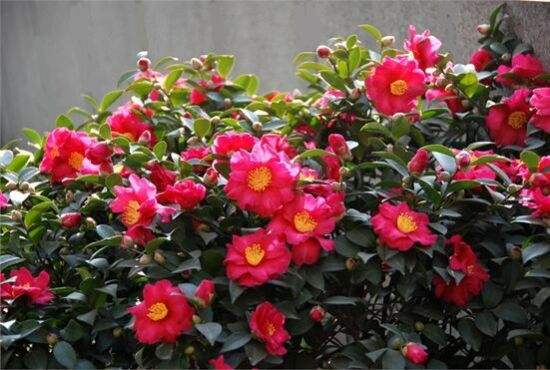
The Camellia sasanqua tree is relatively short, and its branches are also fairly low, making it very easy to prune and shape, which is how Camellia sasanqua bonsai came into being. The Camellia sasanqua tree form is very elegant, its leaves are very refined, and its flowers are strikingly beautiful; moreover, the flowering period can last from November of the current year all the way to March of the following year, so its ornamental value as a bonsai is very high.
Chinese bonsai schools - Lingnan school bonsai
Our country has a vast territory, and due to differences in regional environments and natural conditions, there are many bonsai schools. Especially since the reform and opening up, the traditional schools have further developed, and new schools have continuously emerged, creating an excellent situation of a hundred flowers blooming in competition. As for the traditional five major schools, they are further divided into the southern and northern factions. The southern faction is the Lingnan school represented by Guangzhou, and the northern faction includes the Sichuan school, Yangzhou school, Suzhou school, and Shanghai school of the Yangtze River basin (the latter three were formerly collectively known as the Jiangnan school), among others.
The bonsai art schools of China have a long history and are rich and varied. Because of differences in specific conditions from place to place, their development has been very uneven - some are as grand as mighty rivers, others as fine as trickling clear streams - each with its own style, each with its own character, competing in splendor, a hundred flowers blooming together. In addition to the five major schools mentioned above, some other schools, in the new historical period, have also taken on a brand-new appearance and, riding the east wind of reform and opening up, are strongly poised to contend with the Sichuan, Yangzhou, Suzhou, Shanghai, and Lingnan schools, thus opening up an unprecedented scene of prosperity in the art of bonsai!
Guangdong bonsai, centered on the "City of Flowers" Guangzhou, is called the Lingnan school because it is located south of the Five Ridges. The climate here is warm, the sunshine is abundant, the rainfall is plentiful, and vegetation is lush. This richly endowed natural environment has provided extremely favorable conditions for the prosperity of bonsai art. Although Lingnan bonsai art started relatively late, it still has a history of several hundred years. The famous Qing dynasty Guangdong poet Qu Dajun gave a fairly detailed account of it in his book "New Tales of Guangdong."
However, the true formation of the Lingnan school bonsai art style was something that happened after the 1930s. Traditional Guangdong bonsai resembled the northern school's "wandering dragon curve" style, with the trunk rising upright in a snake-like manner, arms hanging down and extending out to the left and right, made into five tiers or seven tiers, and a flattened crown. It was called "ancient tree," also known as "general tree." This kind of bonsai takes a great deal of effort and time, and generally requires thirty or forty years to take shape.
By the end of the last century, with social changes and the development of culture and art, and especially under the influence of the Lingnan painting school, some Guangdong painters, who were both skilled at painting and fond of growing bonsai, carried out bold reforms in shaping, taking painting conception as the foundation and gradually expanding the range of tree species, which became the prototype of today's Lingnan bonsai. After the 1930s, Guangdong bonsai split into three schools: first, the school led by bonsai artist Kong Taichu, with a vigorous, forceful, and richly substantial tree form, a lush and dense crown, and rigorous composition, expressing the bearing of ancient trees in the open wild; second, the school led by the Daoist priests of Sanyuan Palace in Guangzhou, which mainly used dying tree stumps as material and, through careful cultivation, grew new shoots from a certain part, valuing an unrestrained and smooth effect; third, the school led by the monk Suren of Haichuang Temple in Guangzhou, with sparse, tall, and upright forms standing straight into the clouds. Although there are few branch tiers, it does not feel empty; it is restrained and concise, elegant and natural, very much carrying the poetic flavor of Zheng Banqiao's "cut away all that is redundant and keep the lean and clear," and "every branch and every leaf is imbued with feeling."
After the founding of New China, the Guangzhou Bonsai Association, with Kong Taichu serving as technical director, used Xiyuan as a research base and brought together the strengths of the three schools, merging them into one to become the complete and unique Lingnan school, making the artistic shaping of Lingnan bonsai even more unpredictable and endlessly varied. Examples include the lush, majestic, and extraordinary large-tree type, the sparse, tall, and upright towering type, the wild and naturally charming natural type, and the compact, layered emerald type with short trunks and dense leaves. In terms of overall artistic style, it can be summed up in 8 characters: vigorous and forceful, smooth and natural.
Kong Taichu, one of the founders of the Lingnan school style, devoted himself to the art of bonsai from the age of 19 and pioneered the "accumulate branches and truncate the trunk" method. The specific method of operation is: when the first section branch of the tree (that is, the side branch on the main trunk) has grown to the required thickness, carry out severe pruning and truncation; at the same time, select and retain a second section branch (or bud) with a suitable angle and position, and when the second section branch has been cultivated to the required thickness, prune it again, and the third section, fourth section... below are all carried out according to this method. Generally, about two small branches (or buds) are kept on each section branch, one long and one short. After many years of pruning, the proportions of the branches and trunk are well balanced, twisted and powerful. Its branch tiers "curve upward like deer antlers and hang down like chicken claws," antique and picturesque, with distinctions among leaping branches, drifting branches, and spreading branches. The second, third, and fourth layers of branch claws of each branch tier are required to gradually become thinner and be evenly distributed. Branch tiers (equivalent to the northern school's branch plates, cloud pieces, and branch pieces) are the basic technique of Lingnan school shaping and have very high aesthetic value. They can be enjoyed in all four seasons, spring, summer, autumn, and winter: in spring they sprout, dotted with fresh green; in summer they are lush, with layered emerald canopies; in autumn when frost descends, the yellow leaves show their own charm; in winter when the weather is cold, the claws and angles shine. Sometimes, in order to appreciate the beauty of the claws and angles of the branch tiers, the leaves are deliberately removed, which is called "taking off clothes and changing to brocade." This is an artistic effect difficult for other bonsai schools to achieve.
Although landscape bonsai is not the specialty of the Lingnan school, it has also achieved considerable success, mainly expressing the bright and beautiful natural scenery of the mountains of the south, with no lack of perilous crags and strange peaks, high gorges and deep valleys, and rich in the Lingnan painting style. Commonly used stones include Yingde stone, sandy sedimentary stone, reed-pipe stone, pumice, sea mother stone (coral stone), stalactite, and so on.
The tree species commonly used for tree-stump bonsai mainly include: orange jasmine (Murraya paniculata), Fujian tea (Carmona retusa), elm, plum pine (Sageretia thea). banyan, boxwood, Buddhist pine (Podocarpus macrophyllus), five-needle pine, azalea, water gardenia, plum, ginkgo, and so on.
Chinese bonsai schools - Lingnan school bonsai -
Our country has a vast territory, and due to differences in regional environments and natural conditions, there are many bonsai schools. Especially since the reform and opening up, the traditional schools have further developed, and new schools have continuously emerged, creating an excellent situation of a hundred flowers blooming in competition. As for the traditional five major schools, they are further divided into the southern and northern factions. The southern faction is the Lingnan school represented by Guangzhou, and the northern faction includes the Sichuan school, Yangzhou school, Suzhou school, and Shanghai school of the Yangtze River basin (the latter three were formerly collectively known as the Jiangnan school), among others.
The bonsai art schools of China have a long history and are rich and varied. Because of differences in specific conditions from place to place, their development has been very uneven - some are as grand as mighty rivers, others as fine as trickling clear streams - each with its own style, each with its own character, competing in splendor, a hundred flowers blooming together. In addition to the five major schools mentioned above, some other schools, in the new historical period, have also taken on a brand-new appearance and, riding the east wind of reform and opening up, are strongly poised to contend with the Sichuan, Yangzhou, Suzhou, Shanghai, and Lingnan schools, thus opening up an unprecedented scene of prosperity in the art of bonsai!
Guangdong bonsai, centered on the "City of Flowers" Guangzhou, is called the Lingnan school because it is located south of the Five Ridges. The climate here is warm, the sunshine is abundant, the rainfall is plentiful, and vegetation is lush. This richly endowed natural environment has provided extremely favorable conditions for the prosperity of bonsai art. Although Lingnan bonsai art started relatively late, it still has a history of several hundred years. The famous Qing dynasty Guangdong poet Qu Dajun gave a fairly detailed account of it in his book "New Tales of Guangdong."
However, the true formation of the Lingnan school bonsai art style was something that happened after the 1930s. Traditional Guangdong bonsai resembled the northern school's "wandering dragon curve" style, with the trunk rising upright in a snake-like manner, arms hanging down and extending out to the left and right, made into five tiers or seven tiers, and a flattened crown. It was called "ancient tree," also known as "general tree." This kind of bonsai takes a great deal of effort and time, and generally requires thirty or forty years to take shape.
By the end of the last century, with social changes and the development of culture and art, and especially under the influence of the Lingnan painting school, some Guangdong painters, who were both skilled at painting and fond of growing bonsai, carried out bold reforms in shaping, taking painting conception as the foundation and gradually expanding the range of tree species, which became the prototype of today's Lingnan bonsai. After the 1930s, Guangdong bonsai split into three schools: first, the school led by bonsai artist Kong Taichu, with a vigorous, forceful, and richly substantial tree form, a lush and dense crown, and rigorous composition, expressing the bearing of ancient trees in the open wild; second, the school led by the Daoist priests of Sanyuan Palace in Guangzhou, which mainly used dying tree stumps as material and, through careful cultivation, grew new shoots from a certain part, valuing an unrestrained and smooth effect; third, the school led by the monk Suren of Haichuang Temple in Guangzhou, with sparse, tall, and upright forms standing straight into the clouds. Although there are few branch tiers, it does not feel empty; it is restrained and concise, elegant and natural, very much carrying the poetic flavor of Zheng Banqiao's "cut away all that is redundant and keep the lean and clear," and "every branch and every leaf is imbued with feeling."
After the founding of New China, the Guangzhou Bonsai Association, with Kong Taichu serving as technical director, used Xiyuan as a research base and brought together the strengths of the three schools, merging them into one to become the complete and unique Lingnan school, making the artistic shaping of Lingnan bonsai even more unpredictable and endlessly varied. Examples include the lush, majestic, and extraordinary large-tree type, the sparse, tall, and upright towering type, the wild and naturally charming natural type, and the compact, layered emerald type with short trunks and dense leaves. In terms of overall artistic style, it can be summed up in 8 characters: vigorous and forceful, smooth and natural.
Kong Taichu, one of the founders of the Lingnan school style, devoted himself to the art of bonsai from the age of 19 and pioneered the "accumulate branches and truncate the trunk" method. The specific method of operation is: when the first section branch of the tree (that is, the side branch on the main trunk) has grown to the required thickness, carry out severe pruning and truncation; at the same time, select and retain a second section branch (or bud) with a suitable angle and position, and when the second section branch has been cultivated to the required thickness, prune it again, and the third section, fourth section... below are all carried out according to this method. Generally, about two small branches (or buds) are kept on each section branch, one long and one short. After many years of pruning, the proportions of the branches and trunk are well balanced, twisted and powerful. Its branch tiers "curve upward like deer antlers and hang down like chicken claws," antique and picturesque, with distinctions among leaping branches, drifting branches, and spreading branches. The second, third, and fourth layers of branch claws of each branch tier are required to gradually become thinner and be evenly distributed. Branch tiers (equivalent to the northern school's branch plates, cloud pieces, and branch pieces) are the basic technique of Lingnan school shaping and have very high aesthetic value. They can be enjoyed in all four seasons, spring, summer, autumn, and winter: in spring they sprout, dotted with fresh green; in summer they are lush, with layered emerald canopies; in autumn when frost descends, the yellow leaves show their own charm; in winter when the weather is cold, the claws and angles shine. Sometimes, in order to appreciate the beauty of the claws and angles of the branch tiers, the leaves are deliberately removed, which is called "taking off clothes and changing to brocade." This is an artistic effect difficult for other bonsai schools to achieve.
Although landscape bonsai is not the specialty of the Lingnan school, it has also achieved considerable success, mainly expressing the bright and beautiful natural scenery of the mountains of the south, with no lack of perilous crags and strange peaks, high gorges and deep valleys, and rich in the Lingnan painting style. Commonly used stones include Yingde stone, sandy sedimentary stone, reed-pipe stone, pumice, sea mother stone (coral stone), stalactite, and so on.
The tree species commonly used for tree-stump bonsai mainly include: orange jasmine (Murraya paniculata), Fujian tea (Carmona retusa), elm, plum pine (Sageretia thea). banyan, boxwood, Buddhist pine (Podocarpus macrophyllus), five-needle pine, azalea, water gardenia, plum, ginkgo, and so on.