What are the precautions for growing Lantana camara?
Lantana camara loves sunlight, so it is best to maintain at least five hours of light per day, which helps it bloom abundantly and grow better. It also loves to grow in a warm and humid climate; this species is a tropical plant that prefers high temperature and high humidity, also tolerates dry heat, and has poor cold resistance, so in winter it should be placed indoors for care to prevent it from getting frostbitten outdoors.
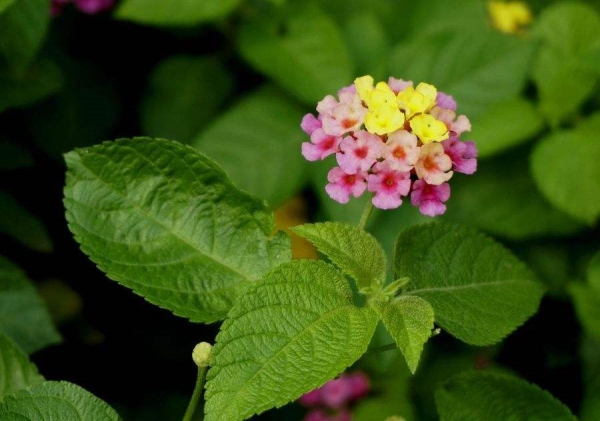
Lantana camara gives off an unusual odor, but this is harmless to the human body! Its leaves and flowers contain toxins, so you must pay attention to safety during cultivation!
Precautions for growing Lantana camara: pest and disease control of Lantana camara
Lantana camara, also known as Shandadan, Ruyi grass, Wucai flower, Wulei dan and so on, is an evergreen shrub plant of the genus Lantana in the Verbenaceae family. Its flowering period is generally from mid-to-late April to around mid-February of the following year, though due to the influence of climate and temperature, it can be seen flowering almost all year round. Its ornamental value is extremely high. Now let us take a look at the cultivation methods of Lantana camara!
The cultivation value of Lantana camara
1. Ornamental: Lantana camara has lush green foliage and abundant flowers, remaining colorful all year round, with a long viewing period for its blooms and beautiful flower colors including red, orange, yellow, pink, white and so on. Some flowers are yellow or pink when they first open, gradually turning orange-yellow or orange-red, and finally becoming red. The flowers are small and unique, appearing very beautiful, and have a certain ornamental value.
2. Bonsai: The young branches of Lantana camara are soft and suitable for making many forms of bonsai. They can be processed into different bonsai forms such as single-trunk style, double-trunk style, waterside style, slanting-trunk style and so on, and are also very suitable for home decoration. Because the leaves are relatively large, the crown is often trained in an elegant natural style, and can also be deliberately wired into a rounded flat shape.
Propagation methods of Lantana camara
1. Sowing: Sowing can be done in late autumn in pots under high humidity and warm temperatures, or in spring. In South China, seedlings from sowing can be used to plant flower beds, and flowers can be seen as early as September of that year. After the fruit ripens, pick it and pile it to compost, then soak it in water and rub-wash away the flesh to obtain the seeds. The seeds must not lose water; they can be collected and sown immediately in autumn, or stored mixed with sand and sown in spring. After sowing, the temperature during the germination stage should be kept above 20C. The germination rate is about 60%, and seedlings sown in the south can bloom in autumn of the same year.
2. Cuttings: Cuttings are mostly taken in May. Take one-year-old branches as cuttings, with every two nodes as one section, keep the 2 leaves on the upper node and cut them in half, and insert the lower node into plain sandy soil or a substrate made by mixing equal parts of plain sandy soil and fully decomposed humus soil. After inserting, shade them, cover with film to retain moisture and heat, and keep the cutting bed moist with air humidity at 80-90%. Roots can develop in about 1 month, and new shoots will sprout.
3. Layering: Lantana camara plants branch extremely heavily and root when touching soil, so flexible branches are nicked and pressed into the soil, and once the root system has grown, they are severed from the parent plant and divided.
Cultivation methods of Lantana camara
1. Fertilizer and water: For pot cultivation, loamy sandy soil that is loose and fertile is suitable, though the requirements are not strict. During the growing period, apply decomposed liquid fertilizer once every 10 days, and at the same time, in combination with watering, spray 3% urea twice every 10 days, which can make the leaves thicker and greener. When planting, apply organic fertilizer as a base fertilizer. Water initially to promote growth, and once the plant has established and is growing vigorously, reduce watering. In open-field cultivation, bury trailing branches into the soil, and they can gradually spread into a large clump.
2. Sunlight: Lantana camara prefers a sunny environment. During the growing season, it can be placed outdoors in a sunny spot for care, and even in midsummer it does not need shading, but good ventilation is required. If light is insufficient, the plant will grow leggy, with stems and branches thin and long, and few flowers, seriously affecting its ornamental value.
3. Pruning: Lantana camara grows relatively quickly. During cultivation, promptly prune branches and leaves that affect the shape to maintain the beauty of the tree form. After each flowering, shorten overly long young branches. In late autumn and early winter, before moving indoors, give the plant one heavy pruning and appropriately shorten all branches of the current year. In winter, move it indoors to a sunny spot. If a room temperature above 15°C can be maintained, the plant can grow and bloom normally, and should be watered, fertilized and pruned appropriately. If such a high temperature cannot be maintained, restrict watering, stop fertilizing, and let the plant enter dormancy; it can overwinter safely above 8°C. Repot once every spring, and prune and reshape the plant again, cutting off dead branches, weak branches and other branches that affect the tree form.
Pest and disease control of Lantana camara
1. Gray mold
[Symptoms] The pathogen first invades from the tip of the petals. After onset, the diseased area becomes water-soaked, soft, faded and lusterless, and finally the petals turn brown and rot, and the flowers drop off. Under humid conditions, a gray mold layer forms on the surface of the diseased part.
[Transmission route] The pathogen overwinters as sclerotia or mycelium on diseased plant residues. In the following spring it produces spores, which spread through wind and rain and cause infection. Low temperature and high humidity, along with poor ventilation, favor the development of the disease. This disease occurs more often in greenhouses.
[Control methods] Pay attention to ventilation and reduce humidity, which can lessen the occurrence of the disease. Promptly remove diseased flowers and burn them in a centralized way or bury them deeply in the soil to reduce the source of infection. In the early stage of the disease, spray 1:200 Bordeaux mixture, or 50% Procymidone wettable powder 2000 times solution, or 50% Iprodione wettable powder 1500 times solution, once every two weeks; the number of sprays depends on the disease situation.
2. Leaf blight nematode
[Symptoms] After the leaves are invaded by nematodes, the leaf color becomes lighter and light brown spots appear, later gradually darkening to almost black. As the lesions expand, they become angular spots due to the restriction of the main and lateral veins. In severe cases, the entire leaf dies, curls and droops along the stem. Most nematodes are in slightly discolored areas, while only a few nematodes are found on leaves that have turned dark brown or black.
[Transmission route] The leaf blight nematode overwinters in the roots and surrounding soil, diseased plant residues and wild hosts. Even on extremely small residual leaves, it can survive in the soil for 6-7 months. The entire development process of the leaf blight nematode is completed within the invaded tissue. When conditions are suitable (22-25°C, sufficient humidity), it takes only 14 days from egg to female adult laying eggs. It is generally transmitted through water droplets, irrigation water, and contact between diseased and healthy leaves, while long-distance spread relies on human movement of diseased leaves, flowers, stems, cuttings and soil. It invades through the stomata on the leaves.
[Control methods] Strengthen quarantine to prevent the leaf nematode and its propagation material from entering disease-free areas. For horticultural control, pot soil must not use diseased soil or soil with much grass. Improve the watering method; it is best not to water by sprinkling, and keep the leaf surface as dry as possible. When placing potted flowers, leave appropriate gaps so that the leaves do not touch each other. For chemical control, 15% aldicarb granules can be used, 5-6 grams per square meter of pot soil, or 2-3 grams for a pot about 25 cm in diameter, applied deep into the soil. Or use 3% carbofuran, 3-5 grams per pot, applied deep into the soil. During the damage period, 50% fenitrothion emulsion, 50% oxamyl and 50% carbaryl wettable powder 1000 times solution can also be sprayed on the leaves.
Note: That is all the editor has to introduce about the cultivation methods of Lantana camara. When growing Lantana camara, note that its flowers and leaves are toxic, and accidental ingestion can cause diarrhea and fever. But as long as we understand their living habits and take certain measures, they will not harm health; they will only be beneficial to the human body.
How to grow Lantana camara: cultivation methods and precautions for Lantana camara
Anyone who knows Lantana camara flowers will surely be most impressed by their rich and varied colors, including red, pink, yellow, orange-yellow, white and many other colors. Lantana camara gets its name from its changeable flower colors. If you want to grow Lantana camara well, you need to put in some effort. Today the editor will introduce to you how to grow Lantana camara, and its cultivation methods and precautions.
Cultivation methods and precautions for Lantana camara 1. Soil:Lantana camara has strong adaptability and is not strict about soil. Sandy soil, heavy clay soil, acidic soil or calcareous soil can all support its growth, but it grows best in fertile, loose sandy soil.
2. Watering:Lantana camara prefers a humid environment. During the growing period, keep the pot soil moist, avoid excessive dryness, and pay attention to spraying water on the leaf surface to increase air humidity.
3. Sunlight:Lantana camara prefers a sunny environment. During the growing season, it can be placed outdoors in a sunny spot for care, and even in midsummer it does not need shading, but good ventilation is required. If light is insufficient, the plant will grow leggy, with stems and branches thin and long, and few flowers, seriously affecting its ornamental value.
4. Fertilizing:Lantana camara has a relatively long flowering period, and needs topdressing once a month in spring, summer and autumn. 20 days before flowering, spray 0.3% urea once every 10 days, which can make the branches and leaves lush and the flower colors brilliant.
The above are the cultivation methods and precautions for Lantana camara introduced to you by the editor. I hope they are helpful to you! The editor believes that as long as you put in the effort, you will surely grow better and more beautiful Lantana camara!