What are the care methods for Lantana camara?
Lantana camara is a sun-loving plant, so the planting site should be sunny, ideally outdoors, or a balcony will also do. Keep the soil moist at ordinary times and do not let it get too dry. You can also spray the leaves with water to raise the humidity. Also, do not accidentally eat the flowers or leaves of Lantana camara, as they are toxic; if eaten, there will be symptoms of poisoning such as diarrhea and fever. It can be grown in pots, and it is especially beautiful when in bloom.
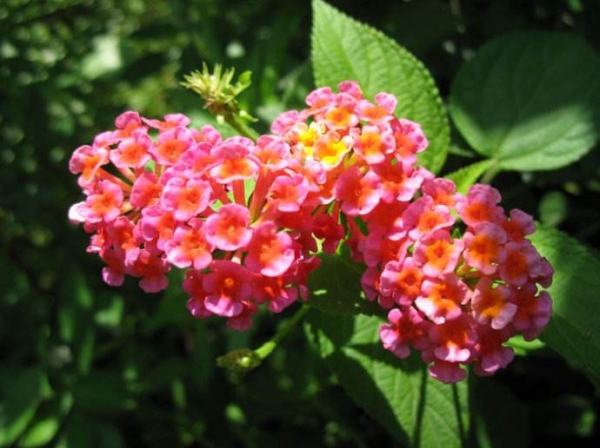
How to grow Lantana camara
Lantana camara originates from tropical America, and a small amount also grows wild in southern China. It likes a warm, humid environment with plenty of sunlight and is not cold-tolerant. A well-made bonsai can be kept in a sunny spot outdoors during the growing season from spring to autumn; even in midsummer it does not need shading, but good ventilation is required.
If light is insufficient, the plant will grow leggy, with thin, long stems and branches, and it will bloom sparsely, seriously affecting its ornamental value. During the growing season, keep the potting soil moist, avoid excessive dryness, and remember to spray water on the leaf surface to increase air humidity; apply a dilute fertilizer mainly of phosphorus and potassium about every 15 days to provide sufficient nutrients so the plant blooms more.
1. Pruning
Lantana camara grows quickly, so during cultivation, branches and leaves that affect the shape should be pruned promptly to keep the tree form attractive. After each bloom, cut back the overly long young shoots. In late autumn and early winter, before moving it indoors, give the plant a heavy pruning and shorten all the current year's branches appropriately. In winter, move it indoors to a sunny spot. If a room temperature above 15°C can be maintained, the plant can grow and bloom normally, and it should be watered, fertilized and pruned appropriately. If such a high temperature cannot be maintained, reduce watering and stop fertilizing to let the plant go dormant; it can overwinter safely at 8°C or above. Repot once every spring, and prune and reshape the plant again, cutting off dead branches, weak branches and other branches that affect the tree form.
2. Propagation
Lantana camara can be propagated from seed, cuttings, layering and other methods. After the fruit ripens, pick it, pile it to compost, soak it in water and rub away the flesh to obtain the seeds. The seeds must not be allowed to lose water; they can be sown in autumn as soon as collected, or stored mixed with sand and sown in spring. After sowing, the temperature during the germination stage should be kept above 20C. The germination rate is about 60%, and seedlings sown in the south can bloom in autumn of the same year. Cuttings are mostly taken in May; use one-year-old branches as cuttings, with each two nodes forming one section, keep the upper leaves and cut off half of them, insert the lower part into the soil, place it under light shade for care and spray water frequently. In about 1 month it will root and produce new branches. The plant branches very profusely and roots where it touches soil, so a flexible branch can be wounded and pressed into the soil; after the root system grows, cut it free from the parent and divide it.
3. Fertilizer and water
For potted plants, a loose, fertile sandy loam is suitable; the requirements are not strict. During the growing season, apply decomposed liquid fertilizer once every 10 days, and while watering, spray 3% urea twice every 10 days, which can make the leaves thicker and greener. When planting, apply organic fertilizer as a base fertilizer. Water initially to promote growth; once it has established and is growing vigorously, reduce watering. In open-ground cultivation, bury the trailing branches in the soil, and it can gradually spread into a large clump.
How to grow Lantana camara: how to grow Lantana camara
Lantana camara is a garden flower plant, and many people think Lantana camara is quite good. Now let us learn together how to grow Lantana camara and the methods for growing it.
How to grow Lantana camara: how to grow Lantana camaraThe origin of the name Lantana camara
Lantana camara is also called seven-change flower, Chinese ixora, lantana, stinking grass and other aliases. Lantana camara has many flower colors, including five colors such as red, pink, yellow, orange-yellow and white. Some flowers are yellow or mostly pink, but gradually they turn orange-yellow or orange-red, so it is called changeable flower or Lantana camara, seven-change flower. Many people want to grow Lantana camara, but Lantana camara is a sun-loving plant and can be grown on a balcony or in a courtyard.
How to grow Lantana camara
1. Soil requirements of Lantana camara
Lantana camara is not strict about soil quality; fertile, loose sandy soil is best for the growth of Lantana camara.
2. Care of Lantana camara
Lantana camara is a sun-loving plant, so the planting site should be sunny, ideally outdoors, or a balcony will also do. Keep the soil moist at ordinary times and do not let it get too dry. You can also spray the leaves with water to raise the humidity. Also, do not accidentally eat the flowers or leaves of Lantana camara, as they are toxic; if eaten, there will be symptoms of poisoning such as diarrhea and fever. It can be grown in pots, and it is especially beautiful when in bloom.