What are the common diseases of pitcher plants? Detailed solutions
Causes of root rot
The root system of the pitcher plant is fairly well developed, and it is usually potted with sphagnum moss. If the pot has poor air permeability, is relatively shallow, or is watered too frequently, waterlogging in the pot easily occurs and triggers root rot.
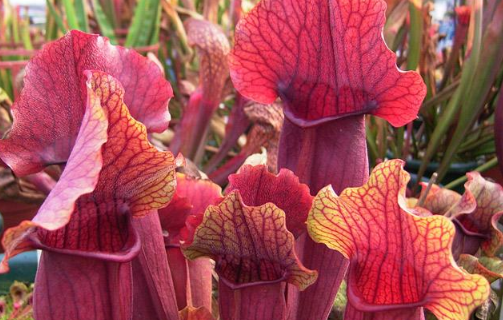
Solutions
The flower pot should be a deep pot, at least 10 cm or more, and the bottom of the pot should preferably have holes; when potting with sphagnum moss, it does not need to be fully covered, and some gaps can be left to increase air permeability; if root rot has already occurred, the plant can be dug out and rinsed clean underwater. For roots that are not completely rotten, the rotten parts can be cut off, the wounds left to dry slightly, and then the plant replanted in a pot with fresh growing medium.
Causes of black spot disease
Poor ventilation and overly shady environments easily trigger black spot disease in pitcher plants. It appears as round spots on the plant's leaves, with black mold-like growth.
Solutions
Pay attention to ventilation and light transmission, strengthen cultivation management, and avoid rain exposure for pitcher plants during the rainy season; cut off leaves affected by black spot disease to avoid further infection of other leaves.
Common pests and diseases of pitcher plants and their solutions
Common diseases of pitcher plants and their solutions
Causes of root rot in pitcher plants
The root system of the pitcher plant is fairly well developed, and it is usually potted with sphagnum moss. If the pot has poor air permeability, is relatively shallow, or is watered too frequently, waterlogging in the pot easily occurs and triggers root rot.
Solutions for root rot in pitcher plants
The flower pot should be a deep pot, at least 10 cm or more, and the bottom of the pot should preferably have holes; when potting with sphagnum moss, it does not need to be fully covered, and some gaps can be left to increase air permeability; if root rot has already occurred, the plant can be dug out and rinsed clean underwater. For roots that are not completely rotten, the rotten parts can be cut off, the wounds left to dry slightly, and then the plant replanted in a pot with fresh growing medium.
Causes of black spot disease in pitcher plants
Poor ventilation and overly shady environments easily trigger black spot disease in pitcher plants. It appears as round spots on the plant's leaves, with black mold-like growth.
Solutions for black spot disease in pitcher plants
Pay attention to ventilation and light transmission, strengthen cultivation management, and avoid rain exposure for pitcher plants during the rainy season; cut off leaves affected by black spot disease to avoid further infection of other leaves.
Common pests of pitcher plants and their solutions
During cultivation, pitcher plants are easily attacked by red spider mites, aphids, and root mealybugs. To grow our pitcher plants well, we must be extra vigilant about pest prevention!
Treatment methods for red spider mites on pitcher plants
Dilute abamectin 2000 times or dimethoate 1000 times, add to a spray bottle, shake well, and spray. When spraying, be sure to move the potted plants outdoors. If spraying indoors, never bring it near food or utensils.
Treatment methods for aphids on pitcher plants
Dilute 10% abamectin emulsifiable concentrate 3000 times and spray on the leaf surface; when spraying, you can wear a mask and gloves to protect yourself and your family.
Treatment methods for root mealybugs on pitcher plants
Dig out the pitcher plant and soak the whole plant in diluted Huahuashen medicated water. After about 1 hour, rinse the entire plant with clean water to wash away the remaining pests, and place it in a cool place to dry. Both the pot and the growing medium should be replaced with new ones and thoroughly disinfected and sterilized.
[Gardening] Illustrated guide to 150 common succulents and complete cultivation guide
Currently a total of illustrated entries: 150[Illustrated guide to 150 common succulents][Crassulaceae] 72 entries
[Crassulaceae, Echeveria] 19 entries[Crassulaceae, Aeonium] 9 entries[Crassulaceae, Crassula] 14 entries[Crassulaceae, Sedum] 9 entries[Crassulaceae, Kalanchoe] 4 entries[Crassulaceae, Sempervivum] 3 entries[Crassulaceae, Cotyledon] 3 entries[Crassulaceae, Pachyphytum] 3 entries[Crassulaceae, Orostachys] 2 entries[Crassulaceae, Graptopetalum] 1 entry[Crassulaceae, other genera and species] 4 entries[Aizoaceae] 8 entries[Liliaceae] 11 entries
[Liliaceae, Haworthia] 8 entries[Liliaceae, other genera and species] 3 entries[Asteraceae] 3 entries[Portulacaceae] 3 entries[Other families and genera] 3 entries[Crassulaceae] 34 entries
[Crassulaceae, Echeveria] 8 entries[Crassulaceae, Sedum] 8 entries[Crassulaceae, Graptopetalum] 4 entries[Crassulaceae, Crassula] 4 entries[Crassulaceae, Pachyphytum] 3 entries[Crassulaceae, Kalanchoe] 2 entries[Crassulaceae, Aeonium] 2 entries[Crassulaceae, Dudleya] 1 entry[Crassulaceae, Orostachys] 1 entry[Crassulaceae, other undetermined genera and species] 1 entry[Liliaceae] 7 entries[Aizoaceae] 6 entries[Asteraceae] 2 entries[Portulacaceae] 1 entry[Gardening] Everyday succulent care tips and answers to common questionsRecently I have organized a great many pictures about care and some common questions, and here is another treat for everyone
I have noticed that everyone keeps repeatedly asking many of the same questions, especially on Weibo. In fact, a lot of this knowledge can be found on my blog
I once saw a gardening veteran give an example: at the beginning of Resident Evil, when the protagonist encounters a zombie, he still goes up to show concern and ask what is going on
By the fifth installment, the protagonist headshots everyone on sight... The popularization of gardening knowledge is the same
So I think if I kept answering the same questions on Weibo every day, before long I would turn into a deranged madmanTherefore I decided to organize these common questions and answer them all at once with pictures
I also hope everyone can read the text carefully. Although it may not be entirely correct, it can still serve as some reference
I also welcome everyone to repost this article, so that more beginners can avoid some detours and have fewer doubts
This content is valuable experience that Ermu has gained from everyday care, and I hope friends who repost it will note the source(I am going on a business trip tomorrow~ This time it is a long journey, and the blog will not be updated for a week to 10 days, so let's interact on Weibo~)
===========================================================================
Before starting the illustrated guide, let's first cover some knowledge about succulent varieties and naming
Succulents are actually not divided into "ordinary goods" and "premium goods." Some newly introduced varieties or newly hybridized varieties
are relatively rare because they were initially put on the market, and are marked with higher prices. This is merely a commercial behavior
It has almost no major relationship with the habits and propagation speed of succulents. Of course, it cannot be denied that some succulents are indeed more difficult to propagate
Once these varieties appear, everyone falls into a misunderstanding, thinking that imported ones are good varieties, or treating some hybridized succulents as imported varieties
For example, hybridizing "White Peony" with "Black Prince." After success, a new variety comes out, possessing the advantages of its parents and looking even more beautiful
Then merchants casually label it with a Latin name, pair it with a gorgeous Chinese name "Peony Prince," and price it at several hundred yuan per plant
The so-called "premium goods" then appear. The above is only an example. At present, the whole world uses Latin to name new species
After the name of a hybrid variety, the names of the parents are written immediately after it, to determine what this variety was hybridized from
In fact, many Chinese names are gradually coined by merchants or enthusiasts themselves, and they are not very accurate
But I think as long as it lets everyone recognize this succulent, it is enough. As long as the Chinese names are not too exaggerated, they are acceptable
So everyone should not obsess over the names of some succulents. First grow them plump and healthy, and in the process look for their names
This is a very interesting process, a process of gaining knowledge of a new field. For example, I also have many succulents at home that have been grown for 2 years and still cannot be identified by name
But they grow very plump and beautiful~ Just looking at them feels satisfying~ Of course, being able to find their names and label them would be even more perfect
===============================================================================
Back to the care content. So when everyone does not recognize a succulent, how can they know how to care for it?
The 150 succulent illustrated entries currently made on my blog: the care methods in them are all written according to the environmental conditions of my home (Weihai, Shandong)
We are in a temperate coastal area with an oceanic climate, which is very suitable for succulent growth
Unlike abroad, our winters here are too cold, and most succulents cannot survive winter outdoors
China spans a very large north-south range, and the Yangtze River basin has more rain, so appropriate adjustments can be made according to the local climate
I do not know if everyone has noticed the real purpose of the illustrated guide: each succulent is labeled with its family and genus
This is very important, because succulents of different families and genera differ greatly in care
If divided by "genus," there would be too many varieties, and everyone would get dizzy
But it is entirely possible to classify and care for plants according to the "family" of succulents
For example:
Crassulaceae: The succulents in this family all love sunlight very much, and most like dry, well-ventilated environments, so the amount of watering should be relatively less.
Liliaceae: The succulents in this family all have very developed root systems and absorb relatively more water, so they can be paired with somewhat deeper containers, and when watering, try to soak them thoroughly each time. Also, some do not have a great demand for sunlight, especially the Haworthia series, which can be grown in a diffused-light environment.
Aizoaceae: This is also a type of succulent that loves sunlight very much, but at the same time it also has a relatively high demand for water and easily forms clusters. However, it is especially sensitive to high temperatures in summer, so special attention must be paid to watering timing and amount; with slight carelessness, it will rot.
Asteraceae: The succulents in this family are not cold-tolerant and cannot take too much cold, and most of them readily form clusters, so they can be grown like spider plants. Their demand for sunlight is not very high either, but sufficient sunlight will also make them very beautiful.
Written this way, it becomes very clear. Of course, the succulents of each "family" can also be further divided into "genera." Succulents of different "genera" also differ in care and habits, but they are largely similar, and everyone can slowly learn about this themselves.
===========================================================================================
Besides caring for succulents according to their varieties, attention must also be paid to seasonal factors. This has been introduced many times before
Spring and autumn are the growing seasons for the plants. In this season, they can be watered heavily; as long as the soil is dry, water thoroughly immediately
In summer and winter, the succulents go dormant, and at this time watering should be done according to the situation
Especially in summer, the idea of cutting off water is not reliable. Many succulents die of dryness in summer because water was cut off.
============================================================================================
Now let's begin the illustrated guide~
The succulents that are relatively expensive on the market now are not expensive because they are difficult to propagate. In the picture below, Spring Miracle and Quiet Night are varieties that are very easy to propagate
Commercial issues about succulents will not be discussed here. The following is all based on care as the starting point
Everyone can look up Spring Miracle in the illustrated guide: Crassulaceae, Sedum
This species has an advantage: it grows very quickly, and the survival rate of leaf cuttings and stem cuttings is also very high
After getting it, the first thing is to let the succulents recover their growth state and adapt to the new environment, and then they can be propagated by various leaf cuttings and stem cuttings
Within half a year, it will become a small patch. If grown for a year, it will basically be a full pot
[Spring Miracle][Quiet Night][Leaf cuttings]
Quiet Night is very easy to propagate successfully by leaf cuttings; the success rate is not much lower than that of "White Peony"
Just note leaf propagation point ①: 20-25 degrees is the best temperature for leaf propagation; if you really cannot wait, it should still be above 15 degrees.
Propagating leaves below 10 degrees basically means you will not see seedlings or roots for two months. Last year I propagated White Peony leaves in winter, in November.
It was not until last month that I saw seedlings, and only this month did roots start growing, nearly 4 months! My goodness!
Leaf propagation point ②: soil moisture. At the beginning, this does not need to be considered until roots have grown.
Then you can water frequently; just a small amount is enough. As soon as you notice the soil surface is dry, water immediately.
Only with enough moisture can leaf-propagated seedlings grow healthily. While watering, they can also get a little sun.Once the temperature is reached, the success rate of leaf propagation for Echeveria 'Tolimanensis' is similar to that of White Peony.
[Leaf propagation of hybrid Echeveria 'Tolimanensis'][Cleaning leaves]
Everyone probably encounters this situation often: many small pups grow from the base of the leaves. Normally, this does not need to be dealt with.
But because most of our succulents are grown in pots, not in the wild, the lower leaves often squeeze the small pups.
Especially in summer, if there are too many lower leaves, it is very easy to smother the small pups at the bottom.
At this time, we can pull off all the leaves around the small pups, and the pulled-off leaves can still be used for leaf propagation.
Moreover, more space will allow the small pups to grow better. After growing for a while, they become the legendary clustered clumps.
[Echeveria derenbergii][Echeveria pulidonis][Stem cuttings]
As for the rooting part of stem cuttings, it is best to let the cut branches dry, and you can even face the cut wound directly toward the sun to dry it.
This ultraviolet sterilization method can make the wound heal faster, and the succulent will grow more healthily later.
It has a better effect especially for some varieties that are harder to propagate.
It is also possible to plant directly without drying, but after comparison it was found that such succulents often suffer from pests and diseases later in growth.
Their health is far inferior to succulents propagated after the wound has dried, so drying the wound is something that must be done![Cutting temperature]
Besides drying the wound, temperature is also very important for cuttings. Below 15 degrees, rooting is very difficult.
Except for some stronger succulents, roots may not grow for one or even two months.
The same was true for some succulents I took cuttings of last winter in November. Because the temperature at home hovered around 10 degrees,
it was not until the third month, after I moved the succulents to a place at 15-20 degrees, that roots grew.
Fortunately, succulents are rather tough by nature; other plants would have died long ago.
For watering, it can depend on the condition of the succulent and the environment. Because the newly grown roots will not be many, just water a small amount.
When you notice the soil surface has dried completely, replenish water immediately. Once the succulent leaves become plump, they can receive sunlight.
[Cutting of Echeveria 'Rusbyi' variegata][Wrinkled leaves]
Observing succulent leaves is very important; a lot of information can be observed from succulent leaves.
The succulent in the picture below is definitely short of water, but after watering, its condition still had not recovered after 2-3 days.
This allows us to conclude that the root system has not grown well. When there are not many roots, the succulent absorbs very poorly; even if there is enough water in the soil, it cannot absorb it.
At this time, you can further analyze your soil mix. If there is no problem with the mix either, then just wait!
Do not pull the succulent out to check just because you are doubtful. Succulents grow relatively slowly, so their recovery speed is also slow.
A cutting in poor condition like this will change after about 3 months.
Of course, the temperature must be above 15 degrees, otherwise the recovery time will be longer.
[Short of water, Ivory Lotus with a poor root system][Judging condition by color]
The situation below is very strange: succulents in the same pot with different conditions.
Last autumn, the one on the left was still green, while the one on the right remained a very beautiful red.
Red is not a healthy color. After entering winter, the green succulent still remained plump and grew slowly.
The red one, however, entered a dormant recovery state, and after the color faded it became very unattractive.
But if you observe carefully (Figure ②), you will find that there is still green in the center of the leaves, so there is no need to be nervous.
Keep waiting! After it warms up in spring, the condition will improve!
There are many reasons for this. Although they are planted in the same pot and daily care is the same,
the plants' own health conditions are different, causing a huge difference, just like a healthy child and a sick child living in the same room.
[Crassula mesembryanthemoides][Leggy growth - growth]
There are also many different states of leggy growth, but overall, leggy growth shows that the plant is still growing normally.
Compared with those succulents that do not grow and have wrinkled leaves, it is much, much healthier. Leggy growth should only count as sub-health!
In the picture below, Figures ① and ② show obvious leggy growth. The cause of this situation is too much water.
But this is not a bad phenomenon. As long as there is enough sunlight at home, increasing sunlight time in later care and continuing to water will make the succulents plump.
Do not think that leggy growth is bad and stop watering, because at this time the succulents are in their growing season.
If you cut off water at this time, growth will slow down, and it will be more difficult to make the succulents plump.
Figure ① [Echeveria 'Afterglow']Figure ② [Fuji][Leggy growth - shaping]
This kind of leggy growth is the most common. Generally there are two handling options: the blue X is pulling off leaves for leaf propagation, and the red O is cutting off for stem cuttings.
Choosing to pull off leaves for leaf propagation can keep the succulent growing in this state, and later it will become what is called an "old stem."
The red cutting method is what everyone often does: propagation. After the cut part is dried, it can be re-cut to produce a new plant.
At the same time, multiple new shoots will emerge from the cut position, and later there will be more and more.
When encountering this kind of leggy growth, you can appropriately reduce the amount of watering and extend the watering interval.
At the same time, increase sunlight time. If conditions allow and it is warm enough outdoors, move them outside to feel the breath of nature!
They will recover very quickly.
[Sedum rubrotinctum][Not leggy growth]
The following two situations are not leggy growth. Everyone must not misunderstand leggy growth as simply growing longer and longer.
Plants, after all, normally grow longer and longer. Only plants that do not grow have problems!
Basically, this counts as becoming an old stem. If you want to shape it separately, you can dig out a single plant, pull off some of the lower leaves,
and then match it with a pot you like. In this way, you can create a very perfect small succulent potted arrangement.[White Peony][Graptopetalum paraguayense][Growth information]
In the picture below, the center leaves of Black Prince turning green is growth information, indicating that the succulent has started growing and that moisture is relatively sufficient.
So for a short time there is no need to water. Continue observing and judge what to do based on the latest condition of the succulents.[Freeze damage]
This situation is caused by long-term low temperature, or by a short period of strong temperature drop. After being damaged, the succulent will not show anything for a short time.
In later growth, it will gradually show the freeze damage, and in severe cases even newly grown leaves will carry the same freeze injury.
Such succulents have lowered immunity and are very prone to mold diseases, so it is necessary to increase sunlight time at the same time to make the succulent healthy.
At the same time, the succulent's condition also needs to be eased slowly. A temperature of around 15 degrees is most suitable. It is better to let the succulent have a transition period for temperature.[Mold phenomenon]
There are several main causes of this phenomenon. Among them, succulents that are planted without a layer of small stones spread on the surface are especially prone to mold.
Too much watering, too low temperature, poor ventilation, moisture cannot evaporate in time, and the succulent reduces its water absorption because the temperature is too low or too high.
In other words, these situations are especially likely to occur in winter and summer. Figure ① can basically be declared dead.
However, you can also immediately pull off the remaining leaves and try leaf propagation. If the blackened part above the soil surface is cut off immediately, there is still hope of sending out new buds.
For those like Figures ② and ③, the root system can be confirmed to be completely rotted, but they can still be saved.
Trim the very bottom again in time, then dry it and plant it in dry soil.
Figure ①Figure ②Figure ③[Handling dead leaves]
The lowest leaves of succulents often dry up, fall off, or become transparent and watery.
The former is a normal metabolic process of succulents, and there is no need to worry. After the leaves are completely dry and can be removed easily, take them off and throw them away.
Dead leaves accumulated over a long time are very prone to pests and diseases. Especially in summer, they easily create a closed, stuffy environment, so they must be cleaned up.
As for those dry leaves that are not easy to remove, do not touch them. Pulling them off by force will harm the succulent itself.
Transparent, watery leaves are mostly caused by discomfort from a sudden change in growing environment shortly after the succulent is bought and planted.
There is not much need to worry about this either, and no management is needed. During later growth, the transparent leaves will also slowly dry up or turn to water.
Just clean them off directly, but these should be treated as key observation targets. The stem of the succulent may become black due to mold infection caused by leaves turning to water.[Echeveria 'Rusbyi' with dead leaves][Withered leaves] -- [Transparent watery leaves] -- [Healthy leaves]The lowest leaves drying up and falling off, plus the normal phenomenon of the succulent stem growing taller, will produce an "old stem."
[Crassula mesembryanthemoides][Leaf cracking phenomenon]
Some succulents will show cracked leaves. I also cannot say exactly what the cause is.
A few succulents at home indeed have this situation, but it does not affect the growth of the succulents.
After the growing season arrives, new leaves will grow and it will be fine. The cracked leaves will eventually dry up and fall off.
So everyone does not need to worry too much. Just keep caring for them as usual.In the picture below, new leaves have already grown above the cracked leaves.
[Sedum pachyphyllum][White mold spots phenomenon]
So far, this situation has been found only on succulents of the genus Crassula, especially Crassula capitella 'Campfire' and Crassula 'Red Devil.'
At present, it has not yet been analyzed what exactly the cause is, but it is certainly related to watering. Too much water in the soil leads to a relatively humid environment.
Crassula itself does not need much water, especially in summer, but this white mold seems to have little effect on the growth of the succulents.
These succulents at home with white mold spots have also grown new leaves, and most of the stems are very long and have begun to become woody.
Later, further observation is still needed![Sunburn spots - disease]
I believe this is the most common phenomenon everyone sees, especially on succulents grown outdoors, where these spots very easily appear.
There are many causes, the most common being water droplets - droplets left on the leaves after watering, or small droplets remaining on the leaves in the early morning.
After being exposed to sunlight on a clear day, they burn scars into the leaves. The principle is simple - it is the same principle as a magnifying glass focusing light to start a fire.
This is especially common when they are placed outdoors under strong ultraviolet light. Relatively speaking, succulents placed behind glass rarely have this problem.
Because glass blocks most of the ultraviolet light, the ultraviolet light received by succulents behind glass is very mild.
However, I have also found that after improving the sunlight environment later on, the newly grown leaves sometimes still have such scars.
At present it is still not certain what causes it. After talking with fellow plant lovers, it feels like a kind of disease, similar to freckles in humans~
None of this affects the growth of the succulents at all. As shown below with the Echeveria 'Frosty Morn', once new leaves grow out they become very beautiful.
The oldest leaves at the very bottom will also slowly dry up and fall off, so there is no need to worry too much.
[Echeveria 'Orion'][Echeveria 'Takasago No Okina'][Echeveria 'Frosty Morn'][Echeveria 'Frosty Morn' reborn]
The old leaves covered in scars form a strong contrast with the newly grown leaves, very striking~ It has the feeling of a lotus emerging from water~[Flowering, flower buds]
Many succulents are themselves shaped like flowers in many forms, so many fellow plant lovers have always mistakenly thought that succulents do not bloom.
In fact, succulents are flowering plants, and basically all of them will bloom; it is just that due to different varieties and habits, there is some difference in flowering time.
Some bloom several times a year, some only bloom every spring, and some bloom only once every ten years.
Fellow plant lovers often mistake flower buds for new branches growing from the succulents. Below, both Figure 1 and Figure 2 are flower buds that have grown out.
This flower bud will slowly grow longer, and finally form a flower stalk that shoots out, as shown in Figure 3, the flower stalk of Echeveria 'Moon Goddess'.
Succulents take a very long time to bloom, and the process of the flower bud forming a flower stalk is also very long, taking on average 2-3 months.
This process consumes a lot of nutrients. Some succulents even bloom only once in their entire life, and then die.
Flowers of the Echeveria type are actually quite beautiful too, and the phenomenon of consuming nutrients is not too obvious.
But if you do not like watching them bloom, you can just cut them off directly~
During growth, the flower stalk will knock off some of the waxy coating and white powder on the leaves, which makes the succulents look very ugly, as shown in Figure 4.
Figure 1 [Echeveria 'Red Glow']Figure 2 [Sinocrassula yunnanensis]Figure 3 [Echeveria 'Moon Goddess']Figure 4 [Echeveria 'Chihuahuaensis'][The relationship between pot size and succulents]
I have always been observing what kind of pot is most suitable for planting succulents, and I found a very interesting phenomenon: whatever size succulent you like, match it with that size of pot.
If you like plump, large succulents, plant them directly in a flower bed, or give them a deeper and larger pot, and the succulents will grow very plump and large.
If you like mini and cute ones, then place them in small, cute mini pots, and the succulents will keep a moderate, mini-sized form.
Both of these points are related to water and soil, with the former being more important. Sufficient moisture inside the pot can ensure continuous growth of the succulents.
When the moisture disappears, the succulents will, according to the drought situation, eventually begin to consume their own water (which is the common situation of the bottommost leaves drying up and falling off).
As for the latter, regarding soil, adding more granules makes drainage stronger and moisture evaporates faster, so it is not very suitable for the growth of succulents.
But for some old-stem succulents, the old stems themselves have reduced absorption function, so using soil mixed with granules actually works better.
Mini pots basically cannot retain moisture. On a clear day, the water dries up the same day it is watered.
In this way, the succulents are in a state of stopped growth or consuming their own leaf moisture most of the time, so they grow very slowly and very small~
But it still does not reduce their cuteness at all~ A lack of water plus sufficient sunlight will make the succulents' colors more vivid.
[Graptoveria 'Titubans'][Pachyphytum 'Blue Haze'][Echeveria 'Black Prince'][Color change in succulent leaves]
I have written about this before~ so I will not say much more. It is on the blog homepage, and those interested can go find it and take a look.
The main 2 points for succulents changing color: temperature difference and sunlight.
The ones below are being used for an experiment. They were just moved outdoors 2 days ago, and they were already quite red inside the glass room.
Right now it is about 2-8 degrees outdoors, and I do not know how many days it will take for them to turn fully red. These past few days there has been smog again, with no sunlight, so I feel it will take even longer.
Color change is not necessarily a good phenomenon; it is just external factors stimulating the succulents, so be sure not to misunderstand this.
So when choosing succulents to move outdoors to try low-temperature color change, it is best to choose ones that are originally cold-resistant, or whose plants are relatively robust.
In the Crassulaceae family, Sedum, Sempervivum, and Echeveria are all good cold-resistant mainstays, so everyone can give them a try.[Echeveria 'Flower Moon Night'][Crassula 'Red Child'][Succulent arrangements]
Regarding combined arrangements in one pot, many fellow plant lovers think that being crowded together is not good for growth, or that after planting they will lose their shape before long.
That is indeed the case, but it can be solved by dividing the varieties, mixing together succulents with similar habits but different varieties and different colors.
This not only makes up for these shortcomings, but is also very beautiful, and they may even grow better when crowded~
However, when selecting varieties, everyone needs to have a certain understanding of the habits of all succulents, and this requires long-term observation to discover.[Color change also happens when sunbathing behind glass]
Many fellow plant lovers feel that glass blocks far too much ultraviolet light, and in addition, indoors is at a relatively constant temperature most of the time.
So the succulents not only fail to change into beautiful colors, but also often grow leggy and very ugly.
In fact, these understandings are correct; it is just that when growing succulents indoors, certain conditions are weakened, which causes this effect.
If daily sunlight reaches more than 4-5 hours, or if you often open the windows for ventilation to maintain a temperature difference effect,
the succulents will still change color, and will not grow leggy either~ Below are succulents that were grown for half a year indoors in a relatively constant-temperature state.
Indoor conditions: the window is completely sealed, no ventilation, 4-5 hours of sunlight every day, winter temperature 22-26, and on clear days the windowsill even reaches 30 degrees.
Everyone can refer to the above conditions and make some adjustments for their own succulents.
[Cotyledon tomentosa][Kalanchoe tomentosa][Watering and Cotyledon tomentosa]
As for watering, it is still the same saying: be sure not to water on a fixed schedule. It is best to water according to the weather conditions and the dryness and moisture of the soil.
Finally, let me talk separately about Cotyledon tomentosa. This is one of my favorite succulents. I have grown it for 3 years and have never pruned it.
After communicating with this little bear over these years, I found that it really likes sunlight, and very much likes a dry environment with sufficient sunlight.
But this does not mean watering less. Every time I water, I wait until the soil is completely dry and then water thoroughly once.
I have given it the spot at home with the longest sunlight hours. Especially in winter, I put it in a place with a slightly higher temperature.
In summer, try not to put it outdoors. It is best to choose a place with fewer sunlight hours or provide some shade.
In summer, this little bear fears rainwater the most. First, because rainwater carries in a lot of dust that makes the little bear's fuzz very dirty; second, because it easily gets infected due to stuffy dampness.
That is basically it! If I run into new problems in the future, I will organize them properly again. Fellow plant lovers, study well and grow fat every day.[Growing experience] How to make succulents more beautiful
These past two days I have crazily bought a lot of books, wanting to enrich my gardening knowledge and creativity more.
What is rather disappointing is that the content in the books is too little, far from enough to read, but Tasha Tudor's book feels especially warm and familiar, and the text is well worth savoring repeatedly.
Let me continue handing in my homework~~ I have seen many friends worrying about why their succulents do not look good, and how to grow them more beautifully.
Some friends' first reaction is surely: PS or a good camera That indeed counts as one, but I think this can only account for 5% of the whole proportion.
Overall, how to make succulents more beautiful, based on my growing experience, comes down to three major factors: 1. sunlight, 2. watering, 3. pairing and landscaping.
Let's go one by one~~~
One, sunlight
This is surely the one everyone is most familiar with. One of the biggest secrets of growing succulents is "sunlight."
Most succulents will turn red after being exposed to strong sunlight, or their colors will become more vivid. In fact, there is also an additional condition - [temperature difference].
Among succulents, the one that best shows color change should be the Crassulaceae~ This is also one of the main reasons why Sedum-type succulents poison the masses.
PS: Sufficient sunlight plus a large temperature difference will make succulents become even redder and more vivid (my home cannot do that for now, so I will just post two random photos).Two, watering
Watering is really, really important! Very important! The most common thing is misting. Small droplets fall onto the succulents, and then it happens to be the strong midday sunlight,
and boom~~ direct sunburn. At this time, the water droplets play the role of a magnifying glass. Think of the example of a magnifying glass focusing light to start a fire in the sun~
So this is one of the reasons why you must never mist.
The second reason not to mist: most succulents, mainly Echeveria, have white powder on their leaves, and this powder is produced only once.
If you spray water or water directly aimed at the leaves, the white powder will be washed away, and the white powder on the leaves will not regenerate.
At this point, if you want the succulents to become more beautiful, you can only wait for new leaves. A long process...
Also, be careful about touching. Those who often like to hold succulents in their hands and fiddle with them should be careful. If you want them to be more beautiful, do not touch the leaves.
PS: When watering, try to pour along the edge of the pot. If you really cannot do that, do not pour water directly into the center of the succulent either.Below are some examples of white powder having been rubbed off.At spot 1, the white powder can very clearly be seen~ Spot 2 is a mark caused by watering.
Besides Echeveria, many other Sedum plants also have white powder.
Among the varieties on my balcony, the ones with white powder are roughly: Echeveria, Echeveria 'Flower Moon Night', Sedum 'Yachiyo', Graptopetalum paraguayense, Echeveria 'Frosty Morn', Echeveria 'Jade Butterfly', Graptoveria 'Titubans', Pachyphytum 'Starfairy', Pachyphytum 'Peach Beauty', and so on. There are too many varieties, so everyone can pay attention and observe on their own normally. No matter the variety, as long as you pay attention to the watering method, it is fine.There are also some succulents that can still remain beautiful after improper watering~ generally ones whose colors are mainly white or blue-green.Three, pairing and landscaping
This is a bit beyond my ability, and I feel it is related to a person's artistic sense~ The most important thing is still a "color tone" issue.
I believe friends who like multicolor painting can quickly put together beautiful succulent landscapes.
When combining succulents, note that enough space should be reserved to give them more room to grow. A tightly packed combination can only maintain its effect for a very short time.
In addition, pay attention to the growth forms of the succulents, such as trailing type, tree-like type, coral-like type, and so on. The habits of the succulents also need attention.
Combining succulents with different habits together brings a lot of inconvenience in watering and sunlight, so these three points must definitely be considered when combining.
I myself am still a beginner and do not have much experience in this area.
I will explore slowly~ There is still a lot to learn~ I will often update things in this area in the future~
PS: Pairing and landscaping requires a person to have a rich understanding of "color," such as black and white, red and green, etc. Combining succulents is also a combination of colors.
Their growth space, habits, and forms are also three very important points, affecting how long the combined landscape can be maintained. Later care and trimming are also necessary.I wrote a whole jumble of stuff~ Finally, let me post one succulent that I have a little question about~ The Echeveria 'Red Glow' at home suddenly became very plump~
It even turned into a double head. When I lifted up the leaves and looked... there is a ring of little babies underneath.Can someone tell me how to handle this? This way, I cannot even behead it.
If I do not deal with it, I am afraid the little babies underneath will develop poorly... Why do all the succulents in my home sprout heads like this~~~~~~~~~Early in the morning I went to look at the new house. It has already been topped out, and I was told it can only be handed over in May next year. I have prepared a bunch of climbing roses for the yard in advance~
In the afternoon I went to a nearby nursery to look at pots. This kind of clay pot is indeed cheap~ 2 yuan, 3 yuan, 5 yuan, pick whatever you like...
I picked the two biggest ones, planning to put them on the terrace first. When I move to the new home next year, I will take them over together.The climbing roses bloom directly~ Awesome!I've had the idea of making a succulent plant illustrated guide for a long time. Before, I just simply saved the images and changed the image names to the names of the succulent plants.
Actually, for me, growing succulents is just a hobby. I don't want to become a succulent botanist myself, so I've always just lazily enjoyed it in my own way.
As time went on, I found that I didn't recognize many varieties, and I couldn't even tell which family or genus they belonged to.
From a hobbyist's perspective, I don't really recommend that everyone memorize which family or genus things belong to, because the fun lies in growing and gardening.
However, I've noticed that whether on QQ groups or Weibo, many friends don't understand the names and habits of succulent plants, and there are quite a few repeated questions.
So I wanted to put together a succulent plant illustrated guide, to make it easier for everyone to recognize and understand them, and also convenient for me to look up information.
The content of the guide is fairly simple. After posting it on Weibo, the response was strong, and many friends offered various opinions.
I summed it up: if I were to write all the information into the guide, then I really would become a botanist.
And collecting all this material takes a very long time - you have to look things up, make comparisons, and also combine it with your own growing experience.
So I gave up on most of the content directly, like Latin names and such. Ordinary hobbyists don't need to know that much, right!
Simply put, this guide I've put together mainly targets ordinary succulent hobbyists:
1. It's mainly for everyone's introductory understanding. Watering and sunlight and other care methods are for reference only.
2. Simple, easy to understand and intuitive, convenient to save and look up (I recommend everyone save the images and then change the image names to the names of the succulent plants).
3. All the images in the guide were taken by me, and they are also succulent plants I am currently growing.
4. The content mainly marks out my usual care experience and some characteristics of the succulent plants. (Blogger's location: Weihai, Shandong)
5. Since I'm not a professional either, mistakes are inevitable. If you find any, you can @ me on Weibo, or send a private message, and I will check and correct it promptly.
6. I reserve the final right of interpretation for the images! This guide is not for commercial use, and for those who casually steal the images for use, I will definitely report them to the end!
[Succulent Plant FAQ]
Because the image content is limited, there is a lot of repeated information I haven't added. Here I'll answer it all at once (I can't finish organizing it in one go, continuously updated):
① When are the growing season and dormant season for succulent plants?
Answer: Spring and autumn are the growing seasons for succulent plants, and summer and winter are the dormant seasons. However, due to regional and climatic conditions, in some areas they can also grow in summer and winter. For example: running air conditioning in summer, or having heating in northern regions in winter, can both allow succulent plants to continue growing.
② What exactly does "full sun" mean?
Answer: "Full sun" refers to sunlight duration, meaning some succulent plants can receive sunlight all day. It doesn't mean completely placing them under the sun to bathe. In summer, some sun protection measures are still needed (shade net).
③ Can the "scientific name" and "alternative names" both be marked in the guide?
Answer: Since I'm not a professional plant researcher, I also have a skeptical attitude toward some of the naming on the internet (many Chinese names are made up by vendors themselves), and I can't distinguish the truly correct names. Latin names are also too cumbersome, so the names in the guide are all commonly used and common ones. If there are errors, I will check and correct them promptly.
④ What temperature is suitable for succulent plants to grow? At what temperatures in summer and winter do they go dormant?
Answer: For succulent plants, the most suitable growing temperature is 10°C-30°C. Of course, the temperature can't be a constant value. In summer, when it exceeds 35°C, some succulent plants will enter a dormant state, especially the "winter-growing type" (growing in winter). When the temperature reaches 40°C, almost all succulent plants will enter a dormant state, even the "summer-growing type" (growing in summer) will enter a dormant state (no longer absorbing water). In winter, when it's below 5°C, some succulent plants will enter a dormant state. 0°C is the freezing point, and water will slowly freeze. The leaves and stems of succulent plants are mostly water inside, so when it's below 0°C, the water inside the succulent plants will also slowly freeze, and the main body of the plant will definitely no longer grow. At this time, you must cut off water.
⑤ Can the suitable cultivation medium for succulent plants be added to the guide?
Answer: I've already written about this in the pinned post on the homepage. From the media I've used so far, soft peat soil + granules is the most suitable. The ingredients of the ready-made soil I commonly use are also: peat soil + rice husk + perlite + vermiculite, etc. To save trouble, I directly use the ready-made soil for cultivation each time. And almost all the succulent plants at home use the same uniform medium.
⑥ Does cutting off water in summer mean completely not watering? How long does this period roughly last?
Answer: The commonly mentioned summer water cut-off is actually only for some succulent plants. Plants still need water after all, so during summer high temperatures, extend the watering interval to once a month, with a small amount being best. At least let the soil retain a tiny bit of moisture. Succulent plants surviving in the wild also rely on the moisture in the ground soil to get through summer, so they can survive for several months or even half a year without rain. But now that succulent plants are transplanted indoors, terracotta and similar flower vessels can easily dry out completely, so in summer sometimes I still keep watering once a week or even once every 5 days. The duration mainly depends on the weather and temperature conditions. When you notice autumn arriving and the temperature slowly dropping, you can increase the amount of watering.
⑦ Can the guide indicate "winter-growing type" (growing in winter) or "summer-growing type" (growing in summer)?
Answer: Considering that existing materials are limited, many succulent plants are hard to distinguish as to which type they belong to. Only after personally growing and observing them can you draw a conclusion, so I haven't directly added it to the guide. However, for those I can confirm from existing materials, I will definitely add them in. "Winter-growing type" and "summer-growing type" don't have much difference during cultivation. The growing seasons are still spring and autumn, and they will still go dormant in summer and winter. So for ordinary hobbyists, it's enough to just know how to care for them. For details, refer to the answers to questions ④ and ⑥.
⑧ Looking at the guide, all the succulents have different watering and sunlight requirements. Can they be planted together? How do you care for those combined mixed plantings?
Answer: They can be mixed planted! And the combined effect is even more beautiful. Succulents of different colors paired together look even prettier. For care, normal sunlight and watering are fine. I think mixed-planted succulents grow better and faster, perhaps because growing together gives a sense of competition! But one thing to pay special attention to: for mixed planting combinations, try to choose plants of the same family and genus, because their habits are roughly the same, so they're easier to manage. For example: mixing Echeveria types, mixing Sedum types, or you can also mix Sedum with Echeveria, because they all belong to the Crassulaceae family. However, mixing Aizoaceae and Crassulaceae together is not so good, because Aizoaceae is more sensitive to water, and after a long time you'll find you have to dig them out and rearrange them.
⑨ What is "fasciation"?
Answer: Fasciation refers to a common abnormal mutation phenomenon in flowers and plants.
Fasciation mutation refers to certain varieties of succulent plants receiving unexplained external stimulation, causing their apical growing point to abnormally divide and double, forming many small growing points. These growing points then develop horizontally and connect into a line, eventually growing into a flat fan shape or cockscomb-shaped band. Because of their strange form, fasciated mutant plants have higher ornamental value, and because they are rare, they are more precious than the original species.
Do you also often grow some succulent plants? Below, the editor will share succulent plant growing methods with everyone.Repotting Succulent Plants
1
Newspaper, tweezers, small shovel, mixed soil, akadama soil, container, fertilizer. After getting the succulent, first trim the roots and let it air dry for two days, which allows the root wounds to heal.2
Preparing the container: prepare a container a bit larger than the original flower pot. First think about where you want to plant the plant in the pot. Add large-grain akadama soil, roughly to about one-third the height of the pot, which allows drainage to be smoother!
3
Before adding fertilizer, first put in a layer of cultivation soil. The amount of soil just needs to cover the akadama soil below, then add a small pinch of fertilizer.
4
Adjusting the plant's height: place the plant into the pot while adjusting the height. After deciding on the height, add cultivation soil - hold the plant with one hand and sprinkle cultivation soil around it with the other. The soil shouldn't be added too full; leave space for watering.
5
Compacting the soil: after placing the plant, tap the pot to make the soil more compact with no gaps. If you feel there isn't enough soil, add some more. Finally, spread volcanic rock on top.
Repotting tips: When dividing offsets, carefully separate the plants, and don't damage the roots! If the baby plants are still connected to the roots, be even more careful not to break the roots. If the bottom of the flower pot is relatively large, it's best to line it with newspaper and mesh. After laying down the newspaper, broken soil won't easily fall out, helping keep the room clean. And by the time the roots have grown well, the newspaper will have mostly decomposed, very practical! Use your hands to remove the soil stuck to the roots - this soil is all old soil with no nutrients, so throw it away.
END
Succulent Plant Stem Cuttings
1
Choose the plant you want to use for stem cuttings. A leggy succulent plant is already at the level where it can be a mother plant, so choosing such a plant for stem cuttings is most suitable.
2
At the top one-third of the plant, use scissors to cut off a section of the plant. Don't worry, your succulent will grow very well.
3
Then the remaining part just needs to be grown as usual, and after some days it will heal itself; then use your hands to remove the excess leaves from the cut plant, exposing a section of stem.
4
Then carefully plant the cutting into a flower pot filled with soil and that's it. Or place the plant into a small bottle filled with water, being careful not to let the plant touch the water surface - leave a gap, so the plant can root well for replanting later.
Stem cutting tips: When planting the cut plant, it's best to wait until the wound turns black or shrinks before planting. When planting, it's best not to touch it with your hands - use tweezers to plant it, which keeps the plant in good condition.
END
Creating a Bonsai Arrangement
1
First choose the colors, types, and heights of the succulent plants, then decide on buying the small seedlings. Roughly decide on the composition, paying attention to the balance and beauty of the plants.
2
Then prepare a small flower pot, first spread a layer of soil, and be sure to wet it with water.
3
Spread a layer of volcanic rock on top. Volcanic rock is a great companion for succulent growth, providing quite a few trace elements. Wet it as well.
4
Start transplanting the small seedlings from the edge of the container. Start transplanting and pushing soil at one edge, then slowly spread toward the other side. (Use the soil in the container to push toward the seedlings - this way, when finished, you won't need to add too much more soil and end up dirtying the seedlings.)
5
Try your best not to touch the seedlings' leaves with your hands, so using tweezers for this is most suitable.
Topsy Turvy EcheveriaTopsy Turvy Echeveria (Echeveria runyonii cv 'Topsy Turvy') also known as Teyeyudie, Crassulaceae family, Echeveria genus.
Topsy Turvy Echeveria is a perennial evergreen succulent plant, with its original species native to Mexico. The first mutated variety originated in California. The plant grows in clusters and freely produces branches. The leaves are arranged in a rosette, covered with a thick layer of white powder. The leaf base is a twisted spoon shape, with both edges curving outward, causing the middle part to arch up, while the leaf tip curves inward toward the growing point. There is an obvious groove in the center of the leaf back, and the leaf color is blue-green.
The plant diameter can reach 20-30 cm, and the height can reach 15-30 cm. This variety grows quickly. It is a very attractive succulent plant whether potted or garden-planted, and is very easy to cultivate.
Topsy Turvy Echeveria likes warm, dry and ventilated environments, likes light, is drought-tolerant, cold-tolerant, shade-tolerant, not tolerant of intense sun exposure, and has no obvious dormant period.
1) Flowering: In autumn, it grows arched racemes and blooms bright red-orange flowers. The flower color is very vivid.
2) Cultivation key points: The suitable growing temperature is 15-25°C, and not lower than 5°C in winter. For soil mix, generally use peat + vermiculite + perlite in equal parts, and add an appropriate amount of bone meal. You can also use 3 parts leaf mold, 3 parts river sand, 1 part garden soil, and 1 part cinder mixed together; during the growing season, water thoroughly when the soil is dry, and when the air is dry you can sprinkle water around the plant. During the growing season, fertilize generally about once every 20 days.
3) Propagation methods: including cuttings and division. Cuttings include leaf cuttings and stem cuttings. For leaf cuttings, lay a complete mature leaf flat on moist sandy soil, leaf surface facing up, leaf back facing down, no need to cover with soil, place in a cool place. After about 10 days, small leaf clusters and new roots will grow from the leaf base. Bury the roots into the soil, then let it get more sunlight, water and fertilize appropriately, and gradually it will grow into a robust new plant. For stem cuttings, you can use single leaves, tiller branches or top branches. The length of the cut stem is not limited, but the cut surface must dry, then remove the lower leaves and insert into a sand bed. After insertion, roots generally form in about 20 days. The cutting medium must not be too wet, otherwise the cut surface easily turns yellow and rots. When roots are 2-3 cm long, pot them up. August to October is better, with fast rooting and high survival rate. Leaf cuttings can also be used. Division is best done in spring.
4) Care: Usually requires full sun or slight shade, or very strong indoor lighting. The soil needs to be very well-draining. In greenhouses, equal proportions of clay and sand are used, with small gravel added to ensure drainage. Watering should follow "water when dry, water thoroughly". This is very important for plant health, because overwatering can cause the plant to die. During the growing season, fertilize usually once, using a balanced fertilizer, diluted to 1/2 the recommended dose according to instructions. During the winter months, reduce water, only enough to keep the leaves from wrinkling.
Solving the trouble of leggy succulents~After planting according to your preferences, try not to move the already transplanted seedlings. When finishing up, use a small shovel to add some akadama or decorative stones.
Purple Pearl Echeveria
Lesson notes (0)
Comments Questions Write a noteRed Rolling Silk Rolling Silk belongs to the Sempervivum genus (Sempervivum L.)
This genus's scientific name means semper (forever) and vivium (growing). English name HOUSELEEK, Japanese name "spider nest bandai grass". Origin: Central and Southern Europe, North Africa, Caucasus and Asia Minor. Distribution areas include North America, Canada, China, Japan, Myanmar, India and other regions with warm climate and hilly terrain.
1) Variety history: This genus had 23 varieties organized in the 1930s. Japan began to popularize this genus from the mid-Meiji period, and it was introduced to China in recent years. Because this genus easily hybridizes under both natural and artificial conditions, the names and quantities are very chaotic. For example, S. tectorum (Lingying) has 70 different scientific names and cultivation names. The varieties recorded in this genus reach 200, and conservatively speaking there are now 45 species (including early natural hybrid varieties).
2) Morphological characteristics: Succulent herbaceous plant, thick leaves, often in rosette form, leaves often have filamentous hairs or fine hairs; flowers in cymose panicles, in colors such as red, white, yellow. Similar and most closely related to the Aeonium genus.
3) Cultivation and propagation: This genus is very cold-tolerant, sensitive to high temperatures. During cultivation, pay attention to air circulation, as it easily rots in summer. The lower layer of soil should be humus soil, and the upper layer should be sandy soil, slightly acidic. Propagation uses offsets that sprout from stolons, and leaf cuttings are also very easy. Hybridization easily produces seeds.
The plant is in a dormant state during summer high temperatures and winter cold. The main growing seasons are the cooler spring and autumn. During the growing season, it requires sufficient sunlight. If there is insufficient light, the plant shape will become loose and not compact, affecting its ornamental value. Plants grown in sufficient light have thick and plump leaves, compact plant shape, and beautiful leaf color.
4) Watering principles: "Don't water if not dry, water thoroughly when watering". Avoid long-term water accumulation to prevent root rot, but also don't let it be too dry, otherwise although the plant won't die, it will grow slowly, with dull leaf color and lack of vitality. Fertilize about once every 20 days with decomposed dilute liquid fertilizer or a low-nitrogen, high-phosphorus-potassium compound fertilizer. In winter, if the nighttime temperature is not lower than 5°C and the daytime temperature is above 15°C, the plant can continue growing, and you can water normally and fertilize appropriately; if you control watering to make the plant dormant, it can also tolerate low temperatures of 0°C.
Pests and diseases mainly include leaf-eating pests and rot molds.
Purple Pearl lesson notes (1)
Comments Questions Write a notePurple Pearl (Echeveria cv. Peale von Nurnberg) Crassulaceae family, Echeveria genus
The Echeveria genus of the Crassulaceae family likes warm, dry and ventilated environments, likes light, is drought-tolerant, cold-tolerant, shade-tolerant, tolerant of stuffy indoor environments, and has extremely strong adaptability. It is not tolerant of intense sun exposure and has no obvious dormant period. Its leaves are a magnificent pink-purple, like spoons. The purple color is not obvious in summer, and deepens in autumn. If placed in sunlight, it will grow into a rose petal shape.
1) Flowering: From late summer to early autumn, flower stems grow from the leaves, blooming slightly purple orange flowers.
2) Cultivation key points: Maintain in a ventilated environment, otherwise it easily gets sick. Its suitable growing temperature is 15-25°C, not lower than 5°C in winter; during the growing season, water thoroughly when the soil is dry. When the air is dry, you can sprinkle water around the plant, but the leaf surface, especially the center of the leaf rosette, should not accumulate water, otherwise it will cause heart rot; during the growing season, fertilize generally about once every 20 days. The growing seasons are spring and autumn - water only after the potting soil is completely dry. In summer, shade is needed and watering should be reduced. In winter, place indoors in a sunny spot for care.
3) Propagation methods: mainly cuttings and division. Cuttings include leaf cuttings and stem cuttings. For leaf cuttings, lay a complete mature leaf flat on moist sandy soil, leaf surface facing up, leaf back facing down, no need to cover with soil, place in a cool place. After about 10 days, small leaf clusters and new roots will grow from the leaf base. Bury the roots into the soil, then let it get more sunlight, water and fertilize appropriately, and gradually it will grow into a robust new plant. For stem cuttings, you can use single leaves, tiller branches or top branches. The length of the cut stem is not limited, but the cut surface must dry, then remove the lower leaves and insert into a sand bed. After insertion, roots generally form in about 20 days. The cutting medium must not be too wet, otherwise the cut surface easily turns yellow and rots. When roots are 2-3 cm long, pot them up. August to October is better, with fast rooting and high survival rate. Leaf cuttings can also be used. Division is best done in spring.
I've had the idea of making a succulent plant illustrated guide for a long time. Before, I just simply saved the images and changed the image names to the names of the succulent plants.
Actually, for me, growing succulents is just a hobby. I don't want to become a succulent botanist myself, so I've always just lazily enjoyed it in my own way.
As time went on, I found that I didn't recognize many varieties, and I couldn't even tell which family or genus they belonged to.
From a hobbyist's perspective, I don't really recommend that everyone memorize which family or genus things belong to, because the fun lies in growing and gardening.
However, I've noticed that whether on QQ groups or Weibo, many friends don't understand the names and habits of succulent plants, and there are quite a few repeated questions.
So I wanted to put together a succulent plant illustrated guide, to make it easier for everyone to recognize and understand them, and also convenient for me to look up information.
The content of the guide is fairly simple. After posting it on Weibo, the response was strong, and many friends offered various opinions.
I summed it up: if I were to write all the information into the guide, then I really would become a botanist.
And collecting all this material takes a very long time - you have to look things up, make comparisons, and also combine it with your own growing experience.
So I gave up on most of the content directly, like Latin names and such. Ordinary hobbyists don't need to know that much, right!
Simply put, this guide I've put together mainly targets ordinary succulent hobbyists:
1. It's mainly for everyone's introductory understanding. Watering and sunlight and other care methods are for reference only.
2. Simple, easy to understand and intuitive, convenient to save and look up (I recommend everyone save the images and then change the image names to the names of the succulent plants).
3. All the images in the guide were taken by me, and they are also succulent plants I am currently growing.
4. The content mainly marks out my usual care experience and some characteristics of the succulent plants. (Blogger's location: Weihai, Shandong)
5. Since I'm not a professional either, mistakes are inevitable. If you find any, you can @ me on Weibo, or send a private message, and I will check and correct it promptly.
6. I reserve the final right of interpretation for the images! This guide is not for commercial use, and for those who casually steal the images for use, I will definitely report them to the end!
[Succulent Plant FAQ]
Because the image content is limited, there is a lot of repeated information I haven't added. Here I'll answer it all at once (I can't finish organizing it in one go, continuously updated):
① When are the growing season and dormant season for succulent plants?
Answer: Spring and autumn are the growing seasons for succulent plants, and summer and winter are the dormant seasons. However, due to regional and climatic conditions, in some areas they can also grow in summer and winter. For example: running air conditioning in summer, or having heating in northern regions in winter, can both allow succulent plants to continue growing.
② What exactly does "full sun" mean?
Answer: "Full sun" refers to sunlight duration, meaning some succulent plants can receive sunlight all day. It doesn't mean completely placing them under the sun to bathe. In summer, some sun protection measures are still needed (shade net).
③ Can the "scientific name" and "alternative names" both be marked in the guide?
Answer: Since I'm not a professional plant researcher, I also have a skeptical attitude toward some of the naming on the internet (many Chinese names are made up by vendors themselves), and I can't distinguish the truly correct names. Latin names are also too cumbersome, so the names in the guide are all commonly used and common ones. If there are errors, I will check and correct them promptly.
④ What temperature is suitable for succulent plants to grow? At what temperatures in summer and winter do they go dormant?
Answer: For succulent plants, the most suitable growing temperature is 10°C-30°C. Of course, the temperature can't be a constant value. In summer, when it exceeds 35°C, some succulent plants will enter a dormant state, especially the "winter-growing type" (growing in winter). When the temperature reaches 40°C, almost all succulent plants will enter a dormant state, even the "summer-growing type" (growing in summer) will enter a dormant state (no longer absorbing water). In winter, when it's below 5°C, some succulent plants will enter a dormant state. 0°C is the freezing point, and water will slowly freeze. The leaves and stems of succulent plants are mostly water inside, so when it's below 0°C, the water inside the succulent plants will also slowly freeze, and the main body of the plant will definitely no longer grow. At this time, you must cut off water.
⑤ Can the suitable cultivation medium for succulent plants be added to the guide?
Answer: I've already written about this in the pinned post on the homepage. From the media I've used so far, soft peat soil + granules is the most suitable. The ingredients of the ready-made soil I commonly use are also: peat soil + rice husk + perlite + vermiculite, etc. To save trouble, I directly use the ready-made soil for cultivation each time. And almost all the succulent plants at home use the same uniform medium.
⑥ Does cutting off water in summer mean completely not watering? How long does this period roughly last?
Answer: The commonly mentioned summer water cut-off is actually only for some succulent plants. Plants still need water after all, so during summer high temperatures, extend the watering interval to once a month, with a small amount being best. At least let the soil retain a tiny bit of moisture. Succulent plants surviving in the wild also rely on the moisture in the ground soil to get through summer, so they can survive for several months or even half a year without rain. But now that succulent plants are transplanted indoors, terracotta and similar flower vessels can easily dry out completely, so in summer sometimes I still keep watering once a week or even once every 5 days. The duration mainly depends on the weather and temperature conditions. When you notice autumn arriving and the temperature slowly dropping, you can increase the amount of watering.
⑦ Can the guide indicate "winter-growing type" (growing in winter) or "summer-growing type" (growing in summer)?
Answer: Considering that existing materials are limited, many succulent plants are hard to distinguish as to which type they belong to. Only after personally growing and observing them can you draw a conclusion, so I haven't directly added it to the guide. However, for those I can confirm from existing materials, I will definitely add them in. "Winter-growing type" and "summer-growing type" don't have much difference during cultivation. The growing seasons are still spring and autumn, and they will still go dormant in summer and winter. So for ordinary hobbyists, it's enough to just know how to care for them~ For details, refer to the answers to questions ④ and ⑥.
⑧Looking at the care guides, all succulents have different watering and sunlight needs, so can they be planted together? How do you care for those mixed-planting combinations?
Answer: Yes, you can plant them together! And the combined effect is even more beautiful~ Succulents of different colors look prettier when paired together. For care, just normal sunlight and watering will do. I think mixed-planted succulents grow better and faster, maybe because growing together gives them a sense of competition! But there is one thing to pay special attention to: for mixed succulent combinations, try to choose plants of the same family and genus, because their habits are roughly the same, so they are easier to manage. For example: mix Echeveria types together, mix Sedum types together, and you can also mix Sedum with Echeveria, because they all belong to the Crassulaceae family. However, mixing Aizoaceae and Crassulaceae together is not so good, because Aizoaceae are more sensitive to water, and after a while you will find that you have to dig them out and rearrange them.
⑨What is "fasciation"?
Answer: Fasciation refers to a common abnormal mutation phenomenon in flowers and plants.
Fasciation mutation means that some varieties (cultivars) of succulents receive external stimulation from unknown causes, and their apical growing point divides abnormally and doubles, forming many small growth points, and these growth points develop laterally and connect into a line, eventually growing into a flat fan-shaped or cockscomb-shaped banded body. Because of their strange shape, fasciated mutant plants have higher ornamental value, and because they are rare, they are more precious than the original species (cultivar).