How to Grow Pitcher Plants? Detailed Guide to Cultivation Methods and Precautions
Substrate
Pitcher plants do not have high requirements for the substrate, because their root system is very well developed and will fill the entire bottom of the pot. This substrate can be mixed by ourselves, combining peat soil, sphagnum moss, perlite and other materials together. Remember to place some broken tiles or bricks at the bottom of the pot, which helps with ventilation and drainage. The soil should be chosen to be slightly acidic.
Temperature
The most suitable growing temperature for pitcher plants is between 20°C and 32°C. They very much like warm winters and cool summers. In winter, because the temperature is too low, the plant needs to enter a dormant period, and at this time it should be moved indoors for care. Generally, the room temperature should not be lower than 5°C. In summer, because the temperature is too high and the light is intense, the plant should not be placed outside in direct sunlight. It should be given some shade, and ventilation should be strengthened to cool it down.
Light
Pitcher plants very much like sunlight, and during their growing period they need even more sunlight to maintain normal growth. If the light is insufficient, the plant's color will become darker, which is not good for the plant's growth. However, in summer, because the light is too intense, the plant should be given appropriate shade, and it should not be exposed to direct sunlight, otherwise the leaves may very likely be scorched. In winter, the plant is in a dormant state, and at this time it generally grows slowly or does not grow, so the light given to it should be reduced.
Watering
Pitcher plants should be given sufficient water during the growing period, and the potting soil needs to remain moist. It is best to water with rainwater. In summer, water multiple times, but the water temperature should not be too high. In winter, watering needs to be controlled, and the soil only needs to be slightly moist. Be careful when watering. Do not pour water into the pitcher, and there should not be standing water inside the pitcher either.
Fertilizing
Nitrogen fertilizer can be applied about once every half month, and the roots can be watered with a 0.2%-0.3% fertilizer solution. However, it is not necessarily always nitrogen fertilizer; pitcher plants with red leaves are best given a combination of nitrogen, phosphorus and potassium. In winter, fertilizing should be stopped.
Today we introduced how to grow pitcher plants. We hope this can be helpful for beginners and help them grow better pitcher plants!
How to Grow Pitcher Plants
Substrate Selection for Pitcher Plants
Pitcher plants do not have high requirements for the substrate, because their root system itself is very well developed and generally fills the entire pot. A mixture of peat soil, sphagnum moss, perlite and other materials can be used. Some broken pot pieces can be placed at the bottom of the pot, which helps with ventilation and light penetration. As for the soil, lean acidic soil is best.
Temperature Requirements of Pitcher Plants
Pitcher plants like warm winters and cool summers. The optimal growing temperature is 20°C-32°C. In winter they enter a dormant period, and the room temperature should preferably not be lower than 5°C. In summer, avoid high temperatures, remember to provide appropriate shade, and strengthen ventilation to create a comfortable environment for them. Also, do not place them on bare concrete ground, as after intense sun exposure it may very likely burn them.
Environmental Humidity for Pitcher Plants
Pitcher plants are suitable for growing in a relatively moist environment and are not tolerant of dryness. The air humidity should preferably be kept above 30%. During the growing season, it is best to use the tray method for cultivation to maintain the moisture of the substrate. In summer, it is best to spray water on the leaves frequently to keep the environment moist, and this also helps lower the temperature.
Light Requirements of Pitcher Plants
Pitcher plants tolerate intense sun exposure, and their growth requires sufficient light so that they grow vigorously. With insufficient light, their color will be very dull. However, in summer, attention should be paid to shading and avoiding direct sunlight, otherwise the too-intense sunlight may scorch the leaf tubes. During the winter dormant period, light can be reduced, but one thing must be noted: do not suddenly take a pitcher plant grown under shady conditions and expose it to intense sun, as it may very likely die from not adapting.
Watering Issues for Pitcher Plants
Pitcher plants should be given sufficient water during the growing period, and the potting soil needs to remain moist. It is best to water with rainwater. In summer, water multiple times, but the water temperature should not be too high. In winter, watering needs to be controlled, and the soil only needs to be slightly moist. Be careful when watering. Do not pour water into the pitcher, and there should not be standing water inside the pitcher either.
Fertilizer Management for Pitcher Plants
In spring, nitrogen fertilizer can be applied once every half month, and the roots can be watered with a 0.2%-0.3% fertilizer solution. However, it is not necessarily always just nitrogen fertilizer; pitcher plants with red leaves are best given a combination of nitrogen, phosphorus and potassium. In winter, fertilizing should be stopped.
That is all for the question of how to grow pitcher plants that we have introduced. We hope everyone can cultivate healthy, brightly colored pitcher plants.
Green Pitcher Plant / Mountain Pitcher Plant Guide: How to Grow Green Pitcher Plant / Mountain Pitcher Plant / How to Propagate Green Pitcher Plant / Mountain Pitcher Plant
Chinese Scientific Name: Green Pitcher Plant, Mountain Pitcher PlantLatin Name: Sarracenia oreophila
Place of Origin: Southern United States
Growing Substrate: A mixed substrate of 1 part peat plus 1 part perlite or coarse sand can be used
Survival Temperature: 20-30 degrees
Suitable Temperature: 0-38 degrees
Humidity: >50%
Introduction:
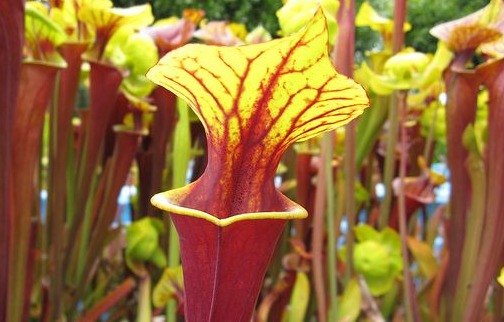
The green pitcher plant (scientific name: Sarracenia oreophila) is a carnivorous plant with a relatively large size and elegant bearing. Its leaves are pitcher-shaped and upright, with basal leaves. The insect-trapping leaves are long and tubular, up to 75cm long, yellow-green, with red veins. Its form is similar to the cage of a Nepenthes. Insects attracted by nectar lose their footing and fall into the pitcher, and the digestive fluid inside the pitcher digests and absorbs the insects.
The green pitcher plant (scientific name: Sarracenia oreophila) is a carnivorous plant with a relatively large size and elegant bearing. Its leaves are pitcher-shaped and upright, with basal leaves. The insect-trapping leaves are long and tubular, up to 75cm long, yellow-green, with red veins. Its form is similar to the cage of a Nepenthes. It can secrete nectar and digestive fluid. Insects attracted by nectar lose their footing and fall into the pitcher, and the digestive fluid inside the pitcher digests and absorbs the insects. It grows in lowland swamps. Plants of the genus Sarracenia have the habit of not fearing cold and are especially suitable for ordinary home cultivation without a greenhouse or conservatory. In addition, their strong reproductive capacity and easy management have made them widely popular potted carnivorous plants in European and American countries today. Wild plants are native to the southern United States.
Chinese Scientific Name: Green Pitcher Plant
Latin Scientific Name: Sarracenia oreophila
Alternative Name: Mountain Pitcher Plant
Kingdom: Plantae
Phylum: Angiosperms
Class: Dicotyledons
Order: Ericales
Family: Sarraceniaceae
Genus: Sarracenia
English Name: green pitcherplant
1. Morphological Characteristics
The green pitcher plant is a perennial herb with creeping rhizomes and many fibrous roots; the leaves form a rosette at the base, and the insect-trapping leaves are long and tubular, up to 20-75 cm long, funnel-shaped, yellow-green with red veins, with an ovate lid standing obliquely above the opening, and an opening diameter of 6 to 10 cm; the sword-shaped leaves are sickle-shaped, more than 50 cm long, and grow in autumn; the pitcher-shaped leaf has an insect-trapping pouch, the wall of the pouch is smooth at the opening and bears nectar glands that secrete sweet nectar to lure insects to come and fall into the pouch. The pouch wall is smooth and contains digestive fluid, which can secrete digestive enzymes to break down insects, and then absorb them through proteolytic enzymes decomposed from glands formed by parenchyma cells on the inner wall; in addition, in autumn and winter, pitcher plants grow sword-shaped leaves. These leaves have no insect-trapping pouch and produce nutrients only through photosynthesis. Each leaf bends at a right angle and has a hood-like leaf cover, bright green in color, similar in form to the cage of insect-catching Nepenthes. Inside the leaf cover there are nectar glands, providing insects with some nectar food. The pitcher stem of the green pitcher plant is very long and narrow, causing insects that fall into the pitcher pouch to slide further down, and the insects cannot fly out of the narrow tube. The pitcher stem leaves digest the soft parts of insects, but the hard shell parts remain.
The flowers of pitcher plants are bisexual. The inflorescence emerges from the base of the leaves and is a loose raceme composed of several large flowers. The flower center consists of 1 helmet-shaped stigma, a 3-5 locular ovary and 50-80 stamens. The flowers are yellow-green, with 5 sepals located below the petals. The fruit is a capsule containing many small seeds, which automatically split open and eject the seeds when mature. The flowers of the green pitcher plant open downward, and the petals are pale greenish-yellow to green, round, and the flowers are unscented. The flowering period is April to June. The seeds are sac-shaped, about 3 mm long, rough, and with many nodules on the surface.
2. Distribution
Distributed in northern Alabama, North Carolina and Georgia.
3. Conservation Status
Listed in the IUCN Red List ver 2.3: 2000 Critically Endangered species - Critically Endangered (CR).
4. Cultivation Techniques
Growing Requirements Plants of the genus Sarracenia grow in open swampy wetlands and like sufficient light, moist soil, and do not fear cold or relatively low air humidity. They are carnivorous plants that are easy to cultivate. Substrate: During the growing season, pitcher plants are more suitable for cultivation using the tray method. A mixed substrate of 1 part peat plus 1 part perlite or coarse sand can be used. During the dormant period, they need to be removed from the water tray and kept in a relatively dry state to prevent root rot. Pure sphagnum moss, or a mixed substrate of 2 parts peat plus 1 part perlite or coarse sand can also be used.
Water: Use a water source with low mineral concentration. During the growing season, the tray method is suitable for cultivation to maintain high substrate humidity.
Humidity: Pitcher plants do not have high air humidity requirements, and only need to be kept above 30%.
Temperature: The suitable growing temperature is 20-30 degrees. Below 10 degrees they will go dormant, and they can survive at 0-38 degrees.
Light: Pitcher plants are light-loving plants and can accept full sun, and light can make the plant's color vivid, but in summer, to avoid high temperatures, appropriate shading can be provided.
Nutrients: During the growing season, use a general compound fertilizer diluted four thousand times and spray it on the leaves or pour it into the pitcher to 1/3 of its height, 1-2 times per month.
Propagation Methods Division: Pitcher plants will grow lateral buds. When they grow large enough, separate them from the mother plant and cultivate them separately.
Cuttings: Both leaf cuttings and rhizome segment cuttings can be used for propagation. The leaves can be cut in half and peeled from the mother plant, then inserted obliquely into a clean substrate. Alternatively, cut the rhizome into 2.5 cm segments, apply fungicide to the cut surface, place them flat on a clean substrate, then cover with wet sphagnum moss, maintain high humidity and bright light, and buds can grow in about 2 months.
Sowing: The seeds of pitcher plants can be stored for a relatively long time, up to 3-5 years, but the germination time is also relatively long, requiring 2-4 months. Before sowing, they need low-temperature refrigeration (about 5 degrees) for 1-2 months, and the seeds need to be kept moist. They can be wrapped in a wet paper napkin or placed in wet sphagnum moss. To avoid mold, the sphagnum moss and seeds are best sterilized, and checked regularly (they can also be sown directly without refrigeration in winter or in spring when temperatures are low); after refrigeration, the suitable sowing temperature is 15-30 degrees. The seeds are directly sprinkled on the surface of a clean substrate, without covering with soil on the surface or covering with 1-3 mm of fine peat or fine akadama soil to help fix the root system. Maintain high humidity and bright light, and they will germinate in about 1 month (in rare cases they may also germinate after several months or even a year). It takes 3-5 years of growing to reach the adult plant stage.
5. Insect-Catching Method
Green Pitcher Plant
The pitcher-shaped leaves of pitcher plants are effective insect traps. The pouch-shaped pitcher leaves have vivid colors, and their openings often secrete sweet nectar to lure insects to come and feed. Once a deceived insect climbs to the top and tries to cross the pitcher mouth and crawl into the inner wall, because the inner wall is very slippery, it slides down into the pitcher and falls into the digestive fluid inside. Insects trying to crawl out of the pitcher are blocked by the barbed hairs on the inner wall, and eventually, unable to struggle any longer, fall back into the digestive fluid and drown. The digestive fluid of pitcher plants contains proteolytic enzymes secreted by the glands on the pitcher wall, which can dissolve the proteins of the drowned insect corpses and turn them into the nutrient amino acids absorbed by the pitcher wall.