How to grow Lycoris sprengeri? Cultivation methods and precautions
Soil
Lycoris sprengeri does not have high requirements for soil; generally, soil in gardens and grasslands will do. However, if you want the plant to grow vigorously, it is best to use loose, airy, fertile soil, as this not only benefits the plant's growth but also promotes flowering, and the flowers it produces will be even more brilliant. We can mix this kind of soil ourselves. Generally, mix 2 parts garden soil, 2 parts peat soil and 1 part perlite.
Fertilizing
Lycoris sprengeri also does not have high requirements for fertilizer, so mixing some base fertilizer into the soil before planting is very effective; this is a very good fertilizing measure, and the base fertilizer can be peat and perlite. For later topdressing, apply phosphorus and potassium fertilizer once every two months. For Lycoris sprengeri, you can first dissolve the solid fertilizer in water and then water it on; be careful not to make the concentration too high. If it is planted in a courtyard, you can dig holes on both sides, broadcast the fertilizer, and then irrigate.
Temperature
Lycoris sprengeri very much likes a warm growing environment, and its most suitable temperature is between 20-25°C. If the temperature is above 30°C or below 0°C, the plant will stop growing and enter a dormant state. Therefore, when summer temperatures are too high, be careful to provide the plant with appropriate shade. Generally, it is better to move the plant indoors, but also be careful to maintain ventilation to lower the temperature around the plant.
Water
After planting, Lycoris sprengeri should be watered, and at this time the soil should be watered thoroughly. During the subsequent growth period, generally wait until the soil is dry before watering, and water thoroughly each time. When the plant is in its vigorous growth period, appropriately increase watering, but be careful not to let water accumulate in the pot, so as to avoid root rot.
Cultivation methods
Trim off the residual roots of the bulb, place it in a cool, dry place to let the cut dry, and then it can be planted. When planting, the top of the bulb should be exposed above the soil surface. After it grows larger, the small bulbs on the bulb can be cut off, the wounds dried, and then transplanted in spring and autumn.
How to grow Lycoris sprengeri Cultivation methods and precautions for Lycoris sprengeri
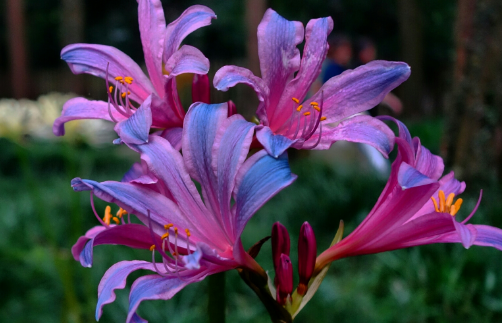
Lycoris sprengeri is a plant with very high ornamental value. Its flowers are slender and long, mostly pink and light purple in color, very beautiful, with an effect like a watercolor painting, faintly visible yet indistinct, giving people a fairyland-like feeling. So how exactly is this flower grown? What precautions are there? Let's take a look below.
How to grow Lycoris sprengeri
Lycoris sprengeri has strong adaptability and is easy to cultivate. It likes shade and moisture, is cold-resistant, and likes well-drained, fertile sandy soil. It has the habit of summer dormancy and winter dormancy. Lycoris sprengeri needs sufficient fertilizer, and before the flower stems and leaves grow, it should be fully watered and fertilized.
In winter, the bulbs do not need to be covered for warmth and can overwinter safely. There are very few pests and diseases, with occasional rot disease and yellow stripe virus disease. Before planting, the bulbs can be soaked in a 2% concentration potassium permanganate solution for 1 hour, dried, and then planted.
Cultivation methods and precautions for Lycoris sprengeri
1. Soil selection
Lycoris sprengeri does not have strict requirements for soil, and it can survive in general soil. However, choosing fertile, airy soil can make the plant grow more vigorously and the flower color more brilliant. Therefore, for the soil, garden soil, peat soil and perlite can be selected and mixed in a 2:2:1 ratio, and after mixing evenly it is ready.
2. Fertilizing measures
Lycoris sprengeri does not have very high requirements for fertilizer, so mixing base fertilizer into the soil before cultivation is a very effective fertilizing measure, and the base fertilizer can be peat and perlite.
For later topdressing, apply phosphorus and potassium fertilizer once every two months. For potted Lycoris sprengeri, you can first dissolve the solid fertilizer in water and then water it on; be careful not to make the concentration too high. If it is planted in a courtyard, you can dig holes on both sides, broadcast the fertilizer, and then irrigate.
3. Temperature control
Lycoris sprengeri likes a warm climate, and 20-25°C is most suitable for growth. If the temperature is above 30°C or below zero, the plant may enter a dormant state. Therefore, in the high-temperature summer season, plants in courtyards should be shaded, and potted plants can be moved indoors.
4. Water selection
After cultivation, Lycoris sprengeri should be watered thoroughly. During subsequent care, water when the surface of the potting soil is dry. During the growing period, the watering frequency can be appropriately increased, and irrigation can be used to keep the soil moist, but there must be no water accumulation.
Propagation methods of Lycoris sprengeri
Huanmianhua is mainly propagated by bulb division, using bulbs for separate planting in spring and the two seasons. Generally, divide the bulbs once every 4-5 years. Seed propagation is often done by autumn sowing; in the same year, young roots grow, in the following spring small bulbs sprout, in autumn young leaves emerge from the soil, and seedlings bloom after 5-6 years of cultivation.
Common diseases of Lycoris sprengeri and solutions
1. Anthracnose
In the early stage of anthracnose, there are several brown small spots on the leaf surface, distributed irregularly. In the later stage, the color of the lesions deepens and enlarges, becoming dark brown or black, and the center of the lesions sinks, called the spore aggregation area. Flower buds fall off and young shoots die.
Control methods: Strengthen management of the cultivation area, loosen the soil in time, and remove dead leaves; plant at a reasonable density and strengthen ventilation and light transmission; before planting, soak the bulbs in copper sulfate solution for 30 minutes, then wash with water, dry, and then plant; spray diluted 500-fold carbendazim wettable powder twice a month; if disease has already occurred, use diluted 2500-fold benlate agent for control.
2. Rot disease
If the soil for Lycoris sprengeri has poor air permeability or the environment has weak ventilation and light transmission, the bulbs are prone to rot, causing the whole plant to die.
Control methods: Plant at a reasonable density and increase ventilation and light transmission; before planting, soak the bulbs in potassium permanganate solution, which can greatly reduce the incidence of rot disease; if disease occurs, cut off the diseased parts as soon as possible, dry the wounds, and plant again in a pot.
The attractive Lycoris sprengeri is relatively easy to grow, so many friends plant some. However, some friends encounter disease problems when planting. In fact, there is no need to worry too much. The editor above has introduced several common disease prevention methods to everyone, and everyone just needs to pay more attention.
Lycoris sprengeri Lycoris sprengeri Comes ex Baker Lycoris sprengeri illustrated guide: how to grow Lycoris sprengeri / how to propagate Lycoris sprengeri
Lycoris sprengeri profileLycoris sprengeri Lycoris sprengeri Comes ex Baker
Cultivation methods and precautions for Lycoris sprengeri Introduction to Lycoris sprengeri
Lycoris sprengeri (scientific name: Lycoris sprengeri) is a plant in the genus Lycoris of the family Amaryllidaceae, and is endemic to China. It is native to the lower reaches of the Yangtze River and is distributed in Zhejiang, Hubei, Anhui, Jiangsu and other places in mainland China, often growing on shady and damp hillsides and in bamboo forests. The flowering period is August-September, with light purplish-red flowers, and the flower color is elegant.
Lycoris sprengeri is native to the lower reaches of the Yangtze River in China. It is cold-resistant and likes shady and damp environments, and can overwinter in the open field in the middle and lower reaches of the Yangtze River. It grows best in well-drained, fertile sandy loam soil. The aboveground parts have the habit of dormancy in summer and winter. It is mainly propagated by bulb division, using bulbs for separate planting in spring and the two seasons. It has strong adaptability and is easy to cultivate, and can grow in general soil. It is suitable for perennial mixed flower borders and clump planting under forests, and is also suitable for potted plants and cut flowers.
Morphological characteristics of Lycoris sprengeri
The bulb is oval, 3.5 cm in diameter, and the flower stem is 60 cm tall. The leaves are green, emerging in early spring, strap-shaped, 30 cm long and 1 cm wide. There are 2 involucral bracts, 3.5 cm long and 1.2 cm wide. 4-6 flowers form an umbel, and the tips of the tepal lobes are blue, with spreading edges, oblanceolate, 4.5 cm long and 1 cm wide. The flower tube is 1-1.5 cm long, the stamens are almost as long as the tepals, and the style is slightly longer than the tepals. The fruit is a capsule, with 3 ridges, dehiscing loculicidally; the seeds are black, nearly spherical, 0.5 cm in diameter.
The bulb is elliptical or nearly spherical. Leaves emerge in early spring, and the leaf blades are broadly linear with blunt tips. The flower stem is 30-45 cm tall; the inflorescence has 5-8 flowers: the flowers are 4.5-8 cm long; the perianth tube is 0.6-1.5 cm long, and the tepal lobes are light reddish-purple with blue tips, oblong-oblanceolate. The flowering and fruiting period is August-September.
A perennial bulbous herbaceous flower, flowering before leafing, with a broadly elliptical bulb. Leaves emerge in early winter, linear or strap-shaped, usually green, emerging from the base after the flowering period. The flowering period is August-September. The flower stem emerges before the leaves, about 30-40 cm tall, with 4-6 terminal flowers. Its flower shapes include lily type, daylily type, dragon-claw type and many others, and the flower colors include white, milky white, light lilac purple, purplish red, deep red, rose red, wheat-straw yellow, orange yellow, etc., as well as varieties with stripes or colored halos. The most common in daily life is the red Lycoris radiata with dripping red color and curled petals.
Ecological habits of Lycoris sprengeri
It is cold-resistant and likes shady and damp environments, and can overwinter in the open field in the middle and lower reaches of the Yangtze River. It grows best in well-drained, fertile sandy loam soil.
In winter the leaves are emerald green, and in summer and autumn the red flowers bloom in full glory. It is a good material for arranging flower borders, rockeries, rock gardens and for use as understory ground cover, and can also be used as cut flowers. It can be planted in courtyards, at the edges of lawns, beside forests, under sparse forests, or planted in patches; it can also be used as an edging plant along roadsides and flower beds, or dotted in rock crevices. The bulbs can be used as pesticide. Lycoris sprengeri pollen can be used as building coating. Lycoris sprengeri alkaloid can be used as medicine, and the seed bulbs can also be used as medicine, having the effects of resolving phlegm, promoting diuresis, detoxifying and inducing vomiting. It treats throat wind, edema, painful carbuncle and swelling toxins, ding sores and other conditions, but it is toxic and should be used with caution.
Most grow in shady and damp environments and are very shade-tolerant plants. Therefore, in garden design they can be widely used as understory ground cover plants. However, after many years of cultivation experiments, the above various strains are also very drought-tolerant. Under strong light and drought conditions, their flowering and leaf growth are good. In addition, they do not have strict requirements for soil conditions, but grow well, have many flowers and are gorgeous in fertile places. These ecological adaptations have opened up broad avenues for the application of various Lycoris strains.
Garden uses of Lycoris sprengeri
Most grow in shady and damp environments and are very shade-tolerant plants. Therefore, in garden design they can be widely used under forests. Lycoris sprengeri blooms in August-September, light purple, very elegant. It is suitable for perennial mixed flower borders and clump planting under forests, and is also suitable for potted plants and cut flowers.
The biggest shortcoming of plants in the genus Lycoris is that in May-June there will be bare woodland after the leaves wither and before flowering. Therefore, when configuring plants, the following three basic modes can be used:
1. Reineckea carnea, Ophiopogon japonicus, etc. + Lycoris sprengeri strains are suitable for greening shady and damp woodland
2. Ophiopogon japonicus, Liriope platyphylla, Ophiopogon bodinieri, etc. + Lycoris sprengeri strains are suitable for cultivation in strong light and dry soil
3. Annual low-growing flowers + Lycoris sprengeri strains are suitable for flower bed cultivation
When cultivating in garden green spaces, the general planting density is a plant spacing of 15-20 cm and a row spacing of 40 m, with 1 row of other evergreen species planted between rows, that is, 12-16 bulbs per sq m. When configuring, if the red strain with smaller bulbs and lower price is used as the base tone, it can be appropriately densified. With this configuration, the expected landscape effect can be achieved after planting.
Medicinal or dietary value of Lycoris sprengeri
The medical information and health dietary information on Hugarden are for reference only and cannot be used as a basis for diagnosis or medical treatment. Any health problems should be consulted with professional medical personnel, and the treatment of any disease should follow a doctor's advice.
Ultimate flower-protecting task: Love yourself, start from reality, and strictly follow a doctor's advice. For illness, do not be careless, do not delay, do not give up hope, face it bravely, warm the silent world with love, and care for the flower field in your heart with your heart.
The medical content on Hugarden is for reference only and cannot be regarded as professional advice. Any health problems should be consulted with professional medical personnel.
Medicinal information (1)
Medicinal material source: the bulb of the Amaryllidaceae plant Lycoris sprengeri.
Latin plant animal mineral name: Lycoris sprengeri Comes ex Bak.
Harvesting and storage: Harvest in spring, summer and autumn, wash clean, use fresh or slice and dry in the sun.
Original form: Lycoris sprengeri, a perennial herb. The bulb is oval, about 3.5 cm in diameter. Leaves emerge in early spring, strap-shaped, about 30 cm long and about 1 cm wide, green, with blunt tips. The flower stem is about 60 cm tall; there are 2 involucral bracts, about 3.5 cm long and about 1.2 cm wide; the umbel has 4-6 flowers, light purplish-red; the tepal lobes are oblanceolate, about 4.5 cm long and about 1 cm wide, the tips often tinged with blue, and the edges not wrinkled; the perianth tube is 1-1.5 cm long, rose red or purple; the stamens are nearly as long as the tepals, and the style slightly extends beyond the tepals. The capsule has three ridges and dehisces loculicidally; the seeds are nearly spherical, about 5 mm in diameter, black. The flowering period is August-September. Wild cattle are found on shady and damp hillsides or in bamboo forests.
[Habitat and distribution]
Ecological environment: wild in shady and damp hillsides or bamboo forests.
Resource distribution: distributed in Jiangsu, Anhui, Zhejiang, Hubei and other places.
[Chemical composition]: The bulb contains lycorine, lycorenin, galanthamine, etc.
[Nature and flavor]: Pungent; warm; toxic
[Functions and indications]: Detoxifying; resolving phlegm; promoting diuresis. Mainly for painful carbuncle and swelling toxins; throat wind; cough with phlegm and asthma; edema
[Usage and dosage]: External use: appropriate amount, pound and apply or decoct in water for fumigation and washing. Oral use: decoct in water, 2-5 g.
[Caution]: Those with weak spleen and stomach should take it with caution.
Distribution area of Lycoris sprengeri
Domestic distribution: Produced in Anhui, Jiangsu, Zhejiang, Hubei.
Native to the lower reaches of the Yangtze River, distributed in Zhejiang, Hubei, Anhui, Jiangsu and other places in mainland China, often growing on shady and damp hillsides and in bamboo forests.
Cultivation techniques for Lycoris sprengeri
Lycoris sprengeri has strong adaptability and is easy to cultivate. It likes shade and moisture, is cold-resistant, and likes well-drained, fertile sandy soil. It has the habit of summer dormancy and winter dormancy. Lycoris sprengeri needs sufficient fertilizer, and before the flower stems and leaves grow, it should be fully watered and fertilized. In winter, the bulbs do not need to be covered for warmth and can overwinter safely. There are very few pests and diseases, with occasional rot disease and yellow stripe virus disease. Before planting, the bulbs can be soaked in a 2% concentration potassium permanganate solution for 1 hour, dried, and then planted.
Requirements for the cultivation environment
Lycoris sprengeri loves a warm climate. For Lycoris sprengeri sown in the first ten days of the month, at this time the maximum temperature does not exceed 30°C, and the ten-day average temperature is 24°C, suitable for the growth of Lycoris sprengeri. Lycoris sprengeri likes sun and partial shade, likes moisture, is drought-tolerant, and slightly cold-tolerant. The soil should preferably be well-drained sandy loam and calcareous loam rich in humus.
Propagation methods of Lycoris sprengeri
Propagation: Mainly by bulb division, using bulbs for separate planting in spring and the two seasons. Generally, divide the bulbs once every 4-5 years. Seed propagation is often done by autumn sowing; in the same year, young roots grow, in the following spring small bulbs sprout, in autumn young leaves emerge from the soil, and seedlings bloom after 5-6 years of cultivation.
Cultivation: It has strong adaptability and is easy to cultivate, and can grow in general soil. Apply base fertilizer when planting, water fully before the flower stems are drawn or leaves emerge, and apply topdressing twice, which is beneficial for the neat emergence and growth of flower stems and leaves. In winter, the bulbs overwinter in the open field.
Disease control of Lycoris sprengeri
This flower rarely suffers from disease and insect damage. Sometimes rot disease and yellow stripe virus disease occur. Before planting, the bulbs can be soaked in a 2% potassium permanganate solution for 1 hour, dried, and then planted.
After flowering, the flower scapes should be cut off to reduce nutrient loss and keep the clump neat. Lycoris sprengeri is managed extensively and has very few pests and diseases. The common pest is white grubs, and when found, pesticides such as phoxim or trichlorfon should be used in time for control (use according to the instructions).
Cultural background and literature descriptions of Lycoris sprengeri
"Illustrated Investigation of Plant Names and Actuals" quotes "Nan Yue Notes" as saying: shed red changes to brocade, shed green changes to brocade, this is why it is named Huanmian. The leaves resemble narcissus, grow in winter, and fall when it changes. It alone sends up one stem about two chi tall, producing more than ten flowers. The flowers are larger than those of Lycoris aurea, either red or green, leaves fall and then flowers, hence shed red and shed green; flowers fall and then leaves, hence change to brocade, and flowers and leaves never see each other. According to this, it is a type of Lycoris. Only the flowers are more numerous and plump, and the stem is slightly different in thickness. An illustration is also attached. Based on the above morphological description and analysis of the attached illustration, what is described matches the Amaryllidaceae plant Lycoris sprengeri.
Research on family and genus
Lycoris is a perennial herbaceous plant genus. There are about surplus species in the world. According to the Flora of China, there are species in China, accounting for of the plants in this genus, mainly distributed south of the Yangtze River, especially with the most types in Jiangsu, Anhui and Zhejiang. The plants of this genus have brightly colored flowers and unique forms, and the flower color variation is very rich. For genetic improvement of plants in this genus, it is very promising to breed new cut flower varieties with Chinese characteristics; the bulbs of Lycoris contain various alkaloids such as lycorine and galantamine, and have high medicinal value.
Lycoris is a rather special group among monocotyledonous plants, mainly shown in: there are significant differences in the leafing period among different species. Some species produce leaves in late autumn, such as Lycoris albiflora, while another part of species unfold leaves in early spring, with phenological periods differing by several months, so they are divided into two types: autumn-leafing species and spring-leafing species, but their flowering periods are basically consistent; the vegetative growth period and reproductive growth period of plants in this genus are discontinuous, that is, they have obvious stages. When the summer temperature is higher, the leaves begin to wither until they fall, and entering autumn, the plants of this genus bloom one after another. Therefore, they present the strange phenomenon of having leaves without flowers and having flowers without leaves, which is very rare among flowering plants.
Another important characteristic of Lycoris plants is that chromosome morphology and number vary greatly, including diploids, triploids, tetraploids and aneuploids, and there is chromosome diversity. It can thus be seen that Lycoris plants are excellent experimental materials in research fields such as cytogenetics and developmental biology. Although China has abundant Lycoris germplasm resources, in-depth and systematic research on them has not been carried out. At present, there are still relatively large disagreements on issues such as the taxonomic status and systematic relationships of various taxonomic groups of Lycoris plants, especially the division of species within the genus. Although a large amount of research has been done on karyotype analysis of Lycoris plants, Liu Yan and Xu Bingsheng divided Lycoris plants into two major categories according to karyotype structure, one being species with a basic chromosome number with subterminal centromeres, and the other being species with terminal centromeres and median centromeres, but the evolution of chromosome karyotypes remains an unresolved issue.
Lycoris is a major resource advantage of China, and there are many natural hybrids, which has caused many difficulties for research on their classification and genetic relationships, and some characteristics used in taxonomic research are difficult to evaluate correctly. Some wild species, such as among species, have very similar morphological characteristics. Some scholars believe that! their different names may be synonyms, and the former was named earlier than the latter and should be used as the official name of this species, and it is only distributed in southern Japan and Taiwan, China! It is often identified as having the same geographical distribution but with great differences in chromosome number. Does it belong to the same species? It is very likely a natural hybrid, very consistent in morphology and karyotype, but with large variation in karyotype and chromosome number among individuals, making the two easily confused.
The morphological variation of Lycoris is complex, the morphological similarity among species is very high, and the change in chromosome ploidy is large, including diploids, triploids and allopolyploids, and the chromosome karyotype also has relatively large variation, all of which increase the difficulty of correctly classifying Lycoris. Lycoris plants can be divided into two major categories. The results are completely consistent with the karyotype research results. Each group is clustered into two major categories by individuals with the same chromosome number, consistent with the isozyme analysis results of Nie Liuwang et al. The first category is composed entirely of chromosomes of the subterminal centromere rod-shaped form, and is the F group chromosomes, with a basic chromosome number of; the second category has a chromosome karyotype entirely composed of two types of chromosomes.
Lycoris sprengeri pictures