How to grow blue daze? Detailed guide to care precautions
1. Pruning
Blue daze enters dormancy or semi-dormancy in winter, so weak branches, diseased branches, dead branches and dense branches should be cut off. Branch tidying can also be combined with cuttings.
2. Propagation methods
Blue daze is mainly propagated by seed sowing and cuttings.
3. Repotting
Blue daze grows very fast. When the plant grows larger, consider giving it a slightly bigger pot. We usually choose to repot in spring.
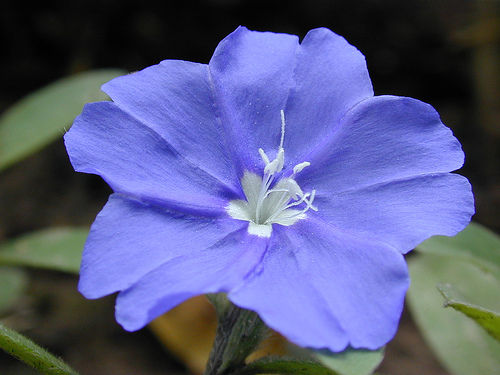
At this point, the introduction to blue daze growing methods comes to an end. After reading it, do you think it is simple? Is your method of growing blue daze correct? Blue daze blooms all year round, is easy to grow and is very popular!
How to grow blue daze? Growing methods and precautions for blue daze
Blue daze is a perennial plant of the genus Evolvulus in the Convolvulaceae family, and is a common potted ornamental flower indoors. Blue daze has small blue flowers, fresh and beautiful, with high ornamental value. So, how do you grow blue daze? The growing methods and precautions for blue daze are introduced below.
Image: blue daze
I. Growing methods for blue daze
1. Light and temperature:Blue daze likes sunlight and has strong adaptability to light, and can be grown in full sun or partial sun. When kept indoors, it should be exposed to sunlight and receive sufficient light. Insufficient light causes the plant to grow leggy and also affects flowering. Blue daze is native to subtropical regions. Its suitable growing temperature is 20-30 degrees. In winter, the overwintering temperature needs to be relatively high. Below 8°C it stops growing and enters dormancy.
2. Humidity requirements:Blue daze likes a relatively humid environment and requires air humidity between 50 and 70%. Air humidity must not be too low, otherwise the lower leaves of blue daze will turn yellow and fall off, and the upper leaves will lose their luster.
3. Water and fertilizer management:Water is very important to blue daze. Spring, summer and autumn are the growing seasons for blue daze, so sufficient water must be given, especially in summer, when the plant must not lack water. When temperatures are high, watering can be increased. In winter blue daze enters dormancy, so watering frequency can be reduced. Since the flowering period of blue daze can be said to last all year, blooming almost all four seasons, fertilizer needs to be replenished frequently. During the growing season, a little more fertilizer can be added appropriately. Note that some organic fertilizer should be added when potting, and quick-acting fertilizer should be applied regularly every month.
Image: blue daze
II. Precautions for growing blue daze
1. Pruning:Blue daze enters dormancy or semi-dormancy in winter, so weak branches, diseased branches, dead branches and dense branches should be cut off. Branch tidying can also be combined with cuttings.
2. Propagation methods:Blue daze is mainly propagated by seed sowing and cuttings.
3. Repotting:Blue daze grows very fast. When the plant grows larger, consider giving it a slightly bigger pot. Repotting can be done in spring.
[Editor's concluding remarks]Blue daze likes humid or semi-dry environments and requires a growing environment humidity of 50%-70%, which needs special attention during care. The above has introduced the growing methods and precautions for blue daze, and we hope it will be helpful to everyone!
Growing methods and precautions for blue daze
Chinese scientific name: blue dazeLatin scientific name: blue dazeOther names: star flower, umbrella flowerKingdom: PlantaePhylum: AngiospermsClass: DicotyledoneaeSubclass: AsteridaeOrder: SolanalesFamily: ConvolvulaceaeGenus: EvolvulusDistribution area: AmericasBlue daze is a perennial semi-trailing evergreen shrub. Its flowering period lasts all year, and it is suitable for courtyard landscaping, flower beds, potted plants or ground cover. It is native to the Americas. It likes sunlight and fertile sandy soil. If light is insufficient, the branches tend to grow leggy and flowering is also poor. Water supply is also very important; if it lacks water for a long time, the plant is not easy to recover. The flowers of blue daze only bloom in the morning and are all gone by the afternoon, not a single one left.1. Morphological characteristics
Leaves: Leaves alternate, oblong, entire, with the underside densely covered with white hairs.Stem: Plant height 30-60 cm. Stem semi-trailing, densely covered with white hairs.
Flowers: Flowers axillary, gamopetalous, corolla five-lobed blue, with a white star shape in the center. It can bloom all year round.
Semi-trailing evergreen small shrub. It likes high temperatures and requires good sunlight. Plant height 30-60 cm, stems and leaf undersides densely covered with white hairs. Leaves alternate, oblong, entire. Flowers axillary, gamopetalous, corolla blue, with a white star shape in the center. It can bloom all year round.
2. Growing environment
It likes humid or semi-dry climatic environments and requires the air relative temperature of the growing environment to be 50-70%. When the air relative humidity is too low, the lower leaves turn yellow and fall off, and the upper leaves lose their luster. It has strict requirements for winter temperature. When the ambient temperature is below 8°C, it stops growing.3. Distribution
Native to the Americas.4. Cultivation techniques
Seed propagation
I. Seed selectionBefore sowing, the seeds must first be selected. Whether the seeds are selected well or not directly affects whether sowing can succeed.
1. It is best to use seeds collected in the current year. The longer the seeds are stored, the lower their germination rate.
2. Choose seeds that are plump and free of defects or deformities.
3. Choose seeds free of pests and diseases.Disinfection:Disinfection includes two concepts: one refers to disinfecting the seeds, and the other refers to disinfecting the sowing substrate. For household seed disinfection, it is common to soak the seeds in hot water at about 60°C for a quarter of an hour, then use warm hot water to promote germination for 12-24 hours. To disinfect the sowing substrate, the best method is to put it in a pot and heat it until hot; any pests and diseases will be killed by the heat.
II. Germination promotion
Soak the seeds in warm hot water (temperature similar to face-washing water) for 12-24 hours, until the seeds absorb water and swell. For very common seeds that germinate easily, this step can be skipped.
III. Sowing
For tiny seeds that are difficult to pick up with hands or other tools, you can moisten one end of a toothpick with water, stick the seeds one by one onto the surface of the substrate, cover with substrate 1 cm thick, then place the sowing pot into water with the water depth at 1/2-2/3 of the pot height, and let the water slowly soak upward (this method is called the "pot soaking method"); for larger seeds that can be picked up with hands or other tools, place the seeds directly into the substrate and sow them in spots at a spacing of 3 x 5 cm. After sowing, cover with substrate to a thickness of 2-3 times the seed size. After sowing, use a sprayer or a fine-nozzle watering can to moisten the sowing substrate. Later, when the potting soil is slightly dry, water again. Still be careful that the force of watering is not too strong, so as not to wash the seeds up;
IV. Management after sowing
After sowing in late autumn, early spring or winter, when encountering a cold wave and low temperatures, the pot can be wrapped with plastic film to help keep warm and retain moisture; after the seedlings emerge, uncover the film in time, and let the seedlings receive sunlight before 9:30 every morning or after 3:30 in the afternoon, otherwise the seedlings will grow very weak; after most of the seeds have emerged, proper thinning is needed: pull out the diseased and unhealthy seedlings so that the remaining seedlings have a certain amount of space between them; when most of the seedlings have grown 3 or more leaves, they can be transplanted.