How to sow Allium giganteum? Teach you the correct sowing method
1. Generally, the seeds begin to mature in late July at the height of summer, at which point they can be harvested, then placed in a cool, shaded spot until autumn sowing.
2. Sowing usually begins from mid-September to late October. Allium giganteum seeds are highly adaptable, and loose, well-aerated garden soil is best, so first turn and prepare the soil.
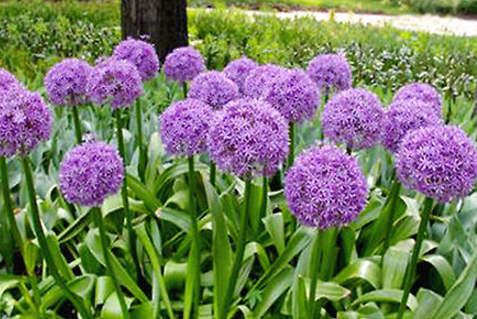
3. Then sow by broadcasting; the seeds can be mixed with moist sand and scattered onto the soil, without burying them too deeply.
4. Cover the sown area with a thin layer of soil and water lightly. They will germinate in about a week.
Is Allium giganteum easy to grow? Allium giganteum planting methods
Allium giganteum, also known as Ji'an flower, giant onion, tall onion, and great onion, is a perennial bulbous flower of the genus Allium in the Amaryllidaceae family. It originates from Central Asia and the Mediterranean region, and in China it is mainly distributed in the northern regions. As a variety used for decorating and beautifying flower borders, rock gardens, or lawnsides, it has high ornamental value. Let us take a look at how to grow Allium giganteum below!
Growth habits of Allium giganteum
Allium giganteum originates from Central Asia and the Mediterranean region, and in China it is mainly concentrated in the northern regions. Its flowering period is spring and summer. It likes a cool environment with plenty of sunlight, and dislikes hot, humid, and rainy conditions, continuous cropping, and semi-shade. The suitable temperature is 15-25°C. It requires loose, fertile sandy loam and dislikes waterlogging, making it suitable for cultivation in the northern regions of China.
Propagation methods of Allium giganteum
1. Seed propagation: After the seeds of Allium giganteum mature in early July, collect them and dry them in the shade, store them at a low temperature of 5-7°C, sow in autumn from September to October, and they will germinate and emerge in March of the following year. In summer, the aboveground parts also wither, forming small bulbs. Seedling plants require about 5 years of cultivation before they can bloom.
2. Division propagation: Bulb division propagation is carried out in summer and autumn. Peel off the daughter bulbs around the main bulb, and choose a cultivation site with a low groundwater table, good drainage, and loose, fertile sandy loam. Each mother bulb can be divided into 1-3 small bulbs, among which the larger bulbs can bloom in the second year after planting.
Cultivation methods of Allium giganteum
1. Allium giganteum is a flower with an extremely low natural bulb multiplication rate, but if the flower stalk is removed as early as possible after it appears, so that nutrients are concentrated on the development of the renewal bulb and daughter bulbs, the number of small bulbs can be appropriately increased. In summer, when the aboveground parts die, the bulbs can be dug out, separated by size, and placed in a ventilated spot to overwinter the summer.
2. Allium giganteum is planted after autumn. Bulbs reaching more than 3 cm can bloom after planting, while those smaller than 3 cm need to be grown for one year before they can bloom. Regarding the bulb multiplication rate, Allium giganteum likes a cool environment with plenty of sunlight, requires loose, fertile sandy loam, dislikes waterlogging, and is suitable for cultivation in the northern regions of China.
3. For open-field cultivation of Allium giganteum, choose a cultivation site with a low groundwater table, good drainage, and loose, fertile sandy loam. The best time to plant the bulbs is from mid-to-late September to early October, with a plant spacing of 20 x 30 cm. The planting depth is such that the soil covering the bulb is 2-3 times the height of the fresh bulb.
4. After planting Allium giganteum, press the hole surface slightly flat, then water. In winter, there is no need to cover for cold protection. In the following spring, when the leaves emerge in March, loosen the soil and water in time, and with liquid topdressing, water once every 10-15 days. Pay attention to intertillage, soil loosening, and weeding. In dry-air locations, appropriately add a small amount of artificial misting or shading, which can ease the yellowing of leaves in early summer.
5. After flowering, the stems and leaves of Allium giganteum wither. Dig up the bulbs early before the rainy season arrives to avoid rotting after rain. Dry them in a ventilated, dry place and then store them, spread out in a ventilated indoor spot. Wait until September to October to plant. The planting site should not be continuously cropped. Pay attention to applying decomposed organic fertilizer. Summers are rainy, so drainage must be timely. Allium giganteum is named for its huge inflorescence.
Allium giganteum seed sowing method, sowing time September and October
Allium giganteum can also be propagated by sowing seeds. Sowing is generally best carried out in September and October. The steps of the seed sowing propagation method for Allium giganteum are organized below.
Allium giganteum seed sowing method 1. Sowing timeThe seed sowing time for Allium giganteum is best in September and October, as the temperature at this time is more suitable for the germination of Allium giganteum seeds.
2. Sowing soilThere is no strict selection for the soil used for sowing Allium giganteum; generally, loess and clay are both acceptable. It is recommended not to use sandy soil, because the seedling emergence rate in sandy soil may not be very good.
3. Sowing methodAllium giganteum can be sown by broadcasting. First wet the fine sand, mix it with the seeds, and blend evenly. Scatter the seeds onto the soil surface; there is no need to bury them too deeply. It is not recommended that flower lovers sow in bad weather.
After sowing the Allium giganteum seeds, you can cover the seeds with a thin layer of soil, and simply gather the surrounding soil over with your hands. The thickness of the thin soil layer should not exceed 4 cm. Once everything is done, the next step is irrigation. When watering, do not wash directly, to avoid washing the seeds away. After sowing Allium giganteum, it can sprout in about one week to ten days.
4. Later-stage care after sowinga. When the young shoots of Allium giganteum develop into small seedlings, just carry out normal daily maintenance; no special care is needed, because varieties of Allium giganteum do not suffer from major diseases.
b. Allium giganteum needs careful management before flowering, and requires an additional 50 to 60 jin of fertilizer. Sufficient nutrition can extend the flowering period, and the number of flowers will also be greater, giving better ornamental value.
c. The soil should be kept moist, but there must be no water accumulation. When the soil looks dry, replenish water in time. When cultivating in a nursery, pay attention to sufficient light, and provide appropriate shading in summer. After Allium giganteum blooms, there is no need to add fertilizer.