A detailed guide to growing King Protea, easy enough for beginners to learn
The first aspect - light
King Protea likes an environment with plenty of light, so make sure King Protea gets enough light; it is generally placed on a balcony or in a ventilated, sunny spot.
The second aspect - soil
The soil for planting King Protea needs to be loose, well-draining sandy soil, as this is good for the growth of King Protea.
The third aspect - watering
King Protea likes a dry environment and dislikes waterlogging, so watering should be moderate and not excessive, so that King Protea does not get root rot.
The fourth aspect - fertilizing
King Protea does not have high fertilizer requirements, so there is no need to fertilize King Protea often; fertilizing just once in spring and once in autumn is enough.
The fifth aspect - pest and disease control
King Protea is relatively prone to insect pests and diseases, so once pests are found, insecticide should be sprayed immediately to kill the pests; if King Protea is found to have a disease, the diseased branches should be cut off immediately and then a repair solution applied to prevent the disease from occurring again.
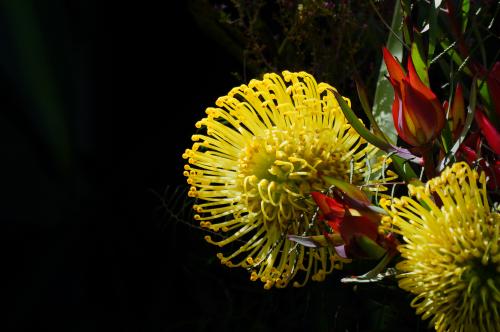
How to care for King Protea
First, soil selection
The soil for planting King Protea needs to be loose, well-draining sandy soil, as this is good for the growth of King Protea.
Second, plenty of light
King Protea likes an environment with plenty of light, so make sure King Protea gets enough light; it is generally placed on a balcony or in a ventilated, sunny spot.
Third, proper watering
King Protea likes a dry environment and is not tolerant of wet conditions, so watering should be moderate and not excessive, so that King Protea does not rot.
Fourth, fertilizing frequency
King Protea does not have high fertilizer requirements, so there is no need to fertilize King Protea often; fertilizing just once during the growing period is enough.
Alright, the above is the introduction to King Protea propagation methods that the editor has prepared for everyone. Have you learned it? Thank you for reading!
King Protea growing methods and flower meaning
King Protea can be planted in courtyards; its small leaves can droop and close, just like a person acting shy, and the name of this plant, King Protea, is very apt. King Protea originates from tropical regions and is widely planted; it can grow well in open fields and wastelands. What are the growing methods and flower meaning of King Protea? Let us introduce them below.
King Protea growing methods and flower meaning1. King Protea growing methods —— roots
King Protea is a taproot plant and does not have many roots itself, so the direct sowing method is better; if the root-moving method is used, it will cause damage to the roots. So even if the roots must be moved, the more suitable method is to wait until the seedling is relatively healthy and strong before moving it to a pot.
2. King Protea growing methods —— sowing
To sow the shy plant, first choose a suitable growing medium, press and level the soil, then use a spray bottle to spray all the soil thoroughly. After the water has seeped down, the seeds can be scattered into the soil. After sowing the seeds, plant the seeds in a shallow pot, then cover the surface with soil, just enough to cover the seeds. After that, cover with plastic film to maintain soil moisture, and place the potted soil in a bright, indirect-light environment at around 20 degrees, and that is enough.
3. King Protea growing methods —— seedlings
After King Protea sprouts, remove the covering from the top of the pot so the sprouts can be surrounded by sunlight. When the seedlings grow to about 3 cm, they can be transplanted out of the shallow pot, and after that they can be planted into individual pots; otherwise they are not easy to survive.