A Detailed Guide to Growing and Caring for Kerria japonica
Soil
Kerria japonica loves to grow in fertile, loose sandy loam, so when planting it is best to grow Kerria japonica in loose, well-drained acidic sandy soil.
Watering
Kerria japonica has a low demand for water, so it does not need much watering normally, and no watering is needed during the rainy season, to avoid water accumulating at the roots and causing rot. In the hot summer, water evaporates too quickly, so water frequently, and you can spray water mist into the air or onto the leaves to keep them moist and prevent the potting soil from becoming too dry.
Temperature
Kerria japonica likes a warm, humid environment, and its suitable growing temperature is between 10°C and 25°C; in winter, if the temperature is too low, it should be moved indoors to grow.
Fertilizing
Potted Kerria japonica needs to be watered with cake fertilizer solution in the afternoon, but not too much; during the growing period of Kerria japonica, apply 1-2 applications of liquid fertilizer as appropriate according to the plant's growth condition.
After understanding how to grow Kerria japonica, we also need to know the following points for attention.
Points for Attention When Growing Kerria japonica
During the growth of Kerria japonica, dead branches need to be pruned away in time. When dieback of Kerria japonica branches is found, they should be pruned away immediately, otherwise bacterial infection will occur and spread to the roots, causing the whole plant to die. After Kerria japonica loses its leaves, dead branches will also appear, and more pruning is needed at this time. Note that the growth of Kerria japonica requires nutrients, so it also needs frequent repotting. In cold regions, such as north of the Yangtze River basin, potted plants need to be repotted about once every 3 years, combined with root trimming and division, to renew old and weak branches.
The above is an introduction to the growing methods of Kerria japonica. If you want to learn more, please pay more attention to the Four Seasons Plants website!
Introduction to Kerria japonica, growing methods for Kerria japonica, care knowledge for Kerria japonica
Kerria japonica, also known as Fengtang flower. Kerria japonica can be planted in the ground or in pots. Kerria japonica also has two varieties, one is the double-flowered Kerria japonica, and the other is the white Kerria japonica. The former has layer upon layer of petals and looks like a small ball, and is a variety with ornamental value. The white Kerria japonica is relatively rare and is highly admired by Japanese people. Let's learn about the planting methods for Kerria japonica below.
Morphological Characteristics of Kerria japonica
Kerria japonica is a deciduous shrub, 1-2 m tall, rarely up to 3 m; branchlets green, cylindrical, hairless, often arching and drooping, young branches angular. Leaves alternate, triangular-ovate or ovate, apex long acuminate, base rounded, truncate or slightly cordate, margin sharply double-serrate, both sides green, upper side hairless or sparsely pubescent, lower side pubescent along the veins or in the vein axils; petiole 5-10 mm long, hairless; stipules membranous, band-shaped lanceolate, fringed with hairs, falling early. Flowers solitary, borne at the apex of lateral branches of the current year, pedicels hairless; flowers 2.5-6 cm in diameter; sepals ovate-elliptic, apex acute, with a small tip, entire, hairless, persistent in fruit; petals yellow, broadly elliptic, apex concave, 1-4 times longer than the sepals. Achenes obovate to hemispherical, brown or dark brown, surface hairless, wrinkled. Flowering period April-June, fruiting period June-August. Leaves ovate to ovate-lanceolate, 2-10 cm long, 1.5-4 cm wide, apex acuminate, base rounded or slightly cordate, margin sharply double-serrate, surface hairless or sparsely short-pubescent, lower side or along the veins and between the veins with short pubescence.
Ecological Habits of Kerria japonica
Kerria japonica likes warm, humid and semi-shaded environments, has poor cold tolerance, and is not strict about soil; it grows best in fertile, loose sandy loam, and grows in mountain slope scrub at an altitude of 200-3000 m. Kerria japonica is native to China from North China to South China; it likes warm, humid and semi-shaded environments, has poor cold tolerance, and is not strict about soil; it grows best in fertile, loose sandy loam. It is commonly propagated by division, cuttings and sowing. Division is suitable for double-flowered varieties. Cuttings are divided into spring hardwood cuttings and plum rain season softwood cuttings. Kerria japonica can be planted in the ground or in pots. Transplanting or repotting should be done before spring germination (February to March) or during October, and the original soil should be retained. When transplanting, base fertilizer should be applied to encourage more new branches and more flower buds.
Propagation Methods of Kerria japonica
Kerria japonica is propagated by division, cuttings and sowing.
Key Points for Rapid Propagation
In spring, collect one-year-old branches as explants for rapid propagation, and propagate them directly on an intelligent seedling bed; in the growing season, collect current-year semi-lignified young branches as explants, keep 1-2 leaves at the upper end, or use one leaf and one bud, and propagate them on a seedling bed with river sand or perlite as the substrate, and turn on the intelligent rapid propagation system; the survival rate reaches 100%.
Division
Often used for double-flowered varieties, carried out from after leaf fall in autumn to before germination in spring. Propagation method: division is mainly by division propagation, and the mother plant does not need to be dug out. It is carried out in early spring and late autumn; use a knife or shovel to directly separate new plants each with 1-2 branches from the mother plant in the soil, take them out and transplant them; the mother plant left in the soil can be divided again the next year. Double-flowered Kerria is suitable for the division propagation method.
Cuttings
During the plum rain season, cut young branches for cuttings; for early spring cuttings, use hardwood cuttings (March) with one-year-old branches that have not germinated. In the plum rain season, around June, use softwood cuttings, using robust current-year branches, keep half of the leaves, and the cuttings are 12-450px long, inserted into brown soil, matured soil or sandy soil; if inserted in the open field, shade is needed to prevent drying.
Sowing
Suitable for single-flowered varieties, germinating about 20 days after sowing. The sowing propagation method is only used when mass-propagating the single-flowered original species. After the seeds are harvested, they need low-temperature sand storage at 5°C for 1-2 months, and are sown the following spring. After sowing, cover with fine soil and mulch with grass; after seedlings emerge, build a shed for shade.
The above is all the content about Kerria that I have learned today. I hope flower lovers will find it helpful after reading this article. If you want to learn more about Kerria, please continue to follow Duorou Huapu, and we will provide you with more related knowledge!
Growing Methods for Kerria japonica, Disease Control for Kerria japonica
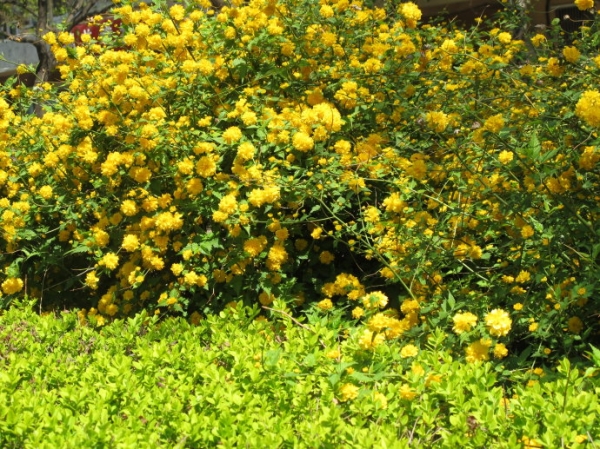
Kerria blooms with golden flowers all over the tree, with a unique charm; besides being ornamental, it can also be used as medicine and has effects such as reducing swelling, relieving pain, relieving cough, and aiding digestion. So how do you grow Kerria japonica? Let's take a look at the growing methods for Kerria japonica.
I. Growing Methods for Kerria japonica
Kerria japonica sprouts in mid-March, and it is generally suitable to transplant before sprouting; after planting, attention should be paid to pruning dead branches and old branches. During the growing period, fertilize once every 2 months, and comprehensively renew once every 2-3 years by pruning off the aboveground part to encourage more new branches. When cultivating in the north, soil should be mounded in winter to prevent dead shoot tips.
Propagation Methods of Kerria japonica: Kerria japonica is propagated by division, cuttings and sowing.
1. Key points for rapid propagation: In spring, collect one-year-old branches as explants for rapid propagation, and propagate them directly on an intelligent seedling bed; in the growing season, collect current-year semi-lignified young branches as explants, keep 1-2 leaves at the upper end, or use one leaf and one bud, and propagate them on a seedling bed with river sand or perlite as the substrate, and turn on the intelligent rapid propagation system; the survival rate reaches 100%.
2. Division: Often used for double-flowered varieties, carried out from after leaf fall in autumn to before germination in spring. Propagation method: division is mainly by division propagation, and the mother plant does not need to be dug out. It is carried out in early spring and late autumn; use a knife or shovel to directly separate new plants each with 1-2 branches from the mother plant in the soil, take them out and transplant them; the mother plant left in the soil can be divided again the next year. Double-flowered Kerria is suitable for the division propagation method.
3. Cuttings: During the plum rain season, cut young branches for cuttings; for early spring cuttings, use hardwood cuttings (March) with one-year-old branches that have not germinated. In the plum rain season, around June, use softwood cuttings, using robust current-year branches, keep half of the leaves, and the cuttings are 12-450px long, inserted into brown soil, matured soil or sandy soil; if inserted in the open field, shade is needed to prevent drying.
4. Sowing: Suitable for single-flowered varieties, germinating about 20 days after sowing. The sowing propagation method is only used when mass-propagating the single-flowered original species. After the seeds are harvested, they need low-temperature sand storage at 5°C for 1-2 months, and are sown the following spring. After sowing, cover with fine soil and mulch with grass; after seedlings emerge, build a shed for shade.
II. Disease Control for Kerria japonica
1. Yellow leaf disease: Symptoms: at the onset, the young leaves at the top of the plant first turn yellow, and the leaf surface tissue becomes yellow or light yellow, but the leaf veins remain green; as the disease worsens, the entire leaf turns yellow or yellowish-white, and the leaf margin becomes grayish-brown and dies.
Control method: In the early stage of the disease, irrigate the roots with a 200-fold ferrous sulfate solution, and spray with a 0.5% ferrous sulfate solution, once every 10 days; after 3-4 consecutive irrigations and sprays, the symptoms can be noticeably improved.
2. Brown spot disease symptoms: In the early stage of the disease, grayish-brown lesions appear on the leaf margins, and the lesions expand in an irregular shape, grayish-brown inside and reddish-brown at the edges; in the later stage of the disease, the lesions dry up, turn brown, and bear black granular bodies.
Control method: Spray with a 800-fold 75% chlorothalonil wettable granule solution, or a 400-fold 70% mancozeb wettable granule solution, or a 500-fold 50% anilazine wettable granule solution, once every 11 days; 3-4 consecutive sprays can effectively control the disease.
The above isGrowing Methods for Kerria japonica, and I hope it is helpful to everyone. Friends who like Kerria japonica can try planting some.