How does Protea propagate? An introduction to common propagation methods
Method one - cutting propagation. First, choose suitable branches for cuttings. Generally, semi-lignified branches from the upper part of the protea plant are selected as cuttings. After cutting the branches off, let them dry in the sun for two days. Once the wounds have healed, insert the branches into pre-prepared soil, and finally just wait for the branches to take root.
Method one - cutting propagation
First, choose suitable branches for cuttings. Generally, semi-lignified branches from the upper part of the protea plant are selected as cuttings. After cutting the branches off, let them dry in the sun for two days. Once the wounds have healed, insert the branches into pre-prepared soil, and finally just wait for the branches to take root.
Method two - seed propagation
When sowing protea, it is generally done in autumn. First, collect the protea seeds, then soak the seeds for a while, then plant the protea seeds into the soil, then keep the soil moist, and finally just wait for the seeds to take root and sprout.
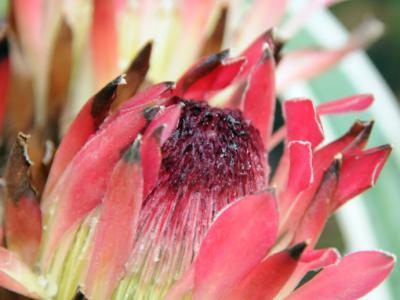
Protea. Protea illustrated guide: how to grow protea / how to propagate protea
Protea profileProtea
Protea cultivation methods and precautions. Introduction to protea
Protea, a shrub, also known as sugarbush, commonly called "wood lily flower" or "longan flower", native to South Africa, is the national flower of the Republic of South Africa.
Protea (Protea cynaroides), with its enormous flower heads, exceptionally beautiful colors and elegant form, stands out among the world's precious flowers. Protea is a perennial, multi-stemmed evergreen shrub plant, and the plant's lifespan can reach over 100 years. This variety is suitable for planting in gardens or pots, is also an excellent cut flower, and is also suitable for making dried flowers. The stamens in the protea flower head can remain open for a very long time, which makes it a dazzling sight in the garden for several weeks, and as a cut flower it can also be displayed for a long time. This is precisely the real reason why protea is regarded by South Africans as "ever-blooming", and it is also because of this that it is loved and admired by the vast number of flower and flower-arranging enthusiasts in China. The fresh flower of protea is actually a flower head, with many flower centers in the middle, surrounded by huge, richly colored bracts. The diameter of the flower head varies between 12 cm and 30 cm. In one growing season, a large and sturdy protea plant can produce 6-10 flower heads, and individual plants can produce 40 flower heads in one growing season. The color of the flower head bracts varies from milky white to deep red, but light pink bracts with a slight silvery sheen are the most popular and admired.
Morphological characteristics of protea
It has thick stems and glossy leaves, and when the plant is mature it is about 1 m tall. Its fresh flower is actually a flower head, with many stamens, surrounded by huge, richly colored bracts. The flower head diameter is 12-30 cm. In one growing season, one protea plant can produce 6-10 flower heads.
Linden flower, shrub - has thick stems, glossy leaves, and when the plant is mature it is about 1 m tall. Its fresh flower is actually a flower head, with many stamens in the center, wrapped by huge, richly colored bracts, and the diameter of the flower head varies between 12 cm and 30 cm. In one growing season, a good linden flower plant can produce 6-10 flower heads, and individual plants can produce 40 flower heads in one growing season. The color of the flower head bracts varies from milky white to deep red, but light pink bracts with a slight silvery sheen are the most popular and admired. With its enormous flowers, exceptionally beautiful colors and elegant form, the linden flower stands out as one of the world's precious flowers, known as the king of flowers.
Ecological habits of protea
Protea likes a warm, slightly dry and sunny environment. It is not cold-tolerant, prefers well-drained water, and dislikes waterlogging. It requires loose, well-drained acidic soil. In winter the temperature is generally not lower than 7 degrees, and individual varieties can tolerate around zero degrees. The soil for seedlings needs good drainage. During the growing period, summer requires a cool and dry climate, and appropriate shading during strong sun. The suitable growth temperature is 27 degrees. In winter it needs a warm, sunny environment with slightly higher air humidity. In winter the temperature must not be lower than 7°C. Individual varieties can tolerate around 0°C.
Distribution range of protea
Protea is distributed throughout South Africa and is the most popular and widely planted flower among the people. It can adapt to different soil types, from sea level to high mountains at 2000 m. Protea varies greatly in the size and color of its leaves and bracts. Protea is dioecious, and its flowering period is very long (from May to December). Together with its richly colored leaves and the bracts surrounding the flower buds, this makes it a very attractive ornamental tree species for gardens.
The flower series to which protea belongs
The PROTEA flower series is mostly produced in the winter-rainfall regions of South Africa. It is a vast family of flowering plants, including protea, duke flower (small protea), princess flower (ruifan) and the wood lily series, etc. Among the world's precious flowers, PROTEA (KING) - protea, stands out with its enormous flower heads, gorgeous colors and elegant form, and is known as the king of flowers. This variety is suitable both for garden or pot planting and as an excellent cut flower or dried flower.
Protea cynaroides is of course the most well-known variety in the PROTEA family, and is also praised as the most luxurious and magnificent cut flower in the world. In South Africa, protea is even revered as the national flower. In fact, it has almost become synonymous with the PROTEA flower series.
Related varieties of protea: wood lily
Leucadendron is also one of the most widely distributed varieties in the PROTEA family. It can adapt to different soil types and grows on high mountains from sea level to 2000 m. Leucadendron varies greatly in the size and color of its leaves and bracts. Leucadendron is dioecious, which is very rare in the PROTEA family. Its flowering period is very long (May-December), and together with its richly colored leaves and the bracts surrounding the flower buds, it makes a very attractive garden tree species.
Leucadendron is a multi-branched shrub with very strong rhizomes, and can sprout and grow quickly even after being damaged by fire. Under natural conditions, Leucadendron can grow to a height of 0.75-2 m. Changes in growing climatic conditions, such as from the warm-winter climate of plain areas to the ice, snow and frost weather of high mountains; as well as changes in leaves and bracts, such as from yellow-green to bright orange-red, Leucadendron can "adapt", making it a main choice variety for horticultural planting. In addition, it can also tolerate heavy pruning and can meet the needs of large-scale cut flower production.
Leucadendron has many varieties, with great differences in growth form, leaf and bract color, flowering time and other aspects. Some varieties are obtained through hybridization. "Sunshine" is the most famous Leucadendron hybrid variety and has become an export flower of some countries; it is a tall, upright, vigorously growing multi-branched shrub that can grow to a height of 2.5 m; from autumn all the way to late spring, on long stems, "Sunshine" can produce deep red bracts, and when flowering these bracts open to set off the cream-colored flower centers, exceptionally beautiful.
In recent years, PROTEA has only occasionally made a "stunning appearance" in the flower markets of large Chinese cities during festivals and holidays, mostly imported from the Netherlands or Australia, but because the price is very expensive, ordinary people can only sigh in admiration. If this deeply loved famous flower could enter ordinary households, the potential market would be enormous. In addition, South Africa's production is limited, while international market demand is very large, and China's seasons are exactly opposite to South Africa's. If China can successfully cultivate it, it will greatly alleviate international market demand and achieve good returns when seasonal supply is short.
Waratah
The first person to describe the morphology of the waratah was the British botanist James Edward Smith, published in his 1793 book on Australian plants, A Specimen of the Botany of New Holland, using herbarium specimens provided by the British military doctor and plant collector John White. He named the waratah Embothrium speciosissimum. In 1810 the British botanist Robert Brown moved it to another genus and changed it to its current scientific name Telopea speciosissima. The species epithet speciosissima is taken from the Latin word speciosus, meaning beautiful, handsome, describing that the flowers of this species look very beautiful.
waratah was originally the English common name of this species, and later also became a general term for plants of the genus Telopea and its closely related genus Alloxylon (Tree Waratah). This name originates from the Eora, the local Aboriginal people of Sydney.
Wild waratah grows in deep sandy soil. When cultivated artificially, as long as the soil is well drained, they can adapt very well, especially on hillsides with a slight slope that can help drainage, which is best. Although wild plants grow under open woodland, when cultivated it is best to plant them in full sun so that the flowers grow better.
Waratah is a very popular flower in Australia. In northern Sydney and the Dandenong Ranges near Melbourne, there are farms cultivating this plant to harvest cut flowers for sale. In other regions, such as New Zealand, Hawaii and Israel, there are also farms producing this flower.
Some naturally occurring variant forms have been selected and grown, as in the following varieties:
'Corroboree' - red flowers. 'Shady Lady White' - white flowers. 'Wirrimbirra White' - white flowers. The following varieties are hybrids:
'Braidwood Brilliant' - a cold-tolerant variety. Parents are waratah and T. mongaensis (Monga waratah). 'Shade of Pale' - parents are waratah and T. oreades (Victorian waratah). 'Shady Lady Crimson' - deep red flowers. 'Shady Lady Red' - red flowers. 'Shady Lady Pink' - pink flowers. The parents of the above three are waratah and T. oreades.
Garden uses of protea
Protea is one of the most widely distributed varieties in the PROTEA family and can grow on high mountains from 0 m above sea level up to 1500 m. Different climatic conditions and geographical environments can cause great changes in protea leaves, flower shape, flower color and flowering time; in commercial cultivation, even under the same growing conditions, protea retains these characteristics. This enables protea, when grown as a cut flower, to adapt to market demand around the world for protea in different seasons, and under suitable soil types it is widely and successfully grown as a garden flower or cut flower.
Linden flower is a perennial, multi-stemmed evergreen shrub plant, and the plant's lifespan can reach over 100 years. Its branches and leaves are luxuriant, the flowers are large, the bracts and petals are upright, the colors are exceptionally gorgeous, and the ornamental period is long. It is suitable for potted viewing and is also an excellent material for cut flowers and dried flowers. The stamens in the linden flower flower head can remain open for a very long time, which makes it a dazzling sight in the garden for several weeks, and as a cut flower it can be displayed for a long time. This is precisely the real reason why linden flower is regarded by South Africans as ever-blooming, and it is also because of this that it is loved and admired by the vast number of flower and flower-arranging enthusiasts.
Protea is an evergreen shrub with luxuriant branches and leaves, large flowers, upright bracts and petals, exceptionally beautiful colors, and a long ornamental period. It is suitable for potted viewing and is also an excellent material for cut flowers and dried flowers. The soil for seedlings needs good drainage.
Medicinal or dietary therapeutic value of protea
The medical information and health dietary therapy information on Hugarden Network is for reference only and cannot be used as a basis for diagnosis or medical treatment. Any health problem should be consulted with professional medical staff, and the treatment of any disease should follow a doctor's advice.
The ultimate flower-protecting task: to love yourself, start from reality and follow a doctor's advice. Toward illness, do not be careless, do not delay, do not give up hope, face it bravely, warm the silent world with love, and care for the flower field in your heart with your heart.
The medical content on Hugarden Network is for reference only and cannot be regarded as professional advice. Any health problem should be consulted with professional medical staff.
Medicinal information (1) Brewing and taste
Linden seed flower tea is made by brewing dried flowers. The golden tea is filled with a delicate sweet fragrance, and the taste
on the palate is mild and mellow. It has the effects of promoting digestion, relaxing nerves, inducing sweating and diuresis, and lowering blood pressure. It is beneficial for reducing cold
fever, soothing nasal mucosa inflammation and sore throat, and preventing arteriosclerosis. When brewing, use 10 pieces, and when drinking you can
add honey to taste. Drinking linden seed flower tea can improve insomnia and is suitable for drinking before bed.
Chemical structure
Alcohols - farnesol
Effects
Antispasmodic, astringent, cough-relieving, mind-clearing, nasal congestion-relieving, diuretic, skin-softening, blood pressure-lowering, nerve-soothing, sedative, sweating-promoting, tonic.
Spiritual effects
Makes one completely relaxed and can bring you deep, sound sleep.
South Africa and protea
In South Africa there are more than 350 species of protea, of which more than half grow in the Cape Floral Kingdom. The best place to admire protea is the Cape of Good Hope Nature Reserve on the Cape Peninsula. Protea has become the preferred variety of South Africa's wild flower industry. Among these widely cultivated varieties, there are great differences in growth form, leaf and bract color, flowering time and other aspects. Some varieties are obtained through hybridization. "Sunshine" is the most famous protea hybrid variety and has become South Africa's main export flower. The flower color and height of protea are praised worldwide as the most luxurious and magnificent cut flower, and this is also the main reason why it is revered as the national flower in South Africa.
Propagation methods of protea
Propagation: mainly by sowing and cutting. For sowing, often carried out in autumn, sow seeds mixed with New High Lipid Film, keep moist after sowing, and after emergence they must not be too wet; when slightly dry and 1 pair of true leaves appears, transplant into pots and place in a ventilated place with sufficient light for care.
Cultivation: the soil for seedlings needs good drainage. During the growing period, summer requires a cool, dry climate, and appropriate shading during strong sun. In winter it needs a warm environment with sufficient sunlight and slightly higher air humidity. During the flowering period and the peak growth period, water appropriately and apply fertilizer once each in spring and autumn. During the growing period, spray Flower Promoter No. 3, which can transform the plant's vegetative growth function into reproductive function, inhibit excessive growth of the main shoot, promote flower bud differentiation, more flowering, more fruit set, and promote development. Then during the young fruit stage, spray Fruit Pedicel Strengthener to increase nutrient delivery. Prevent the occurrence of flower drop, fruit drop, stiff fruit and deformed fruit. Make the fruit brightly colored, beautiful in shape and good in taste.
Disease and pest control of protea
Leaf spot disease often occurs, and pests include scale insects and whiteflies. Rotate spraying multiple targeted pesticides to avoid resistance. Add New High Lipid Film to the pesticide to enhance the control effect.
Protea pictures
Protea Protea cynaroides (L.) L. Protea illustrated guide: how to grow protea / how to propagate protea
Protea profileProtea Protea cynaroides (L.) L.
Aliases: linden flower, wood lily flower, longan flower
Classification: shrub flower
Family and genus: Plantae, Angiosperms, Dicotyledons, Proteales, Proteaceae, Protea
Flowering period: summer, autumn, winter
Protea, also known as Putiya flower and linden flower, is the national flower of the Republic of South Africa. Its flowers are enormous, the flower shape is peculiar, magnificent and colorful, noble and elegant, and it is known as the "king of flowers". The ever-blooming protea is praised as the most luxurious and magnificent cut flower in the world, representing vigorous and tenacious vitality, and symbolizing victory, completeness and auspiciousness. Protea is a shrub, also known as, commonly called "wood lily flower" or "longan flower", native to South Africa, and is the national flower of the Republic of South Africa. With its enormous flower heads, exceptionally beautiful colors and elegant form, protea stands out among the world's precious flowers. Protea is a perennial, multi-stemmed evergreen shrub plant, and the plant...
Protea cultivation methods and precautions. Introduction to protea
Protea, also known as Putiya flower and linden flower, is the national flower of the Republic of South Africa. Its flowers are enormous, the flower shape is peculiar, magnificent and colorful, noble and elegant, and it is known as the "king of flowers". The ever-blooming protea is praised as the most luxurious and magnificent cut flower in the world, representing vigorous and tenacious vitality, and symbolizing victory, completeness and auspiciousness.
Protea is a shrub, also known as, commonly called "wood lily flower" or "longan flower", native to South Africa, and is the national flower of the Republic of South Africa.
With its enormous flower heads, exceptionally beautiful colors and elegant form, protea stands out among the world's precious flowers. Protea is a perennial, multi-stemmed evergreen shrub plant, and the plant's lifespan can reach over 100 years. This variety is suitable for planting in gardens or pots, is also an excellent cut flower, and is also suitable for making dried flowers. The stamens in the protea flower head can remain open for a very long time, which makes it a dazzling sight in the garden for several weeks, and as a cut flower it can also be displayed for a long time. This is precisely the real reason why protea is regarded by South Africans as "ever-blooming", and it is also because of this that it is loved and admired by the vast number of flower and flower-arranging enthusiasts in China.
The fresh flower of protea is actually a flower head, with many flower centers in the middle, surrounded by huge, richly colored bracts. The diameter of the flower head varies between 12 cm and 30 cm. In one growing season, a large and sturdy protea plant can produce 6-10 flower heads, and individual plants can produce 40 flower heads in one growing season. The color of the flower head bracts varies from milky white to deep red, but light pink bracts with a slight silvery sheen are the most popular and admired.
Protea likes a warm, slightly dry and sunny environment. It is not cold-tolerant, prefers well-drained water, and dislikes waterlogging. It requires loose, well-drained acidic soil. It can grow on high mountains from 0 m above sea level up to 1500 m. Different climatic conditions and geographical environments can cause great changes in protea leaves, flower shape, flower color and flowering time, and it has strong ornamental value and medicinal and edible value.
Morphological characteristics of protea
Protea has thick stems and glossy leaves, and when the plant is mature it is about 1 m tall. Its fresh flower is actually a flower head, with many stamens, surrounded by huge, richly colored bracts. The flower head diameter is 12-30 cm. In one growing season, one protea plant can produce 6-10 flower heads.
Protea is a shrub with thick stems, glossy leaves, and when the plant is mature it is about 1 m tall. Its fresh flower is actually a flower head, with many stamens in the center, wrapped by huge, richly colored bracts, and the diameter of the flower head varies between 12 cm and 30 cm. In one growing season, a good linden flower plant can produce 6-10 flower heads, and individual plants can produce 40 flower heads in one growing season. The color of the flower head bracts varies from milky white to deep red, but light pink bracts with a slight silvery sheen are the most popular and admired. With its enormous flowers, exceptionally beautiful colors and elegant form, the linden flower stands out as one of the world's precious flowers, known as the king of flowers.
Protea is a perennial, multi-stemmed evergreen shrub plant. Its fresh flower is actually a flower head, with many stamens, surrounded by huge, richly colored bracts.
The flower head diameter of protea is 12-30 cm. The diameter of the flower head varies between 12 cm and 30 cm. In one growing season, a large and sturdy protea plant can produce 6-10 flower heads, and individual plants can produce 40 flower heads in one growing season. The color of the flower head bracts varies from milky white to deep red. It has thick stems and glossy leaves, and when the plant is mature it is about 1 m tall.
Ecological habits of protea
Protea likes a warm, slightly dry and sunny environment. It is not cold-tolerant, prefers well-drained water, and dislikes waterlogging. It requires loose, well-drained acidic soil. In winter the temperature is generally not lower than 7 degrees, and individual varieties can tolerate around zero degrees. The soil for seedlings needs good drainage. During the growing period, summer requires a cool and dry climate, and appropriate shading during strong sun. The suitable growth temperature is 27 degrees. In winter it needs a warm, sunny environment with slightly higher air humidity. In winter the temperature must not be lower than 7°C. Individual varieties can tolerate around 0°C.
The soil for protea seedlings needs good drainage. During the growing period, summer requires a cool and dry climate, and appropriate shading during strong sun. The suitable growth temperature is 27 degrees. In winter it needs a warm, sunny environment with slightly higher air humidity.
Wild waratah grows in deep sandy soil. When cultivated artificially, as long as the soil is well drained, they can adapt very well, especially on hillsides with a slight slope that can help drainage, which is best. Although wild plants grow under open woodland, when cultivated it is best to plant them in full sun so that the flowers grow better.
Protea cultivation techniques and key cultivation points
The soil for protea seedlings needs good drainage. During the growing period, summer requires a cool, dry climate, and appropriate shading during strong sun. In winter it needs a warm environment with sufficient sunlight and slightly higher air humidity. During the flowering period and the peak growth period, water appropriately and apply fertilizer once each in spring and autumn.
During the growing period, spray Flower Promoter No. 3 on protea, which can transform the plant's vegetative growth function into reproductive function, inhibit excessive growth of the main shoot, promote flower bud differentiation, more flowering, more fruit set, and promote development. Then during the young fruit stage, spray Fruit Pedicel Strengthener to increase nutrient delivery. Prevent the occurrence of flower drop, fruit drop, stiff fruit and deformed fruit. Make the fruit brightly colored, beautiful in shape and good in taste.
Propagation methods of protea
Protea propagation is mainly by sowing and cutting.
Seed propagation
Often carried out in autumn. Sow seeds mixed with New High Lipid Film, keep moist after sowing, and after emergence they must not be too wet; when slightly dry and 1 pair of true leaves appears, transplant into pots and place in a ventilated place with sufficient light for care.
Cutting propagation
Select a protea mother plant and cut branches above the semi-lignified position as cuttings, keeping 4-6 leaves. The substrate is a mix of peat and perlite at a volume ratio of 4:6, adjusted to pH 5.5-6.5 and EC value less than 0.5. Soak the base of the cuttings in a 1000 ppm indole-3-butyric acid solution, soak for 15 minutes, then air-dry immediately. The insertion depth is 1/3-1/4 of the cutting length. After cutting, manage according to conventional techniques, and after emergence transplant to the field.
Disease and pest control of protea
Leaf spot disease often occurs in protea, and pests include scale insects and whiteflies. Rotate spraying multiple targeted pesticides to avoid resistance. Add New High Lipid Film to the pesticide to enhance the control effect.
Related variety of protea: Sunshine
Protea is the most famous protea hybrid variety and has become South Africa's main export flower. The flower color and height of protea are praised worldwide as the most luxurious and magnificent cut flower, and this is also the main reason why it is revered as the national flower in South Africa.
Wood lily
Leucadendron is also one of the most widely distributed varieties in the PROTEA family. It can adapt to different soil types and grows on high mountains from sea level to 2000 m. Leucadendron varies greatly in the size and color of its leaves and bracts. Leucadendron is dioecious, which is very rare in the PROTEA family. Its flowering period is very long (May-December), and together with its richly colored leaves and the bracts surrounding the flower buds, it makes a very attractive garden tree species.
Leucadendron is a multi-branched shrub with very strong rhizomes, and can sprout and grow quickly even after being damaged by fire. Under natural conditions, Leucadendron can grow to a height of 0.75-2 m. Changes in growing climatic conditions, such as from the warm-winter climate of plain areas to the ice, snow and frost weather of high mountains; as well as changes in leaves and bracts, such as from yellow-green to bright orange-red, Leucadendron can "adapt", making it a main choice variety for horticultural planting. In addition, it can also tolerate heavy pruning and can meet the needs of large-scale cut flower production.
Leucadendron has many varieties, with great differences in growth form, leaf and bract color, flowering time and other aspects. Some varieties are obtained through hybridization. "Sunshine" is the most famous Leucadendron hybrid variety and has become an export flower of some countries; it is a tall, upright, vigorously growing multi-branched shrub that can grow to a height of 2.5 m; from autumn all the way to late spring, on long stems, "Sunshine" can produce deep red bracts, and when flowering these bracts open to set off the cream-colored flower centers, exceptionally beautiful.
In recent years, PROTEA has only occasionally made a "stunning appearance" in the flower markets of large Chinese cities during festivals and holidays, mostly imported from the Netherlands or Australia, but because the price is very expensive, ordinary people can only sigh in admiration. If this deeply loved famous flower could enter ordinary households, the potential market would be enormous. In addition, South Africa's production is limited, while international market demand is very large, and China's seasons are exactly opposite to South Africa's. If China can successfully cultivate it, it will greatly alleviate international market demand and achieve good returns when seasonal supply is short.
Waratah
The first person to describe the morphology of the waratah was the British botanist James Edward Smith, published in his 1793 book on Australian plants, A Specimen of the Botany of New Holland, using herbarium specimens provided by the British military doctor and plant collector John White. He named the waratah Embothrium speciosissimum. In 1810 the British botanist Robert Brown moved it to another genus and changed it to its current scientific name Telopea speciosissima. The species epithet speciosissima is taken from the Latin word speciosus, meaning beautiful, handsome, describing that the flowers of this species look very beautiful.
waratah was originally the English common name of this species, and later also became a general term for plants of the genus Telopea and its closely related genus Alloxylon (Tree Waratah). This name originates from the Eora, the local Aboriginal people of Sydney.
Wild waratah grows in deep sandy soil. When cultivated artificially, as long as the soil is well drained, they can adapt very well, especially on hillsides with a slight slope that can help drainage, which is best. Although wild plants grow under open woodland, when cultivated it is best to plant them in full sun so that the flowers grow better.
Waratah is a very popular flower in Australia. In northern Sydney and the Dandenong Ranges near Melbourne, there are farms cultivating this plant to harvest cut flowers for sale. In other regions, such as New Zealand, Hawaii and Israel, there are also farms producing this flower.
The flower series to which protea belongs
The PROTEA flower series is mostly produced in the winter-rainfall regions of South Africa. It is a vast family of flowering plants, including protea, duke flower (small protea), princess flower (ruifan) and the wood lily series, etc. Among the world's precious flowers, PROTEA (KING) - protea, stands out with its enormous flower heads, gorgeous colors and elegant form, and is known as the king of flowers. This variety is suitable both for garden or pot planting and as an excellent cut flower or dried flower.
Protea is of course the most well-known variety in the PROTEA family, and is also praised as the most luxurious and magnificent cut flower in the world. In South Africa, protea is even revered as the national flower. In fact, it has almost become synonymous with the PROTEA flower series.
Distribution range of protea
Protea is distributed throughout South Africa and is the most popular and widely planted flower among the people. It can adapt to different soil types, from sea level to high mountains at 2000 m.
Protea varies greatly in the size and color of its leaves and bracts. Protea is dioecious, and its flowering period is very long (from May to December). Together with its richly colored leaves and the bracts surrounding the flower buds, this makes it a very attractive ornamental tree species for gardens.
Uses and purposes of protea: ornamental value
Protea has enormous flowers, a peculiar flower shape, magnificent and colorful colors, and noble elegance, with strong ornamental value and medicinal and edible value.
Commercial value
Different climatic conditions and geographical environments cause great changes in protea leaves, flower shape, flower color and flowering time. In commercial cultivation, even under the same growing conditions, protea retains these characteristics. This enables protea, when grown as a cut flower, to adapt to market demand around the world for protea in different seasons, and under suitable soil types it is successfully grown as a garden flower or cut flower.
Garden uses of protea
Protea is an evergreen shrub with luxuriant branches and leaves, large flowers, upright bracts and petals, exceptionally beautiful colors, and a long ornamental period. It is suitable for potted viewing and is also an excellent material for cut flowers and dried flowers.
The king protea is one of the most widely distributed members of the Protea family, able to grow from sea level up to mountains 1500 m high. Different climatic conditions and geographical environments cause great variation in the leaves, flower shape, flower color and flowering time of the king protea; in commercial cultivation, the king protea retains these characteristics even under identical growing conditions. This allows the king protea, when grown as a cut flower, to meet market demand around the world for king proteas at different times of year, and under suitable soil types it is widely and successfully grown as a garden flower or cut flower.
The sugarbush is a perennial, multi-stemmed evergreen shrub whose lifespan can reach more than 100 years. It has lush branches and leaves, large flowers, upright bracts and petals, and exceptionally brilliant colors, with a long ornamental period. It is suitable for potted display and is also an excellent material for cut flowers and dried flowers. The stamens in the flower head of the sugarbush can remain open for a very long time, making it a dazzling sight in the garden for several weeks; as a cut flower it can be displayed for a long time. This is precisely the real reason the sugarbush is regarded by South Africans as never fading in bloom, and for this reason it is loved and admired by many flower and flower-arranging enthusiasts.
The king protea is an evergreen shrub with lush branches and leaves, large flowers, upright bracts and petals, and exceptionally beautiful colors, with a long ornamental period. It is suitable for potted display and is also an excellent material for cut flowers and dried flowers. The soil for seedlings needs good drainage.
The dietary therapy or medicinal value of the king protea
The medical information and health dietary therapy information on Huahua Network is for reference only and cannot be used as a basis for diagnosis or medical treatment. For any health problem, consult professional medical personnel, and for the treatment of any disease, follow the doctor's advice.
Ultimate flower-protecting mission: to love yourself, start from reality and strictly follow the doctor's advice. Toward illness, do not be careless, do not delay, do not give up hope; face it bravely, warm the silent world with love, and care for the flower field in your heart with care.
Medicinal information
Effects
Antispasmodic, astringent, cough-relieving, mind-clearing, nasal congestion-relieving, diuretic, skin-softening, blood pressure-lowering, nerve-soothing, sedative, sweat-promoting, tonic.
Brewing and taste
Linden flower tea is made by brewing dried flowers. The golden-yellow tea is filled with a delicate sweet fragrance, and the taste on the palate is mild and mellow. It helps promote digestion, relax the nerves, induce sweating and urination, and lower blood pressure, and is beneficial for relieving colds and fever, easing nasal mucosal inflammation and sore throat, and preventing arteriosclerosis. To brew, use 10 pieces, and add honey to taste when drinking. Drinking linden flower tea can improve insomnia and is suitable for drinking before bed.
Chemical structure
Alcohols - farnesol
Spiritual effects
It allows complete relaxation and can bring you deep, sound sleep.
The king protea's South Africa and the king protea
In South Africa there are more than 350 species of king protea, and more than half of these species grow in the Cape Floral Kingdom. The best place to admire king proteas is the Cape of Good Hope Nature Reserve on the Cape Peninsula. The king protea has become the preferred species of South Africa's wild flower industry. Among these commonly cultivated species, there are great differences in growth form, the color of leaves and bracts, flowering time and other aspects. Some species are obtained through hybridization.
The king protea is the most famous king protea hybrid and has become South Africa's main export flower. The flower color and height of the king protea are praised worldwide as the most noble and magnificent cut flower, which is also the main reason it is respected as the national flower in South Africa.
The king protea as national flower and city flower
The king protea is the national flower of the Republic of South Africa.
With its huge flower head, brilliant colors and elegant form, the king protea stands out and is known as the king of flowers.
The flower language of the king protea
The flower language of the king protea: victory, completeness, wealth and good fortune.
King protea pictures