What should be noted when growing peonies?
1. Flowers with strong, robust plants and strong resistance are easier for us to grow and reduce the difficulty of our management. When planting peonies, do not choose peonies with odd plant shapes.
2. The peony is a symbol of wealth and prosperity and needs careful care. Only by taking management measures according to the specific condition of the plant can the peony be grown both healthy and beautiful.
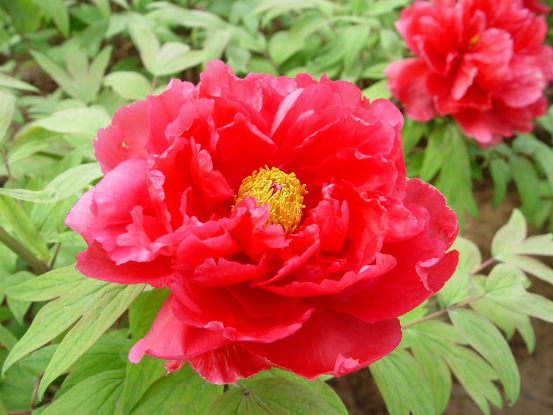
The above is the editor's introduction to the appearance and methods of the peony flower. After reading it, do you not find it quite easy? Is your method of growing peonies correct? I hope this article is helpful to flower lovers who grow peonies.
How to grow peonies: peony growing methods and precautions
Peonies have bright flower colors and are very ornamental. Placed indoors, they can add color to our environment. So, how should we grow peonies? Below, let me explain the peony growing methods and precautions.
Peony growing methods
1. Soil: Peonies are suitable for loose, fertile soil with a deep soil layer. The soil's drainage capacity must be good. For potted plants, general potting soil can be used. The soil pH value is best neutral; slightly acidic or slightly alkaline is also acceptable.
2. Temperature: Peonies are cold-resistant and not tolerant of high temperatures. In East China and the central region, they can overwinter outdoors. When the temperature reaches 4°C, the flower buds begin to gradually swell. Suitable temperature: 16~20°C; below 16°C they will not bloom. During high summer temperatures, the plant enters a semi-dormant state.
3. Light: Camellias prefer shade, peonies prefer sun. Peonies like sunlight but do not like being scorched. When planted in the ground, choose a higher, east-facing sunny spot. Potted plants should be placed on a sunny east-facing balcony. If placed on a south balcony or rooftop platform, shade must be provided on the west side.
4. Planting: Peonies are deep-rooted flowering trees and shrubs. Before planting, deep plowing should be carried out, and base fertilizer should be applied (such as bone meal, oil cake, chicken manure, etc.).
5. Watering: Peonies should not be watered too much. Generally, do not water in winter. After May, the weather gradually becomes hotter. If there is drought and the ground is dry, water moderately, but it is better to keep them dry than wet. Water only after the soil is dry.
6. Fertilizing: It is best to fertilize 3 times each year. The first time is when new shoots emerge and the leaves and flower buds are extending, mainly with quick-acting fertilizer; the second time is after the flowers fade, still mainly with quick-acting fertilizer; the third time is in autumn and winter, mainly with base fertilizer.
7. Pruning and trimming: After the flowers fade, cut off the spent flowers. To make the crown low and the flowers dense, pruning can be done before July to avoid branches being too dense and affecting flowering. It is advisable to keep 5-6 main branches per plant.
Precautions for growing peonies
1. The most suitable season for planting peonies
For potted peonies, it is recommended to cultivate them from September to October, which is best. For home growing, varieties such as Luoyang Hong and Hu Hong are recommended, as they have somewhat stronger adaptability to the environment. Peonies can also be propagated by sowing, but with the sowing method of growing, it takes 4-5 years to bloom.
2. The flowering period of peonies
April to May each year is the flowering period of peonies. If grown well, the normal flowering period is about 105 days, and in some cases it will be longer. Of course, temperature and climate will both affect the flowering period of peonies. When peonies bloom, a shed cover can be set up or they can be temporarily placed indoors to avoid direct sunlight; this can prolong the flowering period. For main branches whose terminal buds are leaf buds, these should be removed to avoid excessive vegetative growth and affect flowering.
3. Management after the flowering period
After the flowers fade, the flowers should be removed in time and the branches pruned. At the same time, apply a wound healing and antiseptic film to the pruning cuts to protect the wounds and prevent pathogen invasion and infection. If you want the plant to be low and the flower clusters dense, then prune back more heavily to inhibit branch expansion and root suckering. Generally, it is advisable to retain 5-6 branches per plant.
4. Growth habits of peonies
Generally, peonies in the south require special attention to temperature and light, because peonies are deep-rooted flowers, like sunlight, are cold-resistant, and relatively prefer a cool environment. They are suitable for growing in loose, fertile, well-drained sandy soil.
Because peonies have relatively long roots and larger plants, they are suitable for ground planting. If potting is desired, choose a large clay pot with good water permeability, with a pot depth of more than 30 cm. It is best to use a clay jar with a depth of 60-70 cm.
The weather in the south is hot and dry. During high summer temperatures, prevent peonies from being exposed to the sun and take cooling measures in time. Some flower lovers report that the peonies they grow do not bloom. Here is a reminder: if the temperature is not controlled well and the plant is allowed to overheat and drop leaves, this will seriously affect future flowering.
5. Root rot problems
Root rot in peonies is mostly caused by watering. During rainy seasons, drain water in time; there must be no standing water, and the plants should be moved indoors. In hot seasons, generally watering about once every 10 days or so is enough.
Do not fertilize too frequently; 2-3 times within a year is enough. In early March, when the flower buds and leaves are extending, fertilize once in order to increase and enlarge the flowers; in late May, just after the flowers fade, fertilize once to replenish nutrients. Stop watering before applying fertilizer. At the same time, be careful not to splash the fertilizer solution onto the branches and leaves. If it has already splashed on them, rinse them clean with clear water.
The above is the introduction to peony growing methods and precautions for everyone. I hope it can help everyone. For more home knowledge, please stay tuned.
Precautions and methods for growing peonies: methods and tips for growing peonies
When peonies are mentioned, the first cities everyone thinks of must be Luoyang and Heze, right? Peonies have beautiful flower colors and charming fragrance, and are deeply loved by many flower lovers. But did you know? There are also many precautions and methods for planting peonies. Today, the editor will introduce them to everyone in detail. Let us learn together.
Preparatory work
According to the growth characteristics of peonies, the potting soil should preferably be loose, fertile, high in humus content, long-lasting in fertilizer effect, and easy to drain. A relatively ideal potting soil formula is to mix humus soil, horse manure, garden soil, and coarse sand or furnace slag in a ratio of 2:1:2:1 and mix evenly. Then seal and compost it with human urine and feces until rotted, and set aside for later use.
Watering
The amount of water should be moderate. After planting, water thoroughly once immediately. Afterward, depending on whether the soil is dry or wet, water once every 3-4 days to keep the potting soil moist. In summer when it is dry, water in the early morning or at night. In autumn, as long as it is not too dry, there is no need to water. If too wet, the buds grow vigorously and sprout in autumn, and they will not bloom the following spring.
Fertilizing
Topdressing can begin in the spring of the second year, using sesame, peanut, or bean cake soaked in water and fermented before use. When applying, dilute with water. During the growing period, apply fertilized water 1-2 times per week; before flowering and during the flowering period, watering can be done once a day; after the flowers fade, it is advisable to nourish the flowers and apply a light fertilizer or spray fertilizer on the leaves. No topdressing is needed during the winter dormant period.
Summer and drainage
Peonies are averse to prolonged rain, excessive moisture, and hot summer heat. During the hottest part of midsummer, potted peonies can be moved under a seedling shed for shade, or they can be buried together in the soil to prevent heat and lower the temperature, while maintaining good drainage and ventilation. On rainy days, turn the flower pots upside down to prevent standing water in the pots. After flowering, spray once every 10-15 days with 150-times Bordeaux mixture or 800-1000-times Topsin solution to prevent leaf diseases.
The above is all the content I have learned today about peonies. I hope flower lovers will find it helpful after reading this article. If you want to learn more about peonies, please continue to follow Duorou Huapu, and we will provide you with more related knowledge!