Detailed Explanation of the Shaping Methods and Techniques for Firethorn Bonsai
Firethorn bonsai should adopt the shaping method of coarse wiring and fine pruning, generally carried out in autumn. First, use iron wire or palm fiber to coarsely bend the main trunk into different forms such as slanting trunk or lying trunk. After cultivating for a period of time, prune and shape the layers of the bonsai according to the design, so that the entire tree form has distinct layers and charm. During the maintenance process, we need to observe the growth of the firethorn more, think more, and repeatedly carry out pruning, shaping, pinching, and bud removal and other operations to maintain a beautiful tree form.
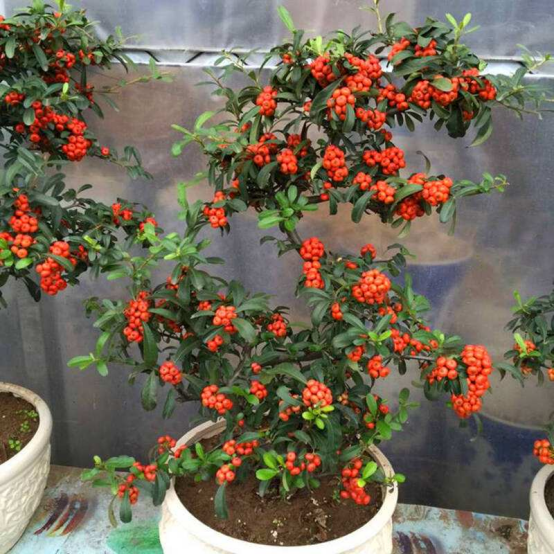
At this point, the production method of firethorn bonsai comes to an end. Is it much simpler than you imagined? I hope the editor's introduction is helpful to you!
How to Make Firethorn Bonsai: Production Methods for Firethorn Bonsai
Firethorn bonsai has luxuriant branches and leaves, and is an excellent home potted plant for viewing flowers in spring and viewing fruit in autumn. Many flower enthusiasts cultivate it at home, but many people do not know how to make firethorn bonsai. Today, I will explain the production methods for firethorn bonsai.
1. Collecting the stump
Firethorn has strong growth ability, and generally wild old stumps up to a hundred years old are collected as the seedling source for bonsai production. The branches of this kind of old stump sprout easily. In spring, almost all buds will germinate, but the formed branches are relatively weak. Usually only 1-2 buds at the top can germinate and grow into strong mature branches of more than 45cm. The newly grown branches have good flexibility and can withstand wiring in all directions. Even if there is a slight sound, there is no need to worry about breaking, and they can be pruned into various shapes.
2. Cuttings
Cutting time:
This time is not certain. Some believe it is September, while others carry it out in spring or the plum rain period. Under normal circumstances, it differentiates flower buds in July and August, and this process is basically completed in September. At this time, the temperature is still relatively high and gradually becomes cooler, which conforms to the habits of firethorn. The seedling source obtained is used for cuttings with a very high survival rate and will grow relatively well.
Cutting process:
① Cuttings: choose relatively luxuriant branches, take 10-15cm sections of their growth, retain two pairs of leaves on the upper part, and choose not to retain any on the lower part.
② Substrate: use river sand or loose, permeable soil. River sand can be washed clean with boiled water, and the culture soil can be disinfected by exposure to sunlight or with a 50-fold formalin solution.
For cuttings, one method is to first insert them into river sand, cultivate them for 1 month in a semi-shaded environment full of moisture until roots grow, and then move them into culture soil to pass the winter in a cold room; the other method is to skip river sand cultivation and carry it out directly in culture soil. Each seedling is inserted separately into a corresponding pot. The suitable temperature is 20-25°C, and roots will grow in about one month.
3. Shaping
For firethorn stumps potted at the beginning of the year, if maintained properly, with soil, fertilizer, water, and pest control kept up, new branches can grow to 60cm-80cm by July-August. At this time, the first shaping and pruning should begin. According to the form of the stump, design and conceive ideas based on the material, and follow the shaping principles of viewing the whole situation, applying skills according to the material, and following nature. Do not keep only 3-5 branches and cut off all other branches. In addition to cutting off parallel branches, overlapping branches, crossing branches, and cut trunk branches, other branches should be kept as much as possible. If there are excess branches later, prune while cultivating, and it will not affect the entire tree form.
For the retained coarse and main branches, use thicker aluminum wire to twist them strongly into place and set them in one go. For the small branches on the main branches, use thin aluminum wire to tie and position the branches, first tying the top and then the lower part, first tying large branches and then small branches, from the base to the tip. When winding, loop one end of the aluminum wire around the main trunk once to fix it. The aluminum wire should be kept close to the bark and wound evenly at a 45° angle to the trunk diameter until the top.
According to the needs of shaping, if the branch bends downward to the right, the aluminum wire should be wound clockwise; if the branch bends downward to the left, the aluminum wire should be wound counterclockwise. Firethorn has extremely strong vitality, and the flexibility of its branches is also particularly good. During shaping, even if the twisted part breaks, as long as there is still a layer of bark unbroken, its normal growth will still not be affected. Generally, aluminum wire wiring is removed after 60 days.
The second shaping and pruning is carried out in September-October. After the first wiring and pruning, the outline lines of the tree crown have basically taken shape. At this time, check whether the roots, trunk, branches, and leaves of the bonsai are natural and smooth and whether the density is appropriate. Cut off excess branches and retain short branches. During the maintenance process, observe frequently, think more, and repeatedly carry out wiring, pruning, shaping, pinching, and bud removal to maintain a beautiful tree form.
The above are the production methods for firethorn bonsai introduced to everyone. I hope it can help everyone. For more home knowledge, please pay attention.
Firethorn Cultivation and Pruning and the Production Methods for Firethorn Bonsai
Firethorn, also known as fire torch fruit, is a plant of the genus Pyracantha in the Rosaceae family. Evergreen shrub or small tree, with oblong leaves, spherical fruit, dark red when mature. Horticultural cultivation includes yellow and orange-yellow fruit varieties.
Species. Native to China, it likes a warm and slightly dry climate and sufficient light, and is slightly shade-tolerant. The suitable growth temperature is 15-25 degrees.
1. Placement
When the fruit is red, the whole tree is red like fire, with luxuriant branches and leaves. It is a good material for making bonsai. Bonsai should be placed separately on a flower rack.
2. Four-season cultivation
(1) In spring, it is suitable to place on balconies facing east, south, and west. Firethorn is a bonsai for viewing flowers and fruit, and is generally repotted every 1-2 years. Firethorn has extremely strong adaptability to soil and does not have high soil requirements. The pot soil should preferably use fertile, loose loam. New soil should be mixed with a little decomposed cow dung and bone meal to meet the nutrition needed for firethorn flowering and fruiting. When repotting, the soil must be compacted. Firethorn grows robustly and has strong adaptability. In spring, sufficient light should be ensured and the soil should be kept moist. During the flowering period, the soil should be prevented from drying out, and appropriate fertilization should be applied.
(2) In summer, it is suitable to place on balconies facing east, south, west, and north. Firethorn likes sufficient light and can tolerate high temperatures in summer. However, firethorn leaves tend to turn yellow under high temperature and strong light, so when high temperature in summer is accompanied by strong light, the bonsai should be moved to a semi-shaded place for cultivation. Cultivating in a semi-shaded place can also reduce the evaporation of water from firethorn and reduce the frequency of watering. At the end of summer, the bonsai should be moved to a place with sufficient light for cultivation. In summer, attention should be paid to water management to prevent dryness.
(3) In autumn, it is suitable to place on balconies facing east, south, west, and north. September-November is the season when the fruit is red, and it is also the best ornamental season. It can be placed on east-, south-, and west-facing balconies with light, and can also be placed on a bright north balcony. Keep the pot soil moist.
(4) In winter, it is suitable to place on balconies facing east, south, and west. Firethorn goes dormant in winter and is extremely tolerant of low temperatures, but firethorn bonsai should overwinter indoors at around 0°C. Water alternately dry and wet, and ensure a certain amount of light. With proper winter management, the fruit-viewing period can be extended to the following spring.
3. Pruning
Firethorn has strong sprouting ability and is tolerant of pruning. Firethorn mostly blooms on short branches, so longer branches, also called vegetative branches, can be retained with 1-2 nodes and cut short to make them become fruiting branches, so that there can be many flowers and dense branches. During shaping, leggy branches, parallel branches, crossing branches, diseased and pest-infested branches, and sprouting branches can be cut off. When branches grow too densely, part of the branches can be appropriately thinned.
4. Production of firethorn bonsai
(1) Characteristics of firethorn bonsai. Firethorn has luxuriant branches and leaves. After entering autumn, strings of red fruits hang all over the branches and do not fall for a long time, just like coral fruits, dazzling and eye-catching. Moreover, the branches and trunk are tolerant of pruning and tying, and are easy to shape.
(2) Material selection. Firethorn is generally cultivated and propagated by oneself. It can be propagated by cuttings or sowing, and firethorn cutting seedlings grow rapidly. Robust firethorn can also be purchased on the market for shaping. It is best to buy potted seedlings, because firethorn has a taproot, and it is not easy to survive when transplanted, especially bare-root seedling transplantation is even less likely to survive. When buying potted seedlings, it is best to have a soil ball. You can also buy rough blanks with a basic shape for processing.
(3) Common shapes of firethorn bonsai. Firethorn has luxuriant branches and leaves, evergreen leaves, and red fruits hanging on the branches in autumn, festive and fiery, and not withered through winter. Moreover, the branches and trunk are tolerant of pruning and tying, and can be made into many forms of bonsai such as forest style, curved trunk style, straight trunk style, and slanting trunk style.
(4) Shaping methods for firethorn bonsai. Firethorn branches are relatively hard and brittle and easy to break. Because of its strong sprouting ability, the Lingnan school's "branch storage and trunk truncation method" is mostly used in shaping, achieving the purpose of bending branches through pruning. The bonsai produced in this way has branches with angled bends, dense branches, and an iron-like firmness. Iron wire can also be used for tying to make the branches form layers, and its natural form can also be used to make a forest-style bonsai.