How to grow Convolvulus tricolor? A complete guide to cultivation techniques
I. Growing environment
This plant is generally grown as an annual and is mostly prostrate. Because of its appearance and habits, it is very suitable as a decoration for fences, or for covering slopes. In addition, railings and supports are also good choices. If you like, it can also be transplanted into flower pots, used as a potted plant or as a decoration for flower beds.
II. Soil
Convolvulus tricolor is not very demanding about soil, and can be planted directly from seeds or plants. During the plant's growth period, to prevent the plant from lodging as it grows, you can set up a few stakes in the flower pot to provide support for the plant, or simply use a hanging basket for planting, letting its branches trail downward like a spider plant. In addition, during cultivation, the soil should be kept slightly moist to prevent the plant from lacking water, but also be careful not to let water accumulate.
III. Temperature
Convolvulus tricolor can grow healthily and vigorously in spring, summer and autumn. Early spring or the beginning of spring is the best time for sowing, when the temperature should be maintained between 18-25 degrees, and generally after about 1-2 weeks, the seeds will germinate. During the high temperatures of summer, the plant is best placed in a ventilated and cool position for care, and it should not be placed under direct sunlight; it is best placed in a position that receives diffused light, which can prevent the plant's leaves from being scorched.
IV. Water
Convolvulus tricolor likes a humid environment, so the soil should always be kept moist, and the plant should be given sufficient water; be careful not to let the soil become dry, as this is very unfavorable for the plant's growth.
V. Fertilizer
Convolvulus tricolor generally blooms about 70-90 days after sowing. Because blooming consumes a lot of nutrients, it should be given sufficient nutrients before blooming. Generally, during the period from one month to half a month before blooming, fertilizer should be applied once every fourteen days to ensure the plant's growth and the accumulation of nutrients, thereby ensuring normal blooming of the plant.
VI. Pruning
To help the plant grow better, the step of pruning is also essential. Especially during the growing period, when the plant grows too fast, it is very easy for it to lodge. In addition to fixing it with stakes or growing it in hanging baskets, you can also choose to prune the plant appropriately to reduce the number of messy branches. The frequency does not need to be too high; just do it as appropriate.
Convolvulus tricolor is not a very difficult plant to grow. As long as you are careful and attentive when caring for it, Convolvulus tricolor can bloom beautifully!
Convolvulus tricolor Convolvulus tricolor illustrated guide: how to grow Convolvulus tricolor / how to propagate Convolvulus tricolor
Convolvulus tricolor profileConvolvulus tricolor Convolvulus
Convolvulus tricolor cultivation methods and precautions Introduction to Convolvulus tricolor
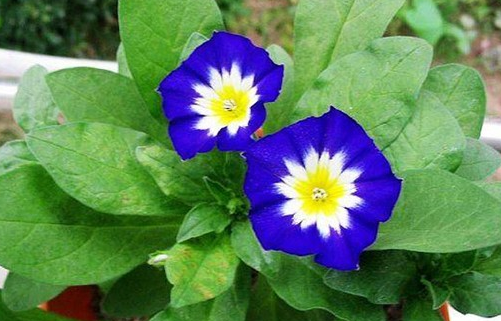
Convolvulus tricolor, native to the Mediterranean coast and North Africa, is an annual or biennial herb in the Convolvulaceae family, with a plant height of about 20-40 cm. Its branches extend and trail with a prostrate habit. The leaves are oblong, with pointed tips. The flowers are funnel-shaped, about 4-5 cm in diameter, resembling morning glory. Inside the flower there is a white star-shaped zone and a yellow center, plus an outer ring surrounding a single color of red, blue, pink or white. But the flower, just like morning glory, can only stay open for one day. It can be said to truly deserve its name: a flower with three colors, the tricolor morning glory.
Morphological characteristics of Convolvulus tricolor
Convolvulus tricolor is an annual or perennial herb, with climbing and ascending stems; leaves narrowly oblong to spatulate, with bluntly rounded tips, stalked, entire; the neck is short and clustered, flowers sparse, cymes solitary.
The corolla is bell-shaped or funnel-shaped, blue or red, with a white edge and a yellow throat. Annual, stems upright or climbing and ascending, with many branches that droop. Red flowers with yellow centers and blue flowers with yellow centers form two color combinations. Flowers trumpet-shaped, 20 cm tall, flower diameter 5-6 cm. Sown from March to May, blooming from June to July, mostly opening in the morning.
Ecological habits of Convolvulus tricolor
Likes warmth, moisture, and plenty of sunlight; not demanding about soil.
Cultivation techniques for Convolvulus tricolor
You can choose organic nutrient-rich potting soil for cultivation. During the growing period, the soil needs to be kept moist and must not be allowed to dry out, and it should be placed outdoors in a place with ample light. About 70-90 days after sowing, it will bloom. From one to one and a half months before blooming, apply fertilizer once every two weeks to increase fertility during blooming and make the flower colors vivid. The branches are trailing, so during the growing period when the stems and branches extend, they can be pruned appropriately, and supports should be set up to prevent lodging. It can also be planted in hanging baskets or flower beds, letting it trail downward, which is also a good choice.
Although the heat tolerance of the tricolor morning glory is good, when the intense heat of midsummer arrives, the stuffy weather easily makes the plant look weak, so the cultivation environment needs to be kept ventilated; moreover, transpiration is relatively fast, so attention must be paid to water supply, but the growing medium used must drain well, so as to avoid the roots rotting easily under hot and humid conditions. Its cold tolerance is also good, so the cultivation period can be extended to early autumn.
Propagation methods for Convolvulus tricolor
Generally, sowing is mostly used for propagation. The sowing period can be from early spring to early summer. The suitable germination temperature is about 18-25°C. It can be sown in a seedling tray, covered with a thin layer of soil, and kept moist. The seedling tray can be covered with transparent plastic film to maintain humidity, but water must not accumulate in the tray. It will germinate in about 7-14 days. At this point, the plastic film can be removed and the tray placed in a bright place. When there are 3-5 true leaves, it can be transplanted into a pot. However, the seedlings of the tricolor morning glory do not tolerate transplanting well, so care must be taken during transplanting. Alternatively, it can be sown directly into the pot from the beginning.
Uses of Convolvulus tricolor: greening role
Convolvulus tricolor is a herbaceous plant in the genus Convolvulus of the Convolvulaceae family, suitable as a beautifying and greening plant.
Landscape uses of Convolvulus tricolor
Suitable as a greening and beautifying material for hedges, railings and trellises.
Convolvulus tricolor pictures
Cultivation techniques for ornamental sweet potato | Ground planting for ornament | Flower arrangement application
Cultivation techniques for ornamental sweet potato | Ground planting for ornament | Flower arrangement application -- As a new type of ornamental plant in recent years, ornamental sweet potato has been widely accepted and used by people for its excellent biological characteristics and ornamental value, such as rapid growth, few pests and diseases, easy cultivation, and bright and attractive leaf colors.Ornamental sweet potato is an annual or perennial trailing herb in the genus Ipomoea of the Convolvulaceae family. It is a foliage variety selected through screening and cross-breeding improvement among sweet potato varieties around the world. At present, ornamental sweet potato already has multiple series and multiple varieties, and has also been widely used in garden landscapes in our country. According to leaf color, it can be divided into purple-leaf sweet potato, golden-leaf sweet potato and tricolor sweet potato. Purple-leaf sweet potato has purple leaves; golden-leaf sweet potato has yellow-green leaves, with palmately lobed leaves entire or three-lobed; tricolor sweet potato has young unfolding leaves that are blue-green with rose-red edges, and mature leaves that are blue-green with pink-white edges, with palmately three-lobed leaves.
Container cultivationFor large-pot cultivation of ornamental sweet potato, choose a 40 cm large pot, planting 4 to 6 plants per pot. After 2 months, the vines will be more than 1 m long, and it can be used as a trailing plant for flower platforms and balconies. When the vines are more than 1 m long, insert several bamboo poles into each pot, make a circle 20 cm to 25 cm in diameter with thick iron wire, then use thin iron wire to tie the circle to the bamboo poles at intervals of 30 cm to 50 cm, tie the bamboo poles into a cylindrical shape, and use thin string to evenly tie the ornamental sweet potato branches and vines to the cylinder, thus making a flower pillar. The thin string is tied in a figure-eight pattern, tying once every 30 cm to 50 cm. As the branches and vines grow, the sweet potato flower pillar keeps getting taller.
Small-pot cultivation of ornamental sweet potato can be used as a foliage plant for three-dimensional flower pillars or as an edging plant for holiday flower beds. Generally, insert 1 cutting per pot, about 10 cm to 15 cm long, with 2 to 3 leaves on the tender tip, and it can survive and be used in about 20 days.
Ground planting for ornament
When ornamental sweet potato is planted in the ground, it can be used as a ground-planted plant around flower borders to set off the bright flowers in the center; as a transition zone where pond banks meet water and land, making the water-land boundary clear; and as a slope-greening plant. Because ornamental sweet potato grows rapidly and has strong adaptability, it is more economical and water-saving than other artificial grass slopes, and has a more remarkable greening and beautifying effect during the ornamental period.
Purple-leaf sweet potato, golden-leaf sweet potato and tricolor sweet potato can be combined and planted as ground cover.
Flower arrangement application
In flower arrangement applications, ornamental sweet potato is used as an accompanying foliage material. It not only offers different leaf colors to match with the main flowers, but its naturally curved branches can often effectively combine the container and the flowers perfectly, making the flower arrangement work more integrated and ornamental.
Ornamental sweet potato likes light and warmth, is not cold-tolerant, has a well-developed root system, is relatively drought-tolerant, grows rapidly, and has few pests and diseases. Ornamental sweet potato has a strong regenerative capacity. In summer, when the branches and vines grow prostrately, adventitious roots are very easily produced at the nodes. After cutting the aboveground part, cutting off the roots, or breaking the stubble, it can still develop into new plants. Purple-leaf sweet potato and golden-leaf sweet potato grow quickly. When planted with a row spacing of 40 cm and a plant spacing of 30 cm, they can cover the ground in 2 months. Because ornamental sweet potato likes high temperatures, the tubers or branches and vines should be moved into a greenhouse before frost to preserve the mother plants.
(The author's unit is the Anyang City Landscape Greening Research Institute, Henan Province)