What are the precautions for growing purple shamrock (Oxalis triangularis)?
1. Pruning
When the plant grows too vigorously, remove the denser leaves to improve ventilation and light penetration; also remove dead leaves promptly in normal care to keep the plant shape attractive.
2. Repotting
Purple shamrock grows quickly, so repot it once every spring and promptly replace the soil with fresh, fertile, suitable soil.
3. Fertilizing
When potting up purple shamrock, apply plenty of base fertilizer; during the growing season, apply a nitrogen-phosphorus-potassium compound fertilizer once a month. The fertilizer concentration should not be too high, and do not apply a single-nutrient fertilizer, otherwise it will affect the plant's growth.
The above is the purple shamrock growing method brought to you by the editor. We hope it helps you grow a beautiful purple shamrock.
How to grow purple shamrock: purple shamrock propagation methods
Purple shamrock, also called red-leaf oxalis, triangular oxalis, and purple-leaf Yamamoto oxalis, is a perennial herbaceous plant with a rhizome, blooming from April to November. Other names: sour grass, three-leaf sorrel, triangular sorrel, sour mother, vinegar mother, sour basket, dove sorrel, sparrow woods grass, small sour thatch, red grandson's gift, turtledove sorrel, three-leaf sorrel. The fruit is a capsule. After the fruit ripens it splits open automatically, so it must be harvested in time. The flowers and leaves are sensitive to light. They open on sunny days and close at night or on cloudy days when there is not enough light. It likes a warm, humid environment. It grows vigorously in fertile, moist soil, with large, plump leaves. It is relatively cold-tolerant, and the winter temperature should not be lower than 0°C.
Morphological characteristics of purple shamrock
Rhizome
Purple shamrock is a perennial herbaceous plant with a rhizome. Its root system consists of semi-transparent fleshy roots that are forked and light brown, with a few fibrous roots on the lower part. At the top of the roots grow underground stems, which are made up of scale-like segments; the underground stems branch underground and are distributed in a coral-like pattern.
Leaves
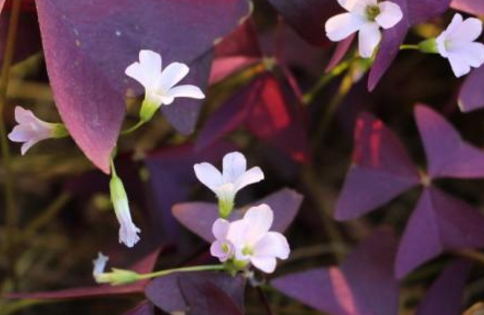
The leaves of purple shamrock grow from the top of the stem, and each leaf blade is connected to each scale of the underground stem. The leaves are trifoliate palmate compound leaves, clustered, growing at the top of the petiole; the leaflets have very short petiolules, are shaped like an isosceles triangle, and are borne on the common petiole, which is 15-31 cm long. The upper surface of the leaf is rose red, with an irregular light rose-red marking in the middle shaped like the Chinese character "", extending toward both edges of the leaf. The underside of the leaf is deep red and glossy. Generally the leaves unfold during the day, and droop under strong light and toward evening, with the three leaflets pressed tightly together, looking just like dancing butterflies; when planted under sparse forest, the leaves stay unfolded all day and the leaf color is quite glossy.
Flowers
The flowers of purple shamrock are umbel inflorescences, light pink, with 5 petals, and 5-8 flowers clustered at the top of the flower stalk. The flower stalk is slender, 14-20 cm, swaying in the wind with a graceful posture. One to several flowers form an axillary umbel inflorescence. The sepals are oblong, acute at the tip, and pubescent; the petals are obovate and slightly rolled outward; the bases of the filaments unite into a tube shape.
Fruit
The capsule of purple shamrock is nearly cylindrical, with 5 ridges and short pubescence. When it matures and splits open, it ejects the seeds. The seeds are small, flat and ovate, red-brown, with transverse grooves.
The flowering and fruiting period of purple shamrock is from March to August.
Ecological habits of purple shamrock
Purple shamrock is suitable for well-drained loose soil; it likes light and tolerates partial shade; its flowering period lasts as long as 8 months. It has no pests or diseases; during periods of high temperature and high humidity, old leaves are prone to gray mold, but this does not affect new leaves, and purple shamrock is very easy to control. It is relatively cold-tolerant; above -5°C it stays evergreen in winter, and below -5°C the aboveground leaves wither, but the underground part does not die, and new leaves can sprout again in March of the following year. It has no obvious dormancy period, and cultivation and management are simple.
Cultivation techniques for purple shamrock
Purple shamrock is propagated mainly by division, and can also be grown from seed or by tissue culture. It is a perennial herbaceous plant with a rhizome, having bulbs covered with dark brown scales, from within which bulbils grow and gather into clumps; the lower part of the bulb has spindle-shaped, semi-transparent tuberous roots.
Propagation methods of purple shamrock
Division propagation
It can be done throughout the year, but division in spring from April to May is best. Division propagation means dividing and planting the corms, and it can be done all year round.
Tissue culture propagation
When dividing, first dig up the plant and break apart the corms for separate planting; the corms can also be cut into small pieces, each retaining more than 3 buds, and placed in a sand bed for cultivation. In about 15 days new plants will grow; after they take root and unfold leaves, transplant them.
Seed propagation
Propagate by sowing in pots in spring; the suitable germination temperature is 15-18°C. They germinate about 15 days after sowing, and the seedlings can bloom and be enjoyed in the same year.
During the growing period, the light should not be too strong, otherwise the leaf color will be dull. Maintain relatively high air humidity, and when watering, be careful to avoid soil soiling the leaves, which would affect the ornamental effect. Fertilize once a month. The leaves are strongly phototropic, so the position of the pot needs to be rotated frequently. It needs to be replanted and renewed every year.
Distribution area of purple shamrock
Purple shamrock is native to Brazil in South America, or according to one account Mexico, and is a rare, excellent colored-leaf groundcover plant. It has been successfully introduced into China.
After reading the above introduction on how to grow purple shamrock, do you have a better understanding of purple shamrock cultivation? If you want to know more about purple shamrock, please keep following.
How to divide purple shamrock: how to propagate purple shamrock
Purple shamrock, also called purple oxalis, is a beautiful ornamental plant that many people like to grow, but do you know how to divide purple shamrock? Do you understand the propagation methods of purple shamrock? If not, you can take a look with the editor.
How to divide purple shamrock: how to propagate purple shamrock1. How to divide purple shamrock
Usually there are several ways to divide purple shamrock. People can directly divide its bulbs, can divide the mother bulb into several daughter bulbs, or can directly divide the new bulbs produced on its stems into new plants and plant them in other flower pots. In addition, when dividing purple shamrock in normal care, you can separate its stems; as long as there is a root bulb at the base of the stem, it will easily survive.
2. How to propagate purple shamrock
There are two propagation methods for purple shamrock. One is bulb division, which is what people usually call division, and the other is cutting propagation. Bulb division is relatively simple and has a high success rate, while cutting propagation is mostly used for some new varieties that do not form bulbs. When propagating by cuttings, you can cut off its branches and insert them directly into the soil; after about ten days they will grow new roots, and then they can be transplanted into flower pots.
3. Purple shamrock has a high demand for fertilizer
When propagating or dividing purple shamrock in normal care, be sure to pay attention to the supply of fertilizer. Plenty of base fertilizer should be applied in the potting soil; bean cake or bone meal, for example, are ideal choices for base fertilizer. In addition, after purple shamrock enters its peak growing season, it should also be top-dressed in time, preferably once every ten days, and the fertilizer should preferably be a compound fertilizer with a relatively high phosphorus and potassium content.