How to grow Limonium sinense? Detailed growing methods and care tips
Soil
Limonium sinense has relatively high soil requirements; the soil should be loose, breathable and fairly soft. For this kind of soil, we can generally mix it ourselves, using leaf mold, or mixing one part peat and one part perlite, and then disinfecting it.
Fertilizer
Limonium sinense needs a large amount of boron during its growing period, so adding borax to the base fertilizer can effectively regulate soil fertility while also adjusting the soil pH. For topdressing, diluted soybean cake water and quick-acting nitrogen, phosphorus and potassium can be applied indirectly.
Temperature
After sowing, Limonium sinense needs low-temperature vernalization, which is very beneficial for the plant's flowering; in autumn it can generally be sown at 18-21°C, and sprouts usually appear about 5 days after sowing. After the young shoots emerge, place them below 16°C for low-temperature treatment, then after 3 days place them at normal temperature for care.
When the first true leaf appears, the seedlings can be separated; when 5-6 leaves have grown, they can be planted out. The usual planting time is October-November, and the flowering period is June-August. During the plant's growth period, keep the daytime temperature at 18-20°C and the nighttime temperature at 10-15°C, which is better; generally the temperature should not be below 0°C.
Light
Limonium sinense loves sunlight very much, and especially during its growing period it should be given sufficient light. But in summer the light is too intense, so it is best not to place it where the sun shines directly; a position receiving diffused light is better, and it should also be properly shaded. In winter, when the temperature is too low, it should generally be placed indoors in a position that receives sunlight and has good ventilation.
That is all for today's introduction to how to grow this Chinese groundsell; I hope that after learning it, everyone can grow more beautiful and stronger Limonium sinense.
Limonium sinense (Girard) Kuntze Limonium sinense gallery: how to grow Limonium sinense / how to propagate Limonium sinense
Limonium sinense profileLimonium sinense (Girard) Kuntze
Aliases: Haichishao, Fangzicao, Baihua Yuqianxiang, Haibocai, Haiman, Haimanjing, Chiyecao, Huamanjing, Yanyuncao, Chiyejisong, Zhonghua Limonium sinense
Classification: perennial herbaceous flower
Family and genus: Plantae, Angiosperms, Dicotyledoneae, Plumbaginales, Plumbaginaceae, Limonium
Full bloom period: spring, summer, autumn
Limonium sinense (scientific name: Limonium sinense (Girard) Kuntze), aliases: Limonium sinense (Fujian), Haichishao (Fujian), Fangzicao (Taiwan, China), Baihua Yuqianxiang (Guangdong), Haibocai, Haiman (Shandong), Haimanjing (Hebei), Chiyecao (Seed Plant Names), Huamanjing (Indicator Plants), Yanyuncao (Seed Plants of Southern Jiangsu Manual), Chiyejisong (Northeast Plant Key), Zhonghua Limonium sinense (Iconographia Cormophytorum Sinicorum). Perennial herb, distributed in the coastal provinces and regions of China; grows on coastal moist saline soil or sandy soil. Also found in Vietnam. Root...
Growing methods and precautions for Limonium sinense Introduction to Limonium sinense
Limonium sinense (scientific name: Limonium sinense (Girard) Kuntze), aliases: Limonium sinense (Fujian), Haichishao (Fujian), Fangzicao (Taiwan, China), Baihua Yuqianxiang (Guangdong), Haibocai, Haiman (Shandong), Haimanjing (Hebei), Chiyecao (Seed Plant Names), Huamanjing (Indicator Plants), Yanyuncao (Seed Plants of Southern Jiangsu Manual), Chiyejisong (Northeast Plant Key), Zhonghua Limonium sinense (Iconographia Cormophytorum Sinicorum). Perennial herb, distributed in the coastal provinces and regions of China; grows on coastal moist saline soil or sandy soil. Also found in Vietnam. The root or the whole plant is used in folk medicine and has astringent, hemostatic and diuretic effects. Because its flowers are small, dry-membranous and elegantly colored, and its ornamental period is long, it is, like baby's breath, an important cut-flower filler material, commonly known as "forget-me-not". Besides being used as a fresh cut flower, it can also be made into natural dried flowers, giving it even wider uses.
Morphological characteristics of Limonium sinense Plant
Perennial herb, 15-60 cm tall, the whole plant (except the calyx) hairless.
Leaves
Leaves basal, light green or grayish green, obovate-oblong, oblong-lanceolate to lanceolate, 4-12 (22) cm long, 0.4-2.5 (4) cm wide, apex usually obtuse or acute, lower part gradually narrowed into a flat petiole, numerous, arranged in a rosette.
Flowers
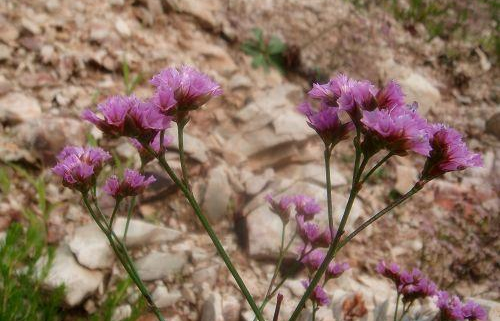
The upper part of the flower axis branches many times; the flowers gather into short and dense spikelets, clustered at the top of the flower axis branches; the stem leaves of the spikelets are reduced to scale-like, brown, with white membranous margins. The inflorescence is corymbose or paniculate; the inflorescence axis is usually 3-5 (10), ascending or upright, with 4 angles or furrows, often branching several times from above the middle, the terminal branchlets two-angled; sterile branches few, located at the lower part of the branches or at the forks, usually simple; spike-like inflorescences stalked to sessile, arranged from the upper part to the top of the inflorescence branches, composed of 2-6 (11) spikelets; spikelets contain 2-3 (4) flowers, the 1-2 flowers enclosed by the first inner bract often open late or do not open; outer bract about 2-2.5 mm long, ovate, first inner bract 5-5.5 mm long; calyx 5-6 (7)0 mm long, funnel-shaped, calyx tube about 1 mm in diameter, the lower half or entirely along the veins covered with long hairs, calyx limb white, 2-2.5 mm wide (near the middle of the calyx), spreading diameter 3.5-4.5 mm, lobes broad and short and apex usually obtuse or acute, sometimes slightly mucronate, often with intervening lobes, veins extending below the lobes and disappearing, along the veins with or without puberulence; corolla yellow. Petals 5, blue-purple; stamens 5; pistil with superior ovary, styles 5, stigma filiform. Fruit obovate, yellow-brown.
The flowering period of Limonium sinense is July (early) to November (mid) in the north, and April to December in the south.
Limonium sinense is similar to Limonium bicolor (Bunge) Kuntze, but this species has a narrower calyx limb, and the spreading diameter is smaller than the length of the calyx; it is also close to Limonium tetragonum (Thunb.) Bullok (Statice japonica Sieb. et Zucc.), but the latter has a narrower white membranous part of the calyx limb (about 1-1.5 mm wide), and the red veins extend to the apex of the calyx lobes.
Ecological habits of Limonium sinense
Limonium sinense grows on coastal moist saline soil or sandy soil; when cultivated at high temperature it does not flower, or flowering is obviously inhibited; if cultivated at a night temperature below 16°C, it flowers well; if it has already received low-temperature treatment at the seedling stage, it will still flower even if later exposed to high temperature.
With differences in habitat salinity and climatic conditions, the form of Limonium sinense changes somewhat. The inflorescence axis can change from slender, lower part prostrate, and four-angled to stout, upright and with deep furrowed angles; the number of open spikelets, and the shape and size of the leaves, etc., also vary within a certain range.
Cultivation techniques of Limonium sinense Seedling raising
In production, tissue culture is mostly used for seedling raising. When the seedlings grow to 5-8 leaves, they can be planted out. They can also be propagated by seed. The seeds are relatively small, with a 1000-grain weight of 2.5-2.8 grams. At 18-21°C, the seeds germinate in 1 week. When the first true leaf appears, the seedlings can be separated; when there are 5-6 leaves, they can be planted out.
Land preparation
Choose a high, dry plot, apply 5 tons of farmyard manure per mu, and add borax to the base fertilizer.
Making beds
The bed surface is 70 cm, 20 cm above the ground, with 40-50 cm paths between beds. Water once 1-2 days before planting to make the soil moist.
Planting
Planting spacing is 40 cm x 40 cm, with double rows planted crosswise to facilitate ventilation and light penetration. A three-row planting pattern can also be used, with a bed width of 1-1.2 m and a ditch width of 40 cm, planted in a plum-blossom arrangement.
Management
In addition to applying sufficient base fertilizer, fertilize once a month during the growing period; a compound fertilizer is sufficient, and an appropriate amount of boron can also be applied as a foliar fertilizer.
In greenhouse cultivation, water about once every 3 days. During the stage of inflorescence emergence and growth, water and fertilizer must be sufficient; otherwise the flower stems will be short and the flowers will not be luxuriant. Maintain a suitable growing temperature, preferably 18-20°C during the day and 10-15°C at night. Attention should be paid to ventilation to prevent diseases. At the same time, nets or supports need to be set up to prevent lodging. After the first flush of flowers is cut, remove old branches and dead leaves to help promote the sprouting of new shoots.
Disease control of Limonium sinense Viral disease
Pathogen
Several viruses can harm Limonium sinense, mainly: broad bean wilt virus (BBWV), cucumber mosaic virus (CMV), Limonium sinense virus Y (SVY), tomato bushy stunt virus (TBSV) and turnip mosaic virus (TMV), etc.
Diseased plants are dwarfed, leaves become smaller, shrunken and deformed or mosaic-like.
Occurrence pattern and epidemic characteristics
The virus is mainly transmitted through sap contact or by green peach aphid (Myzus persicae) and cotton aphid (Aphis gossypii), etc.
Control measures
1. Choose seeds from healthy plants for seedling raising or cultivate virus-free seedlings for planting.
2. Promptly pull out diseased plants to reduce sources of infection. Pay attention to disinfecting cutting tools to avoid sap transmission of the virus.
3. Control the aphids that transmit the virus. During the aphid occurrence period, spray 40% omethoate emulsifiable concentrate at 1000 times dilution or 2.5% deltamethrin emulsifiable concentrate at 4000 times dilution for control.
Scorch disease
Limonium sinense scorch disease, also known as Limonium sinense mold disease, is one of the important diseases in Limonium sinense production.
Pathogen
Botrytis cinerea Pers et Fr.
Symptoms
The leaves, flowers, flower stalks, shoot tips, seedlings and the stubble left after flower harvesting of the plant can all be affected. After the leaves are affected, brown nearly circular lesions appear, which can later lead to leaf death. After the flowers are affected, their membranous calyx changes color, collapses or breaks; in severe cases, part or the entire inflorescence scorches and necroses. In humid environments, a gray-brown mold layer can be seen on the diseased parts, which consists of the pathogen's conidiophores and conidia.
Occurrence pattern
The pathogen survives and overwinters on diseased plant residues. The following spring, conidia spread through wind and rain or are carried by seeds to invade the host. There is reinfection.
Epidemic characteristics
Rainy, highly humid and cool environments favor pathogen growth and reproduction. Seed-borne pathogens transported over long distances can lead to long-distance spread and diffusion of the pathogen.
Control measures
1. Promptly remove diseased plants and the surrounding diseased flowers and branches, bury them deeply or burn them, to reduce sources of inoculum.
2. Treat the seeds: soak infected seeds in 50°C water for 30 minutes or in 800 times diluted Mie Jun Ling solution for 60 minutes to kill the pathogen without affecting seed germination.
3. In cultivation management, pay attention to keeping the plants dry; avoid wetting leaves and flowers when watering; greenhouses should maintain ventilation and dryness to reduce air humidity.
4. In the early stage of disease, spray 65% zineb wettable powder at 600 times dilution or 50% Sumilex (procymidone) powder at 1000-2000 times dilution or 50% vinclozolin wettable powder at 1000-1300 times dilution for control, spraying 3-4 times every 7-10 days, which can better control the spread of the disease.
Brown spot disease ⟧71⟧Symptoms
Symptoms
The disease occurs on the leaves, stems and lateral leaves of flower stems. On the leaves, the lesions first appear as water-soaked, indistinct pale yellow spots, with a yellow-brown periphery and gray-brown interior, later becoming tea-brown. The periphery of old lesions is purplish red. The lesion diameter is about 2-5 mm. Stem lesions are similar.
Pathogen
It is Cercospora insulana Sacc; conidiophores pale brown, fasciculate. Conidia colorless, whip-shaped, with 3-7 septa. Size 30-98 3.4-4 micrometers. The optimum temperature for growth and development of this fungus is 27-30°C; growth stops above 37°C or below 5°C; the lethal temperature is 45°C for 10 minutes; the optimum temperature for conidial germination is 26-31°C, and the optimum relative humidity is 98%-100%, with water droplets being best.
Transmission route
The pathogen mainly overwinters as mycelial masses and conidia on diseased residues and seeds. When climatic conditions are suitable in the following spring, conidia are produced on the mycelial masses and spread by airflow and rainwater, invading through leaf stomata and causing damage. The incubation period is 9-10 days, after which conidia are produced on the diseased parts and reinfection occurs through airflow and rainwater. The ten-day average temperature is between 19-25°C, and the average minimum temperature is above 13°C.
Control methods
Spray promptly during the disease period. Use 65% zineb wettable powder at 600-800 times dilution; or 50% carbendazim wettable powder at 600-800 times dilution. Spray once about every 10 days, for 2-3 consecutive times.
Distribution area of Limonium sinense
Limonium sinense is distributed in the coastal provinces and regions of China; it is also found in Vietnam.
The type specimen of Limonium sinense was collected from the seaside area from Penglai, Shandong to Tianjin; the type specimen of the synonym was collected from Quanzhou, Fujian.
Dietary therapy or medicinal value of Limonium sinense
The medical information and health dietary information on Huahua.com are for reference only and cannot be used as a basis for diagnosis or medical treatment. For any health problem, consult professional medical personnel; for the treatment of any disease, follow doctor's advice.
Ultimate flower-protecting task: love yourself, start from reality, and strictly follow doctor's advice. For illness, do not be careless, do not delay, do not give up hope; face it bravely, warm the silent world with love, and care for the flower field in your heart with care.
The root or whole plant of Limonium sinense is used in folk medicine and has astringent, hemostatic and diuretic effects.
Nature and flavor: bitter, slightly salty, cool in nature.
Functions and indications: clear heat; promote diuresis; stop bleeding; detoxify. Mainly for damp-heat bloody stool; rectal prolapse; bloody strangury; menorrhagia, leukorrhea; carbuncles, swellings and sores.
Usage and dosage: oral administration: decocted in water, 15-30 g, fresh product or up to 60 g. External use: appropriate amount, pounded and applied; or decocted in water for sitz bath.
Various discussions: **Chinese Herbal Medicine Manual: stops bleeding and disperses blood stasis. Treats functional uterine bleeding, cervical cancer and other bleeding.
Uses and purposes of Limonium sinense
Nearly 20 species in the genus Limonium can be used ornamentally. Because their flowers are small, dry-membranous and elegantly colored, and their ornamental period is long, they are, like baby's breath, important cut-flower filler materials. Besides being used as fresh cut flowers, they can also be made into natural dried flowers, giving them even wider uses.
Limonium sinense pictures
Another name for forget-me-not, Limonium sinense, forget-me-not flower language
Huahui Pencai Network introduction, belowWhat Huahui Pencai Network editors share with you is about the alias of forget-me-notLimonium sinense,the article on forget-me-not flower language,let's take a look together.
Forget-me-not(scientific name: Myosotis sylvatica), also known asforget-me-not, is a plant in the genus Myosotis of the family Boraginaceae.
It is distributed in Europe, Iran, Russia, Pakistan, Kashmir, India, as well as China's Jiangsu, Northwest China, North China, Sichuan, Yunnan, Northeast China and other places. It grows in areas from 200 m to 4,200 m above sea level, mostly on mountain forest edges, hillsides, under forests and in valley grasslands. It has not yet been introduced and cultivated artificially.
Forget-me-not is a light blue small flower with five petals and no fragrance. Although ordinary, couples are willing to tie them into a bouquet and give them to their lovers to express deep love.
Althoughforget-me-not is also calledLimonium sinense, there is actually another plant also called Limonium sinense, Limonium sinense(scientific name:Limonium sinense), which is a plant species under the genus Limonium in the family Plumbaginaceae.
Another name for forget-me-not
Forget-me-not, also known as Liuli Cao, Wu Wang Cao, Winged-stem Limonium, Xingchen Hua, Limonium sinense, Everlasting Flower, Spoon-leaf Flower, Statice, Jisong, is a plant in the genus Myosotis of the family Boraginaceae.
Morphological characteristics of forget-me-not
Forget-me-not is an annual or biennial herb, 30-60 cm tall. Leaves simple, alternate, leaf blades oblanceolate, lower leaves petiolate, upper leaves sessile, raceme terminal, 10-15 cm long; calyx small, 5-lobed; corolla salverform, lobes 5, blue, pink or white, throat yellow. Flowering period April-May, nutlets brown-green, fruiting period May-June.
Living habits of forget-me-not
Forget-me-not has strong adaptability, likes dry and cool climates, avoids damp heat, likes light, is drought-tolerant, and the suitable growth temperature is 20°C-25°C. It is suitable for growing in loose, fertile, well-drained slightly alkaline soil.
Forget-me-not flower language
The flower language of forget-me-not is eternal love, deep affection and friendship, and an unchanging heart. Forget-me-not is the sentimental one among flowers. According to legend, in ancient Europe, a knight was touring the seaside with his beloved lover. His lover saw a bunch of flowers standing upright in the water and wanted to pick them to wear. To please her, the knight waded into the water to pick them, but unexpectedly was swept away by the surging tide. Before being swept away, he did not forget to throw the flowers onto the shore and shout to his beloved: "Do not forget me!" Thereafter, this flower was named forget-me-not and became a token of mutual love, deeply cherished by couples.
Forget-me-not varieties and uses
Complete list of forget-me-not varieties
Algerian species, with orange-yellow flowers, plants more than 1 m tall, loose and slender plant form, brilliant flower colors, early flowering period, and the longest-lasting flower color.
Deep-lobed leaf species, with purple flowers, plants nearly 1 m tall, compact plant form, and hard, thick stems. In addition, there are other flower color varieties, including blue, white, orange-red, yellow, peach red, light red, purple-red, blue-green, and so on.
Forget-me-not varieties can also be divided into early-maturing and late-maturing types. Early-maturing varieties include Early Blue, Gold Coast, and Blue Pearl. Mid-to-late-maturing varieties include Iceberg, Night Blue, and Blue Velvet. Growers should fully understand variety characteristics and market demand in order to choose suitable varieties.
Functions and Effects of Forget-Me-Not
Ornamental effect: forget-me-not flowers are small and delicate, with a wide range of flower colors. Although ordinary, couples are willing to tie them into a bouquet and give them to their loved ones to express deep love. Forget-me-nots are often used as cut flowers. At present, what is sold in flower shops is not true forget-me-not, but sea lavender; selling sea lavender as forget-me-not merely borrows its beautiful meaning.
Forget-me-not flower tea: forget-me-not can be made into flower tea for drinking. It has the effects of nourishing yin and tonifying the kidney, beautifying the face, tonifying blood and nourishing blood, and can promote the body's metabolism, delay cell aging, delay cell aging, improve immunity, and have antiviral, anti-cancer, and cancer-preventing effects. It can be used to treat conditions such as blood deficiency and irregular menstruation, beauty and facial care, clearing fire and improving eyesight, freckles and acne, low immunity, viral infection, and insufficient blood supply to the heart and cerebrovascular system.