What are the care methods for golden-edge Daphne odora?
1. Soil
For golden-edge Daphne odora, choose loose, fertile soil with good air permeability. Generally, the soil also needs to contain slightly acidic matter.
2. Light
Golden-edge Daphne odora is a shade-loving plant, so it should not be exposed to excessive light, but it should still receive moderate light.
3. Watering
Golden-edge Daphne odora likes a semi-shaded environment, so when watering, the soil should be watered thoroughly, but golden-edge Daphne odora is not tolerant of waterlogging, so there must never be standing water in the potting soil, to prevent root rot.
4. Fertilizing
Golden-edge Daphne odora likes fertilizer, but not heavy fertilizer, so applying some dilute liquid fertilizer to golden-edge Daphne odora is enough.
5. Pest and disease control
Golden-edge Daphne odora often suffers from pest damage, so it should be controlled early. If an infestation occurs, insecticide should be sprayed immediately, as this is relatively quick.
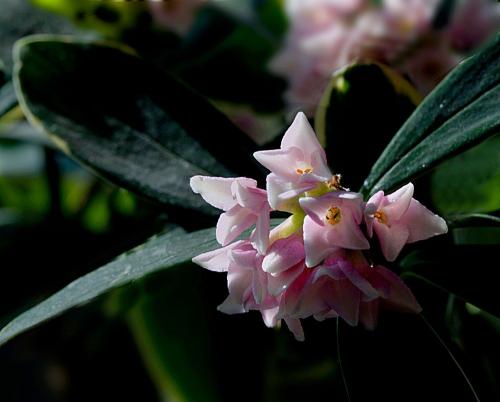
These are the summer care methods and routine care measures for golden-edge Daphne odora that the editor has introduced. Have you learned them?
Winter care methods for golden-edge Daphne odora
Daphne odora flowers are strongly fragrant, and both the plant shape and leaf color are beautiful, so it is deeply loved by households. Legend says a monk on Mount Lu took a nap on a huge rock and was awakened in his sleep by the strong fragrance. Later he found the plant and named it "Sleeping Fragrance." Because it blooms around the severe cold period near Spring Festival, people regarded it as auspicious and changed the name to "Daphne odora."
The flowering period of Daphne odora comes exactly when most flowers have faded, and its fragrance is of a mixed type, so in the old days it was called "fragrance-stealing flower." Among Daphne odora varieties, golden-edge Daphne odora is the best. It likes diffused light and avoids blazing sun, and in the height of summer it needs shading. It is now winter, so it needs to be brought indoors for care. During the day it should be placed at a south-facing window to receive sunlight; at night it should not be placed at the window and needs to be moved to a place not below 5°C. In addition, attention must be paid to what it avoids: avoid potting soil that is too wet, avoid concentrated fertilizer and raw fertilizer, avoid alkaline soil, avoid rain exposure, and avoid earthworms, ants, and other insects in the pot. Daphne odora is nearing its flowering period, so the above points are especially important to avoid bud drop and flower drop. Usually, observe the golden-edge leaves of golden-edge Daphne odora. If the gold and emerald colors are distinct and glossy, and the leaves are upright and growing upward, it means fertilizer and water are normal; if the leaves droop, then the fertilizer used was too concentrated, too raw, or too frequent, or watering was too much or too frequent, and the cause must be identified and measures taken. Too much watering is easy to correct; if fertilizer was used improperly, water thoroughly several times in succession to let the fertilizer flow out of the pot, then place it in a ventilated spot to help the potting soil dry quickly. If the roots have rotted, the pot must be repotted, the rotten roots cut off, washed clean with a fungicide, and planted in sandy soil to let it grow new roots. Some of the upper branches and leaves should also be pruned accordingly.
How should golden-edge Daphne odora be cared for in winter?
Daphne odora flowers are strongly fragrant, and both the plant shape and leaf color are beautiful, so it is deeply loved by households. Legend says a monk on Mount Lu took a nap on a huge rock and was awakened in his sleep by the strong fragrance. Later he found the plant and named it "Sleeping Fragrance." Because it blooms around the severe cold period near Spring Festival, people regarded it as auspicious and changed the name to "Daphne odora."
The flowering period of Daphne odora comes exactly when most flowers have faded, and its fragrance is of a mixed type, so in the old days it was called "fragrance-stealing flower." Among Daphne odora varieties, golden-edge Daphne odora is the best. It likes diffused light and avoids blazing sun, and in the height of summer it needs shading. It is now winter, so it needs to be brought indoors for care. During the day it should be placed at a south-facing window to receive sunlight; at night it should not be placed at the window and needs to be moved to a place not below 5°C. In addition, attention must be paid to what it avoids: avoid potting soil that is too wet, avoid concentrated fertilizer and raw fertilizer, avoid alkaline soil, avoid rain exposure, and avoid earthworms, ants, and other insects in the pot. Daphne odora is nearing its flowering period, so the above points are especially important to avoid bud drop and flower drop. Usually, observe the golden-edge leaves of golden-edge Daphne odora. If the gold and emerald colors are distinct and glossy, and the leaves are upright and growing upward, it means fertilizer and water are normal; if the leaves droop, then the fertilizer used was too concentrated, too raw, or too frequent, or watering was too much or too frequent, and the cause must be identified and measures taken. Too much watering is easy to correct; if fertilizer was used improperly, water thoroughly several times in succession to let the fertilizer flow out of the pot, then place it in a ventilated spot to help the potting soil dry quickly. If the roots have rotted, the pot must be repotted, the rotten roots cut off, washed clean with a fungicide, and planted in sandy soil to let it grow new roots. Some of the upper branches and leaves should also be pruned accordingly.