How to grow Daphne odora 'Aureomarginata'? Detailed growing methods and precautions
1. Pot and soil
Choose a flower pot of moderate size, and select soil that contains humus and is slightly acidic, as this is beneficial to the growth of Daphne odora 'Aureomarginata'.
2. Repotting
Daphne odora 'Aureomarginata' generally needs to be repotted once every 2 years, which keeps it able to produce beautiful flowers and promotes its growth.
3. Watering
Daphne odora 'Aureomarginata' likes a semi-shaded environment, so watering should soak the soil through, but it is not tolerant of waterlogging, so there must never be standing water in the pot soil, to prevent root rot.
4. Fertilizing
Daphne odora 'Aureomarginata' likes fertilizer, but not heavy fertilizer, so applying some dilute liquid fertilizer is enough.
5. Pruning
Daphne odora 'Aureomarginata' needs frequent pruning to maintain a graceful plant shape; if you want more beautiful flowers the following year, cut off the dead branches after flowering.
6. Pest and disease control
Daphne odora 'Aureomarginata' often suffers from pest problems, so prevention and control should be carried out early; if disease occurs, it should be dug out by the roots immediately and burned.
These are the growing methods and precautions for Daphne odora 'Aureomarginata'. Have you learned them? Below, the editor will introduce the main value of Daphne odora 'Aureomarginata'.
Growing methods and precautions for Daphne odora 'Aureomarginata'
Soil requirements for Daphne odora 'Aureomarginata'
Potted Daphne odora 'Aureomarginata' is fairly flexible about pot soil; choose fertile, humus-rich acidic soil and mix in a small amount of river sand and rotted cake fertilizer.
Of course, for soil dug directly from outdoors, you can add a small amount of river sand or large-grained gravel.
Water and fertilizer requirements for Daphne odora 'Aureomarginata'
The roots of Daphne odora 'Aureomarginata' are fleshy roots, so during routine care be careful to control watering; if watered too much and the pot soil stays wet for a long time, the roots rot easily. Generally the watering cycle is 10-15 days, and according to weather conditions, the cycle can be appropriately shortened or lengthened.
Daphne odora 'Aureomarginata' prefers fertilizer; during the growing period, apply a dilute liquid fertilizer about once every 10 days. Apply an extra fertilizer once before and after flowering, choosing dilute cake fertilizer water.
Light and temperature requirements for Daphne odora 'Aureomarginata'
Daphne odora 'Aureomarginata' likes a semi-shaded environment; in winter and spring, just care for it normally in sunlight and give it sufficient light. In summer, place Daphne odora 'Aureomarginata' in a well-ventilated shady spot, and spray water promptly when it is hot.
Daphne odora 'Aureomarginata' is not cold-tolerant, so in winter it should be moved indoors to overwinter. After Frost's Descent, move it to a sunny spot indoors, keep the temperature above 5°C, and keep the pot soil dry so it can overwinter safely.
Pruning methods for Daphne odora 'Aureomarginata'
Daphne odora 'Aureomarginata' has strong sprouting ability and tolerates pruning; to control the plant shape, promptly pinch out the growing tips and remove the tops to promote branching. After the flowers fade, prune according to the plant shape, cut off dead leaves, and remove diseased and weak branches to improve the plant's light penetration.
Precautions for growing Daphne odora 'Aureomarginata'
Daphne odora 'Aureomarginata' is generally repotted once every two years, before the flower buds sprout in early spring. When repotting, remove the outer layer of soil from the roots, add new culture soil, and after planting, water thoroughly, place it in a cool spot to dry for 10-15 days, then carry out normal care.
Common pests of Daphne odora 'Aureomarginata' include aphids and scale insects; once pests are found, they must be controlled promptly.
How to grow Daphne odora 'Aureomarginata', growing methods and precautions for Daphne odora 'Aureomarginata'
Daphne odora 'Aureomarginata' is a variety of Daphne odora; it blooms before Spring Festival, adding much color to the New Year festival. Daphne odora 'Aureomarginata' is not only an ornamental plant for people, but its flowers, leaves, bark, and roots can all be used as medicine, so Daphne odora 'Aureomarginata' also has high medicinal value. Today let us take a look at how to grow Daphne odora 'Aureomarginata', and its growing methods and precautions.
1. What is Daphne odora 'Aureomarginata'?
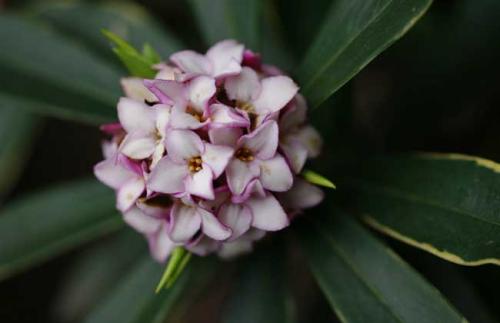
Daphne odora 'Aureomarginata' belongs to the Thymelaeaceae family, genus Daphne, and is an evergreen small shrub. It has a fleshy root system. The leaves are densely whorled, elliptical, about 5-6 cm long and 2-3 cm wide; the leaf surface is smooth and thick, leathery, hairless on both sides, dark green on the surface, light green on the underside, with golden-yellow leaf margins and short, thick petioles. It bears terminal head inflorescences; the perianth is tubular, with four lobes at the upper end about 1.5 cm across. Each flower is composed of dozens of small florets, opening from the outside inward. The flowering period lasts more than two months, with the full bloom period during Spring Festival. The flowers are vivid purplish-red and strongly fragrant.
2. How to grow Daphne odora 'Aureomarginata', growing methods and precautions for Daphne odora 'Aureomarginata' 1. Soil:For potted Daphne odora 'Aureomarginata', the pot soil should be fertile, loose, humus-rich, acidic leaf mold soil, mixed with an appropriate amount of river sand and rotted cake fertilizer.
2. Watering:The roots of Daphne odora 'Aureomarginata' are fleshy, so during routine care and management special attention must be paid to controlling watering; if watered too much and the pot soil stays wet for a long time, root rot is easily caused. After rain, promptly pour out any standing water in the pot.
3. Sunlight:Although Daphne odora 'Aureomarginata' likes semi-shade, in winter and spring it should be placed in an environment with sunlight. During the growing period, if light is sufficient and fertilizer is appropriate, the branches can be plump and the leaves dark, with bright flowers and strong fragrance. In summer it should be placed in a well-ventilated shady spot, and sprayed with water to cool down when hot.
4. Temperature:After Frost's Descent, move Daphne odora 'Aureomarginata' indoors to a sunny spot, keep the room temperature at about 5°C, and control watering; keep the pot soil water content at about 45%, so it can make it through winter.
5. Fertilizing:Daphne odora 'Aureomarginata' prefers fertilizer, so during the growing season apply a dilute liquid fertilizer about once every 10 days. Before and after flowering, apply an extra dilute cake fertilizer water once each.
6. Pests:The main pests harming Daphne odora 'Aureomarginata' are aphids and scale insects, which mostly appear in dry, hot climates and should be controlled early. The main disease is mosaic disease caused by a virus; infected plants show colored spots and deformities on the leaf surface, poor flowering, and stunted growth. Once found, they should be dug out by the roots and burned.
7. Pruning:Daphne odora 'Aureomarginata' has clustered branches, strong sprouting ability, and tolerates pruning; after flowering, the branches must be trimmed.
8. Cutting propagation technique:Choose a cutting medium with good permeability and a pH of about 5; generally use water-retaining fine sandy soil or vermiculite. Before cutting, split the base of the cutting from the middle with a sharp small knife to a length of 1.5-2 cm, then immediately insert a small stone in the middle so it does not close, increasing the contact area between the cutting base and the medium, which helps the cutting root. Insert 1/3-1/2 of the cutting into the medium and press the medium firm.
9. Management after cutting:After cutting, keep the cutting soil moist often, promptly supplying the water needed for the cuttings to root, and keep the temperature at 20-25°C. At the beginning of the seedling stage, water often with a small amount of clear water, just enough to penetrate the medium; never use muddy water or flood irrigation, to prevent young leaves from getting muddy and suffering scorch damage. At the same time, pay attention to shading and avoid direct sun exposure. The root system of Daphne odora 'Aureomarginata' has fragrance, so avoid ants and earthworms eating it. Generally, cuttings can root in 30-35 days.
A good plant can not only purify the air but also regulate a person's mood. I hope "how to grow Daphne odora 'Aureomarginata', growing methods and precautions for Daphne odora 'Aureomarginata'" can help friends who like growing Daphne odora 'Aureomarginata'. To learn more about Daphne odora 'Aureomarginata', please follow Huobao Nongzi Information.