What are the propagation methods for the African false hosta (Ledebouria petiolata)?
Division
For African false hosta (Ledebouria petiolata), division can be done at any time except winter; usually the plant is separated at the bulb, the old and withered leaves are trimmed off, and the divisions are planted elsewhere.
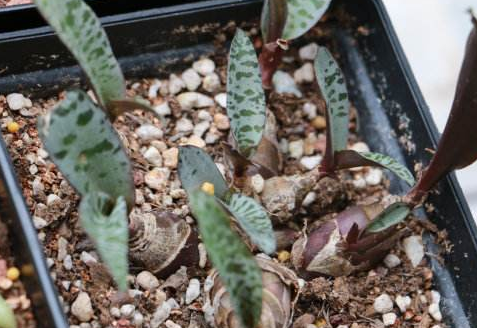
Sowing
African false hosta (Ledebouria petiolata) can be sown in spring, summer and autumn; generally a soft brush is used to help with pollination, and once the seeds are ripe they are harvested and grown in a seedbed, with a moderate amount of thin fertilizer applied during the growing period.
Leaf cuttings
African false hosta (Ledebouria petiolata) can be propagated by leaf cuttings at any time except winter; first select a leaf as the cutting, cut it into pieces about 3 cm long, insert them into the growing medium, then water moderately.
How to grow African false hosta (Ledebouria petiolata)
1. Light
African false hosta (Ledebouria petiolata) loves light very much, and its growth is closely related to light; plants with sufficient light are cuter and shorter, while a lack of light makes the plant leggy and harms its ornamental value. If the new leaves are wider and larger than the old leaves and their color turns pale, then the plant needs a large amount of additional light.
2. Temperature
The suitable growing temperature for African false hosta (Ledebouria petiolata) is 20-30°C; if the temperature drops below 10°C the plant stops growing, so in winter be sure to keep the plant warm.
3. Water
African false hosta (Ledebouria petiolata) has bulbous roots; when watering, just keep the soil moist and never let water stand in the pot. In summer, when temperatures are high, water once every two days. If the leaves droop and their color becomes dull, then it is time to water appropriately.
4. Choosing a container
To grow African false hosta (Ledebouria petiolata), use a wide, shallow pot; as the plant grows it will produce many side shoots, which causes crowding, blocks light and leads to leggy growth, so it should also be divided regularly.
Propagation methods for African false hosta (Ledebouria petiolata)
Propagation methods for African false hosta (Ledebouria petiolata)
Division method
Planting time: any season except winter is suitable.
Specific operation: separate the African false hosta (Ledebouria petiolata) at the bulb, remove the old and withered leaves, and plant each division separately.
Sowing method
Sowing time: spring, summer and autumn.
Specific operation: when the African false hosta (Ledebouria petiolata) is in flower, use a soft brush to help with pollination; after the seeds mature, harvest them and sow them in a well-drained seedbed. African false hosta (Ledebouria petiolata) has little need for fertilizer, so a moderate amount of thin fertilizer can be applied during the growing period.
Leaf cutting method
Leaf cutting time: spring, summer and autumn.
Specific operation: choose the leaves to be used as cuttings, cut the leaves into 3 cm lengths, and do not water the soil too much to avoid standing water.
Points to note when growing African false hosta (Ledebouria petiolata)
African false hosta (Ledebouria petiolata) loves light; with sufficient light the plant grows shorter and stouter, while with insufficient light the whole plant stretches out, causing it to fall over and lose its ornamental value. But in the hot summer do not leave it in direct sunlight, otherwise the leaf edges are easily scorched, which harms the ornamental effect.
When African false hosta (Ledebouria petiolata) is transplanted as a potted plant, when planting it into the new potting soil the bulb must not be completely buried; a little of it should be left exposed, otherwise the survival rate will be affected.