What are the key points to note when growing Buddhist pine (Podocarpus macrophyllus)?
Because Buddhist pine has a well-developed root system and strong sprouting ability, and stays green with foliage throughout all four seasons, it consumes a large amount of nutrients during its annual growth. If grown for two years, the walls of the pot are basically filled with fibrous roots, and the fertility of the soil is basically exhausted. Therefore, during its growth, it is essential to repot frequently to maintain the nutrient supply.
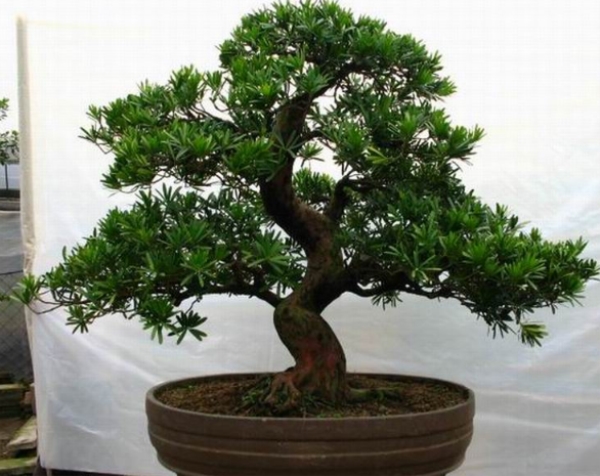
Buddhist pine is relatively tolerant of drought, so when watering during the growing season, be sure to remember the principle of preferring dry over wet! Only in this way can you grow a pot of vigorous, full-of-life Buddhist pine!
How to grow Buddhist pine: key points to note when growing Buddhist pine
Many people like Buddhist pine: it is evergreen all year round, has a good decorative effect, and carries excellent symbolic meaning, making it a very common bonsai in modern homes. After buying a Buddhist pine bonsai, some friends do not know how to grow it in daily life, how much to water it, how much fertilizer to apply, what to pay attention to, or how to make it grow well. In fact, growing a Buddhist pine bonsai is not difficult. Below, the editor will answer your questions. Let's take a look together.
Basic information about Buddhist pine:
Buddhist pine (scientific name: Podocarpus macrophyllus (Thunb.) D. Don) is a type of pine tree, also known as Luohanshan, evergreen Luohanshan, Tushan, money pine, immortal cypress, Luohan cypress, and Jiangnan cypress. It is an evergreen tree that can reach up to 18 m in height and is usually pruned to keep it low. Its leaves are alternate and arranged in a spiral shape. It is also dioecious. The female cone is larger than the seed and turns red when mature; together with the green seed, it looks like a bald monk wearing a red monk's robe, hence the name Luohan pine (Buddhist pine).
How to grow Buddhist pine:
1. Soil: It requires a slightly acidic growing medium rich in humus, loose and fertile, and well-drained. In alkaline soil, the leaves turn yellow and growth is slow. It is long-lived and can reach several hundred years old, or even over a thousand years.
2. Watering: Buddhist pine is not a plant in the Pinaceae family and is not drought-tolerant. On the contrary, Buddhist pine is tolerant of shade and moisture, and during the growing period it should be watered frequently, but it should not become waterlogged. In the Shunde area, on sunny summer days, water frequently; generally water once in the morning and once in the evening, and also spray water on the leaves regularly to keep the leaf color fresh green and the growth good. Summer rainfall is usually also plentiful, and Buddhist pine is not tolerant of waterlogging, so be careful to prevent prolonged standing water.
3. Sunlight: Buddhist pine is a neutral to shade-leaning tree species. It can accept relatively strong light and can also grow in a more shaded environment. Although summer temperatures are high and sunlight is intense, because large Buddhist pine trees benefit from high temperature and strong light for maintaining their tree posture and leaf shape, it is not necessary to shade large Buddhist pine trees in summer. However, Buddhist pine seedlings, because their tissues are tender, should not be exposed to strong light for long periods, and it is best to keep them under tree shade for care.
4. Temperature: For potted cultivation in northern regions, move the plant outdoors when the outdoor temperature is stable at around 10°C, and place it in a wind-sheltered, sunny spot outdoors for care. After summer begins, move it to a semi-shaded place. In winter, when the temperature does not drop to 5°C, it should be moved indoors. After moving indoors, control watering, and it can overwinter safely as long as conditions do not freeze.
5. Fertilizing: Buddhist pine likes fertilizer, so apply light fertilizer frequently, mainly nitrogen fertilizer, and an appropriate amount of black alum can be added and fermented into alum fertilizer water. During the growing period, fertilize once every 1 to 2 months. Fertilizing can be done together with watering (water-to-fertilizer ratio of 9:1).
6. Pests and diseases: The main diseases are leaf spot and anthracnose, which can be sprayed with a 500-fold dilution of 50% thiophanate-methyl wettable powder. Pests include scale insects, red spider mites, and bagworms, which can be killed by spraying with a 1500-fold dilution of 40% omethoate emulsifiable concentrate.
Key points to note when growing Buddhist pine:
1. Buddhist pine likes fertility, so when growing it, try to choose fertile soil; for example, sandy loam and leaf mold are relatively good. Of course, the soil's air permeability and drainage also need to be very good. During bonsai cultivation, also be careful to keep the pot soil moist to ensure a sufficient water supply during the growth period of Buddhist pine. In summer, water evaporates quickly, so frequent watering is needed. In winter, when temperatures are low, watering should be reduced. At the same time, to avoid water accumulation in the pot, watering must be moderate, neither too much nor too wet. Also be careful to place the Buddhist pine bonsai in a ventilated and air-permeable place.
2. Buddhist pine likes light, but it is also very averse to direct sunlight, so it is usually best to keep it indoors for cultivation. At the same time, in summer, when the sun is scorching, be careful to shade it. In addition, when Buddhist pine grows to a certain extent and the plant becomes larger, it needs to be repotted. Also pay attention to pest and disease control and regular pruning for the Buddhist pine bonsai. Buddhist pine has relatively many pests and diseases. If any are found during cultivation, they should be dealt with promptly. Pruning can be carried out according to everyone's ideas, and usually can be done by cutting, tying, and pressing.
If you want to learn more related information, you can continue to follow No. 1 Home Network.
How to grow mini Buddhist pine and key points to note!
Mini Buddhist pine is a precious and rare tree species unique to Guangxi, and it is also a species endemic to China. It is naturally suited to being made into bonsai. Its tree posture is graceful, and its bearing is simple, ancient, and vigorous. Its leaves are short, small, dense, and glossy. It has strong sprouting ability, luxuriant branches and leaves, and is evergreen all year round. Its root system is well developed, and the roots are covered with small root nodules. It grows slowly and is loved by people for its long lifespan and elegant taste. Today, we will briefly introduce how to grow mini Buddhist pine and the key points to note.
How to grow mini Buddhist pine
The small seedlings of mini Buddhist pine bonsai are usually obtained by artificial propagation methods such as sowing and cuttings. There are also wild mini Buddhist pines in the mountains and fields, generally growing in rock crevices. You can collect plants that are short, have quaint branches and trunks, and graceful posture.
Mini Buddhist pine is usually potted before sprouting in spring. The potting soil should preferably be loose-textured, well-drained, slightly acidic sandy loam. Because its posture is simple and elegant, it is suitable to use purple clay pots or glazed ceramic pots for cultivation, and the pot shape is determined by the tree shape.
The shaping of mini Buddhist pine is mostly carried out during the dormant period, mainly by wiring and bending, with pruning as a supplement. Common forms include curved-trunk style, slanting-trunk style, lying-cloud style, cascade style, and exposed-root style. Its branches and leaves can be pruned into sheet-like or steamed-bun-like shapes.
During the growth period, applying appropriate fertilizer to mini Buddhist pine can increase its growth space, but after it becomes a mature plant, it is actually no longer suitable for fertilizing. Generally, in spring, a little light fertilizer can be applied appropriately to nourish the soil.
Mini Buddhist pine relatively likes a moist environment and needs frequent watering. Especially in summer, water should be sprayed on its leaf surface and the surrounding space to increase the air humidity around the potted plant, so as to facilitate better growth.
Key points to note when growing mini Buddhist pine
The main diseases of mini Buddhist pine are sooty mold and leaf spot. For leaf spot, spray a 60-800-fold dilution of 50% carbendazim or thiophanate-methyl wettable powder for control. For sooty mold, wash it off with soapy water or clean water. Pests include scale insects, aphids, red spider mites, longhorn beetles, and bagworms, which can be killed by spraying a 1000-fold dilution of 40% omethoate emulsifier or a 1000-fold dilution of 80% dichlorvos emulsifier. Mite pests can be killed and controlled by spraying dicofol.