How to grow white magnolia (Michelia alba)? A detailed guide to the correct cultivation methods
Pot and soil selection
White magnolia prefers loose, fertile, well-draining and airy soil rich in humus. Granular soil of various shapes has good aeration and drainage.
Flower pots should also be chosen for good aeration; clay pots, purple clay pots and plastic pots with many drainage holes at the bottom can be used. The pot size should be chosen to suit the plant's growth according to the size of the canopy and the age of the plant.
Repotting
White magnolia grows relatively quickly, so it should be repotted in good time. Stop watering before repotting and do it when the potting soil is relatively dry. Tilt the pot slightly or turn it upside down, support the pot with your hand and hold the plant, then tip it out. Clean the soil off the roots, cut off any rotten or aged roots, place it in a new pot, apply a suitable amount of base fertilizer, and water thoroughly.
Planting position
The time to move potted white magnolia outdoors is March to April each year; simply place it in a spot with sufficient light. In summer, when temperatures are high, shade netting or a simple shade shed should be used accordingly for cooling care, so that the white magnolia receives sufficient light while also avoiding excessive direct strong light, preventing the branches and leaves from being scorched by sunburn.
Pruning
When pruning the terminal buds and shortening some side branches, pay attention to choosing the height; a suitable pruning position will promote side branches, flower buds and blooming. Before placing the white magnolia indoors, remove dry, leggy, diseased and overly dense branches to reduce nutrient consumption to a minimum; when placed outdoors, the old leaves at the base of the branches can be removed as appropriate, which helps stimulate the growth of new branches.
Fertilizing
White magnolia is relatively fond of fertilizer. During the growing season it should be fertilized once every half month; a compound fertilizer can be used, 2-6 grams each time. Be careful not to let the fertilizer come into direct contact with the roots when fertilizing, to avoid "burning the roots." Stop fertilizing in winter. During the growing season, fertilize with water once every 3-4 days, and once every 5-6 days during the flowering period. Of course, by applying light fertilizer frequently, the number of fertilizations can be changed according to the situation.
Watering
Remember never to overwater the white magnolia; overwatering will cause waterlogging and root rot. Water according to the principle of "don't water until dry." In summer, when temperatures are high or the air is dry, you can sprinkle an appropriate amount of water around the plant. In the rainy season, promptly pour off any accumulated water in the pot.
Temperature
White magnolia is susceptible to cold damage, so temperature is the key to whether it can safely overwinter. Outside South China, it must be brought indoors for care in winter, and the room temperature should be kept at a minimum of 5°C or above, until the Qingming and Guyu periods, when it can be placed outdoors again. In summer, when temperatures are high, effective measures should be taken to help the white magnolia cool down.
Light
White magnolia naturally prefers an environment with sufficient light, but in summer, when the light is too intense, certain shading measures should also be taken to avoid direct strong light, generally paying special attention to the light at noon. When grown indoors, it should be placed in a spot with sufficient light.
Pest and disease control
Common white magnolia diseases include chlorosis, root rot and anthracnose. Before diseases occur, enhance the plant's resistance through ventilation and air movement, loosening the soil and controlling watering; after diseases occur, immediately carry out scientific spraying of medicinal solutions.
Common pests include red spider mites, scale insects and aphids. Before pests occur, spray water frequently to raise humidity as a preventive measure; after pests occur, if the infestation is mild, the leaves can be rinsed with clean water, and if severe, insecticide must be sprayed.
Propagation
White magnolia can be propagated by four methods: grafting, cuttings, layering and sowing, but grafting and layering are commonly used.
Layering is suitable in June-July; use the air layering method and keep the plant moist, and roots will form in about 2 months.
For grafting, the rootstock should be two-year-old branches. In the plum rain season, take branches of the same thickness as the rootstock. About 60-70 days after grafting is completed, the union will have healed, and it can then be cut away from the mother plant.
How to grow white magnolia (Michelia alba)? Cultivation methods and care guide
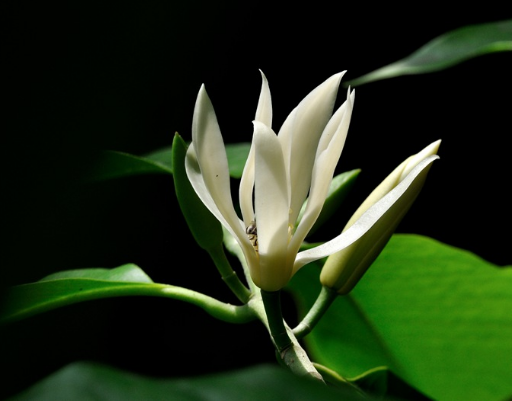
White magnolia, pure white and elegant, has a unique scent and is deeply loved by flower enthusiasts, but there are relatively few white magnolias now, and not many people grow them. I wonder whether the many flower lovers out there have grown this flower. In the season when white magnolia blooms, there are even elderly people who come out to sell the flowers; they string the flowers together with wire, and they can also be hung on the body, very beautiful. Since white magnolia cannot be propagated by cuttings, we generally choose grafting or layering to propagate it. Although such operations are complicated, flower lovers who have the conditions can give it a try.
The grafting method uses a rootstock, generally 2- to 3-year-old Michelia figo or magnolia trees. In May and June, we can graft white magnolia branches onto the rootstock, wrap them well with plastic film and care for them normally. For the layering method, it is best to use a white magnolia over three years old; choose a thick, sturdy branch 1 to 2 years old from the upper part, and the branch should be longer than 15 cm. At that time, at the end, cut off 3/4 of the bark at 5 cm. After cutting, spray with carbendazim solution to disinfect, then wrap with slightly moist soil, fix it at the peeled position, spray water to keep the soil moist, and after about ten days you can cut the branch below.
Score it a little each week, and after two months, cut the branch; by then it should basically have rooted and can be planted directly. Following the two propagation methods above, if it is too troublesome, you can also directly buy white magnolia seedlings. White magnolia seedlings are not too expensive now, but you must distinguish true from false. White magnolia grows relatively slowly, and some flower lovers buy seedlings that have grown for more than a year to grow. Everyone says white magnolia is rather delicate, but once you establish a routine, it can be grown for decades. What soil does white magnolia use? For a flower that grows like a tree, it is best to use relatively firm native soil, or mix in leaf mold for planting.
For the flower pot, use a ceramic pot or porcelain pot, a pot with relatively good aeration. White magnolia is relatively sensitive to water quality, so we had best use clean tap water, let it settle, and then water with it. It relatively likes water but fears waterlogging, so it is not suitable to water a lot each time. Watering by spraying is recommended, as this can both clean the white magnolia's leaves and let the leaves and branches drink their fill. Can white magnolia be exposed to the sun? White magnolia relatively likes sunlight, but it is best to place it at home in a spot with relatively good light, and in summer be sure to avoid shade.
Before 10 a.m. it can get light, but after that time it must be moved to a cool place. Regarding the problems of yellow leaves and bud drop in white magnolia, white magnolia sold in flower markets generally uses southern clay soil, which is very sticky. After flower lovers buy it and take it home, it is generally placed indoors without ventilation, and on top of that the potting soil is not airy and watering causes waterlogging. Over time, the leaves and roots rot this way, and the white magnolia will not live long either. Growing a white magnolia at home is simple and easy to care for, and can make the whole house fragrant.
But when we generally buy white magnolia in clay soil, we must first wash the roots when we get home, but be careful not to damage the roots. After drying, replant it in airy garden soil mixed with leaf mold, and then it can be grown at home. If we do not want to wash the roots and change the soil, it is best to keep the newly bought white magnolia in a ventilated courtyard or on a balcony.
White magnolia blooms only in summer and autumn, and it is not cold-tolerant in winter, so it needs to be kept warm. If we grow it well, it can also bloom in a heated room. Grafted white magnolia can bloom only after growing to about 50 cm, while layered ones will bloom a bit earlier. The flower buds can be picked off, threaded with string, and hung at the head of the bed, which has a calming effect.
White magnolia pruning methods, how to grow white magnolia
White magnolia pruning methods:
In summer, when the white magnolia grows vigorously, choose a 3—5 cm section where new buds have emerged for pruning. After pruning, immediately seal the wound with a mud ball mixed with fungicide and auxin, and wrap it tightly on the outside with a small plastic film.
Conclusion: Have you all understood the above knowledge about how to grow white magnolia? The fresh fragrance of white magnolia leaves the deepest impression. Although the flowers are delicate and small, their fresh fragrance fills the nose, and the scent of white magnolia is different from that of other flowers. It is a fragrance that is neither arrogant nor impatient, a fragrance with endless aftertaste, a fragrance that makes people very nostalgic.
How to grow white magnolia: Watering:Whether watering is done properly is the key to caring well for white magnolia. White magnolia likes a moist environment and is not tolerant of drought. But it has fleshy roots, so if drainage in the pot is poor, accumulated water will inevitably cause root rot. Therefore, it should not be watered too frequently or excessively. The principle for watering white magnolia is that the frequency should be less rather than more, and each watering should soak through.
In spring and autumn, water once a day. Water appropriately according to the size of the pot. Watering should ensure that the roots can absorb water, but also not cause waterlogging.
In summer, water once each in the morning and evening; if it is too dry, spray water on the leaves. Generally, as soon as you see the leaves drooping, it is time to water. If the soil temperature is high at noon and there is a sudden shower, the water temperature in the pot will rise, which is extremely harmful to the roots, so water immediately to lower the temperature.
In winter, when potted flowers are brought indoors, let the soil surface dry before watering, and when watering, soak through. If you find the branch tips shrinking and turning withered and yellow, it may be caused by roots being damaged by excessive moisture; immediately control the water and loosen the soil. If you find the leaves suddenly wilting, it may be caused by the potting soil being too dry; water promptly and place it in a cool place to recover.
On rainy days, prevent water from accumulating in the pot, and pour off any accumulated water in the pot at any time.
For watering, it is best to use rainwater or pond water. If using tap water, place it in a container for about 2 hours before watering. Do not use stagnant water that has been stored for a long time, and do not water flowers with water that contains many impurities and is somewhat alkaline.
In summer, the water temperature for watering flowers should be slightly lower than the soil temperature, and in winter slightly higher.
Fertilizing:Fertilizing: White magnolia has a long flowering period and blooms many times, consuming a lot of nutrients, so it needs frequent additional fertilizing, applying light fertilizer frequently.
After being moved out of the room, a dilute liquid fertilizer at 6~7 times dilution can be applied, with additional fertilizing once every week.
During the vigorous growth period, that is, between May~June or July~August, a flower fertilizer can be applied once every half month, or a small amount of nitrogen, phosphorus and potassium compound fertilizer can be applied about every 20 days, about 2~6 grams each time. When fertilizing, do not scatter the fertilizer directly at the plant's roots, as it easily burns the roots. You can make a few furrows in the pot, then scatter the fertilizer into the furrows, cover it with the surface soil of the pot, water a little, and let the fertilizer slowly seep into the plant's roots with the water.
During the full flowering period, apply a liquid fertilizer mainly of phosphorus and potassium once every 3~4 days. Fertilizing should be done in the evening on a sunny day after the potting soil has dried, and the next day water thoroughly once, to facilitate root absorption and also avoid burning the roots.
Sunlight:White magnolia by nature very much likes sunlight, so its growing environment cannot be separated from sunlight, but in summer we must be sure to prevent drought. If the summer sunlight is too intense and there is no careful care, white magnolia is prone to drought and withering.