What should be noted when planting and caring for pagoda tree flowers?
1. Weed promptly
Grass usually grows around pagoda tree flowers, and the same is true for potted plants. We cannot use herbicides, because they would affect the growth of pagoda tree flowers. We can only weed manually by hand, removing the grass roots and all.
2. Pruning
Timely pruning helps keep the pagoda tree's shape beautiful, and more importantly, it ensures that every branch tip of the pagoda tree can bloom.
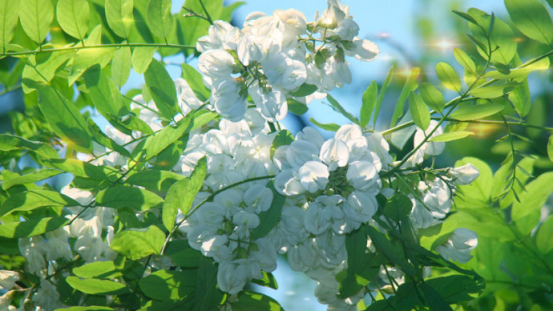
After reading this article, don't you think pagoda tree flowers are easier to grow than you imagined? So what are you waiting for? Hurry and plant one of your own!
How to grow pagoda tree flowers and points to note
Chinese scientific name: Huaihua (pagoda tree flower)Latin scientific name: Sophora japonica LinnAlso known as: black locust flowerKingdom: PlantaeDivision: MagnoliophytaClass: MagnoliopsidaOrder: FabalesFamily: FabaceaeSubfamily: FaboideaeTribe: SophoreaeGenus: StyphnolobiumDistribution: native to northern China, most common on the Loess Plateau. Also distributed in Japan, Korea and Vietnam.English name: sophora flowerIn the broad sense, black locust flower refers to the flowers and flower buds of plants in the Fabaceae family, but generally the open flowers are called "huaihua", also known as "huai rui", while the flower buds are called "huai mi". They are often planted beside houses and roads, and are widely cultivated throughout China, mainly in the north, especially on the Loess Plateau and the North China Plain. They usually bloom from April to May each year, and the flowering period is generally about 10-15 days. Black locust flowers have good ornamental value. When the flowering season arrives, strings of pure white flowers cover the branches, and a faint, simple and elegant fragrance fills the air, refreshing the heart. In ancient Chinese poetry related to huaihua, such as: "How much the rustling autumn wind brings, half the huaihua has become fruit" (Bai Juyi, "Autumn Day"), "The wind dances and huaihua falls into the imperial ditch, the colors of Zhongnan Mountain enter the city's autumn" (Zilan, "Early Autumn in Chang'an"), these poems praise the native Chinese species Sophora japonica, not the black locust or black locust tree, because black locust was introduced to China from North America only in the second half of the 19th century. This point must be clearly distinguished.1. Plant characteristics
Pagoda tree flowers are shrunken and curled, with petals mostly fallen off. In complete ones, the calyx is bell-shaped, yellow-green, with 5 shallow lobes at the apex; there are 5 petals, yellow or yellow-white, 1 petal larger, nearly round, slightly concave at the apex, and the other 4 petals oblong. There are 10 stamens, 9 of which are united at the base, with slender filaments. The pistil is cylindrical and curved. Light in weight. Slight odor, slightly bitter taste. Pagoda tree flowers (black locust) are multiple flowers, in racemes, with papilionaceous corollas, hanging in overlapping clusters when in full bloom. The small flowers are mostly shrunken and curled, with petals mostly fallen off; in complete ones, the calyx is bell-shaped, yellow-green, with 5 shallow lobes at the apex; there are 5 petals, mostly yellow or yellow-white, though there are also other colors such as purplish red (see picture), usually 1 petal larger, nearly round, slightly concave at the apex, and the other 4 petals oblong; there are 10 stamens, 9 of which are united at the base, with slender filaments; the pistil is cylindrical and curved.How to grow potted pagoda tree flowers and points to note
How to grow pagoda tree flowers
Sowing
Although the pagoda tree looks tall and large, it can actually be propagated from seeds. Choose mature, plump seeds, soak them in warm water for 24 hours, take them out and mix them evenly with 2-3 times their volume of fine sand, then place them in an environment of about 20°C for germination. During germination, turn them often to ensure the temperature above and below the seeds is consistent. Once the seeds sprout, they can be planted. Note that the pagoda tree's root system is relatively long, so a larger and deeper flower pot should be chosen. Sowing is best done in open ground, where growth is faster, and after they grow into small plants they can be transplanted into pots.
Thinning seedlings
In the year of sowing, when the plants grow to 10-15 cm, they can be planted in pots. Choose a deeper flower pot and ensure sufficient sunlight. For some weak and thin seedlings, they can be removed directly.
Fertilizing
Sufficient nutrients help the pagoda tree flowers grow. During the growth period of pagoda tree flowers, sprinkle a little granular fertilizer around the pot soil, then water, or directly apply fertilizer water. For smaller flower pots, water and loosen the soil promptly after fertilizing. Fertilizers used at home are usually bean cake, horse hoof slices and sheep horns, used after fermentation.
Pruning
The pagoda tree grows at a moderate rate. During the seedling growth period, pinch off the tops promptly to promote branching. Remove aging and yellowing branches and leaves promptly.
Points to note when growing pagoda tree flowers
Weed promptly
Perhaps because the pagoda tree flower is highly tolerant, many weeds grow around it. The same is true for potted plants. It is recommended not to use herbicides, as they will have a certain effect on the growth of pagoda tree flowers. Loosen the soil and weed by hand, pulling the grass out roots and all.
Pruning
Timely pruning helps ensure the pagoda tree's shape is perfect, and there is another very important point: potted pagoda tree flowers can be dwarfed through pruning to promote branching, so that every branch tip is full of flowers.