Care methods and precautions for Lewisia cotyledon during its blooming period
During the blooming period, the watering frequency should be increased appropriately, as the flowering period has a high demand for water and moisture must be replenished in time, but be careful not to let water accumulate. Lewisia cotyledon, which blooms many times, likewise needs sufficient nutrients. After entering its blooming period in June, it will continue to bloom intermittently until October. Fertilizer should be applied appropriately every month, mainly phosphorus fertilizer, once or twice each time, and over-fertilizing must be avoided.
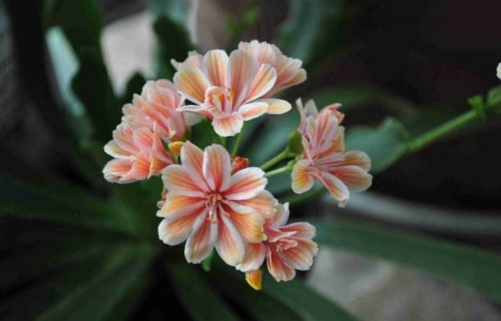
The blooming period of Lewisia cotyledon
The blooming period of Lewisia cotyledon is very long, so there is no need to worry about missing the flowers because the blooming period is too short. Its blooming period lasts about four months, and it usually blooms from June to October each year. However, Lewisia cotyledon does not bloom continuously for four months; instead, it blooms in alternating, intermittent cycles. For example, in a single year, after it blooms once, a second bloom will soon follow, then a third, a fourth, and so on.
During the blooming period of Lewisia cotyledon, some flowers grow relatively quickly, so they bloom in early summer, but this is only a very small portion. Most Lewisia cotyledon plants bloom in midsummer, that is, in June. Because Lewisia cotyledon does not have high temperature requirements, it can produce its most beautiful flowers even in the hot summer.
Now that you know when Lewisia cotyledon blooms, do not miss the blooming period again, or you will not get to see the flowers. Below, let us look at the flower language of Lewisia cotyledon and its care during blooming.
When does the coral flower bloom? Which months are the blooming period of the coral flower?
The petals of the coral flower are Xichang, generally mainly red. Seen from a distance, they look like individual corals and are very beautiful, which is how the plant got its name. Coral flowers are now grown in many places. As a plant grown for its ornamental flowers, what everyone most wants to know is surely its blooming period.
When does the coral flower bloom?
There is no fixed blooming time for the coral flower. This mainly depends on individual cultivation techniques and the variety. Some need to be grown for three years before they bloom, and if propagated from seed, they need five years to bloom. However, with good cultivation, they will bloom earlier.
Which months are the blooming period of the coral flower?
The blooming period of the coral flower is from June to August. The flowers are pink-purple, about 5 cm long, with sticky hairs, labiate, the corolla tube slightly shorter than or equal in length to the lip, the upper lip slightly concave at the tip, the lower lip reversed, with a shallowly lobed tip; the stamens are exserted, inserted at the throat, the filaments filiform, 2.5 cm long, the anther cells unequal in height, the connective wide.
Correct cultivation methods for the coral flower
1. Light and temperature. The coral flower likes light. In the hot midsummer, pay attention to shading and do not let direct sunlight hit it; at ordinary times, make sure it gets enough light. As for temperature, different regions have different temperatures, so the requirements differ. In the north, it can generally be moved indoors for care in early to mid-October, and indoors it should be placed in a spot with ample sunlight. During overwintering, the indoor temperature needs to be kept at around 12°C or above.
2. Watering and fertilizing. During the growth period of the coral flower, do not water frequently, as too much moisture easily causes leaf drop and root rot. However, pay attention to spraying water on the leaf surfaces and around the potting soil to maintain the humidity of the leaves and the environment. Apply dilute cake fertilizer water regularly, about once every 10 days; when winter comes, remember to stop fertilizing.
3. Pruning. After the coral flower seedlings are potted, when they grow to a height of about 15 cm, pinch off the growing tips to promote branching and flowering. For mature plants, after repotting, prune once every year in early spring to promote balanced plant growth and development and ensure the plant's graceful form.
4. Prevention and control of pests and diseases. In high-temperature environments, the coral flower is prone to leaf spot disease, which must be controlled in time. It can be sprayed with a 600-fold dilution of 65% zineb wettable powder. Common pests of the coral flower include slug moths, leafhoppers and aphids, which can be killed by spraying with a 2000-fold dilution of 10% chlordecone emulsifiable concentrate.
How to propagate the coral flower
1. Propagation by sowing. Coral flower seeds vary in size, and generally smaller seeds are superior for planting. You can use your hands or another tool to pick up the tiny seeds, or use a toothpick dipped in water to stick the seeds onto the surface of the substrate, then cover with soil, not too thick. After that, place the sowing pot into water, keeping the water depth at half the height of the pot. Choose a suitable pot, fill it with loose, fertile, slightly acidic soil, then simply drop the seeds in and cover with a thin layer of soil.
2. Propagation by cuttings. For coral flower cuttings, a mixed substrate of wet sand and bran ash is needed, or clean sandy loam can be used directly. Temperature and light for coral flower cuttings: the cuttings used for coral flower propagation will only sprout and root in an environment with a temperature of about 20°C to 30°C. It must not be lower than 20°C, otherwise normal sprouting will be affected, and the cut end will be infected by pathogens and rot. After rooting, use a culture soil mixed from leaf mold, garden soil and a small amount of sandy soil for care, and add a small amount of bone meal as a base fertilizer. Pay attention to regular pruning. When mature plants are repotted, prune once in early spring, cutting away some of the lush branches to help light absorption, and also cut away diseased and damaged branches and leaves.
The coral flower likes warmth, so its blooming period is in summer each year. Some coral flowers take several years to bloom, so during this time cultivation work must be done well. Proper watering and fertilizing are both necessary conditions to ensure its normal growth. If you want it to bloom more, you can propagate it, most commonly by cuttings and by sowing.