How to grow yellow allamanda? Detailed guide to cultivation methods and precautions
1. Placement and light
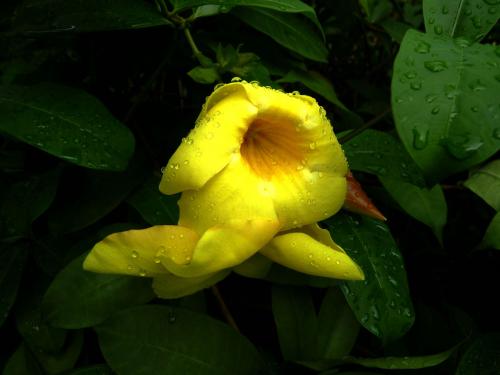
Yellow allamanda likes a hot, humid environment with plenty of light, so place it in a courtyard or a spot with direct sunlight. However, be careful never to keep it indoors, so as to avoid accidental poisoning.
2. Watering
Yellow allamanda is tolerant of wet conditions and likes a humid environment, so water it frequently during its growing season, but reduce watering in winter.
3. Soil
Yellow allamanda is not demanding about soil. Like other plants, it needs fertile soil with good drainage, which promotes its growth.
4. Fertilising
Yellow allamanda needs sufficient nutrients to grow well, so fertilise it regularly, generally once every half month.
5. Pest and disease control
Although yellow allamanda is toxic, it can still suffer from pests and diseases. Once pests are found, spray insecticide immediately, which is both fast and effective. If the plant is found to be infected by a virus, cut off the diseased branches, which is simple and quick, but be careful not to touch the plant's sap.
That's all for today's content. I hope it has been helpful to you! Thank you for reading!
How to grow red allamanda and precautions
Chinese scientific name: red allamandaLatin scientific name: Mandevilla sanderiAlso known as: red-flowered dipladeniaKingdom: PlantaeFamily: ApocynaceaeDistribution: native to BrazilRed allamanda, about 20-40 cm tall, the whole plant has white sap. Suitable for potted cultivation or group planting in courtyards for landscaping; not suitable as a shade-trellis plant.1. Morphological characteristics
Leaves opposite, long heart-shaped, smooth on both sides. Flowers from summer to autumn, funnel-shaped, corolla with 5 lobes, peach-red, the flower tube swollen and bright yellow; the flower form and colour are delicate and gorgeous.2. Growth habits
It likes high temperatures; the suitable growing temperature is 22-28 degrees; in winter it needs warmth and shelter from the wind3. Main varieties
1. Red Mill dipladenia; a hybrid variety that won the 2007 French International Horticultural Flower Gold Award. Characteristics: large flowers with vivid colour, opening light purple and turning deep purple when fully open, with a long flowering period.2. Double-flowered dipladenia; the double-flowered variety of Red Mill. Characteristics as above, with larger, double flowers and higher ornamental value.
3. Purple-flowered dipladenia; characteristics: shorter plant, more densely arranged leaves, smaller flowers, deep purplish-red, with a yellow throat.
4. Lovely dipladenia; characteristics: emerald-green leaves, narrow ovate leaves, large trumpet-shaped white flowers with a yellow throat, strong fragrance, flowering in summer.
5. Yellow-flowered dipladenia; characteristics: soft branches, narrow ovate sparsely arranged leaves, yellow flowers with a star-shaped band in the centre, unique appearance, rich fragrance.
6. Bolivian dipladenia; characteristics: relatively short and small plant, dense leaves, white flowers with a yellow throat, flowering all year round.
How to grow purple allamanda and precautions
Chinese scientific name: purple allamandaLatin scientific name: Allamanda violaceaAlso known as: purple-flowered yellow allamandaKingdom: PlantaeDivision: SpermatophytaSubdivision: AngiospermaeClass: DicotyledoneaeOrder: GentianalesFamily: ApocynaceaeGenus: AllamandaDistribution: Brazil, China's Guangxi; Guangdong; Fujian; Taiwan, China; BeijingFlowering period: 3-4 monthsGrowth habit: likes high temperaturesThe stems of purple allamanda are trailing, and the whole plant has white sap. Leaves in whorls of 4, long elliptic or obovate-lanceolate. Flowers from late spring to autumn, axillary, funnel-shaped, corolla with 5 lobes, dark peach-red or pale purplish-red, soft and pleasing to the eye, with a flowering period as long as 3-4 months. Purple allamanda is an elegant woody flower that likes warmth and humidity and is suited to red soil. It originated in Brazil and is a wild resource (individual). This variety is high quality and stress-resistant, and its main use is ornamental1. Growth habits
It likes high temperatures; the suitable growing temperature is 23-30 degrees.2. Species distribution
Native to Brazil.