A detailed guide to planting yellow oleander (Allamanda), easily master the planting techniques
The first method - seed sowing
First, collect the seeds of yellow oleander, but the seeds of yellow oleander do not store well, so it is best to sow them right after collecting.
The second method - layering
Choose a branch close to the ground, then cut and wound the branch and press it into the soil. After the yellow oleander has rooted, separate it from the mother plant; this is layering propagation.
The third method - cuttings
There are many kinds of cuttings, and the one with the highest survival rate for yellow oleander is water propagation. First cut a well-developed branch, then insert it into a glass bottle filled with water, then change the water frequently until it roots, and finally plant it into the soil.
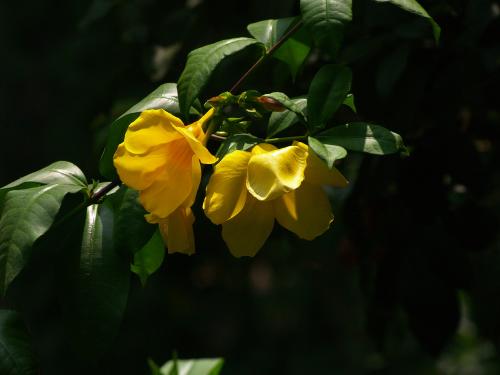
Well, that is all for today's content. I hope the editor's content can help you better understand yellow oleander! Thank you!
How to plant yellow oleander - planting methods for yellow oleander
Yellow oleander is often used for garden landscaping. The plant is dense, the leaves are emerald green, and the flowers are bright and brilliant, very eye-catching. It is suitable as a medium to large potted plant, decorating living rooms, balconies, parks, shopping malls, conference halls and other large indoor spaces, with very good results. Next, follow the editor to take a look at how to plant yellow oleander and the planting methods for yellow oleander.
Introduction to yellow oleander
Yellow oleander (scientific name: Allemanda neriifolia Hook.): an evergreen shrub, the plant grows upright, about 2 m tall, and potted plants are generally kept at about 1 m. Leaves are in whorls of 3 to 5, the leaf blade is elliptical or oblanceolate-oblong, 5 cm to 12 cm long and 1.5 cm to 4 cm wide, covered with short soft hairs. Cyme, flowers golden yellow, with orange-red stripes at the throat, corolla broadly funnel-shaped, with 5 lobes overlapping to the left or right, the base of the corolla swollen, with 5 stamens borne inside. Capsule spherical, with long spines. Flowering period May-June. Native to the southern United States and Brazil, distributed in tropical America, introduced and cultivated in China. Used for garden landscaping, the plant is dense, the leaves are emerald green, and the flowers are bright and brilliant, very eye-catching. It is suitable as a medium to large potted plant, decorating living rooms, balconies, parks, shopping malls, conference halls and other large indoor spaces, with very good results.
I. Morphological characteristics
Branches: Yellow oleander is an upright shrub, 1-2 m tall, with milky juice; the branches are grayish white.
Leaves: The leaves of yellow oleander are in whorls of 3-5, entire, elliptical or obovate-oblong, 6-12 cm long and 2-4 cm wide, apex acuminate or acute, base cuneate, dark green above, light green beneath, except for the midvein and lateral veins on the underside being covered with short soft hairs, the rest is hairless; the veins are flat on the upper surface and raised on the lower surface, lateral veins 7-12 on each side, anastomosing before reaching the margin; petiole very short, with glands at the base and in the axils.
Flowers: Yellow oleander has terminal cymes; the peduncle and pedicels are covered with chaffy puberulence; flowers orange-yellow, 4-6 cm long, the open mouth about 4 cm in diameter; bracts lanceolate, borne at the base of the pedicel; calyx deeply 5-lobed, the lobes lanceolate, with a few glands at the inner base: corolla funnel-shaped, with red-brown stripes inside, the lower part of the corolla cylindrical, no more than 2 cm long, 2-4 mm in diameter, swollen at the base, the throat expanding upward into a limb, about 3 cm long and about 1.5 cm in diameter, the top of the limb 5-lobed, the corolla lobes overlapping to the left, the lobes ovate or circular, apex obtuse, 1.6-2.0 cm long and about 1.7 cm wide; stamens 5, borne at the throat of the corolla tube, filaments short, base covered with soft hairs, anthers ovate, apex obtuse, base rounded; disc fleshy, entire, surrounding the base of the ovary; ovary entire, 1-locular, style filiform, stigma apex obtuse, base annular. The flowering period of yellow oleander is May-August.
Fruit: The capsule of yellow oleander is spherical, with long spines, about 3 cm in diameter; seeds flat, with a membranous margin, about 2 cm long and 1.5 cm wide. The fruiting period of yellow oleander is October-December.
II. Ecological habits
Yellow oleander likes high temperatures, much humidity, and full sunlight, and is slightly tolerant of semi-shade. It is suitable for fertile, well-drained soil. It is not cold-tolerant and avoids frost; when exposed to long-term low temperatures of 5-6°C, the branches and leaves are damaged.
Yellow oleander likes fertile, moist sandy loam soil, and grows poorly in heavy clay soil; it avoids waterlogging and saline-alkali land. It is relatively tolerant of moisture and not tolerant of drought, and the soil should be kept moist regularly. The suitable growth temperature is 18-30°C, and it can also grow normally above 35°C. The suitable temperature during the winter dormancy period is 12-15°C, and it must not be lower than 10°C; below 5°C the plant suffers cold damage.
III. Propagation methods
1. Seed propagation
Yellow oleander sets fruit after flowering. The capsule has soft spines, and the seeds have wings. They should not be stored for long and are best sown as soon as collected. One-year-old seedlings can leave the nursery.
2. Layering propagation
Layering is carried out during the rainy season. Cut and wound the bark of a branch near the ground and press it into the soil. It roots after about 2 months, and can then be separated from the mother plant.
3. Cutting propagation
Water propagation is especially easy to root and can be done during the growing season. Cut a 30-40 cm long branch, split the lower end open 4-6 cm with a small knife, insert it into a glass filled with water. Spring and autumn temperatures are more suitable, and roots can grow in about 2-3 weeks. For water propagation in summer, because the temperature is higher, the water easily spoils, so change to clean water once every two days.
In production, cutting propagation is mostly used for raising seedlings. From late March to mid-April, after the temperature steadily rises, cut half-year-old to 2-year-old branches as cuttings, insert them densely into wet sand or a sand-stone bed, and spray to keep moist. When the temperature is above 20°C, roots can develop in about 20 days, and after about 40 days they can be moved to the nursery for cultivation or potted.
IV. Toxicity of yellow oleander
The milky juice of the yellow oleander plant is toxic. Poisoning in humans and livestock stimulates the heart, and the circulatory system and respiratory system are affected. Pregnant animals that eat it by mistake will miscarry.
Cultivation techniques for yellow oleander
1. Environment
Use peat soil or leaf mold for potting. It likes warmth, and the minimum winter temperature should be above 15°C; it is a strongly sun-loving plant, and in summer it can be moved outdoors to grow in sunlight, while in winter it is placed indoors in a spot with direct sunlight. It likes a humid environment. From spring to autumn, keep sufficient water in the pot soil, and in winter reduce watering appropriately, keeping the pot soil slightly moist.
2. Water and fertilizer
During the growing season, keep the soil moist regularly and fertilize once every 20 days to promote vigorous shoots and continuous flowering. Control water during the dormancy period. Generally, do not fertilize plants after cold damage, and watering should also be moderate; water must be well controlled, because plants in the recovery period find it hard to absorb nutrients, and if too much water is given, the plant cannot absorb it either, which instead causes its roots to rot. It likes fertilizer. When planting, apply decomposed cake fertilizer or garbage as a base fertilizer. Before flowering in spring and during the peak flowering period in summer, apply compound fertilizer once each, which can promote more flowering and prolong the flowering period.
3. Planting
When yellow oleander is a small seedling, it can first be planted in the ground, and the tips should be pinched in time to develop branches. After the branches reach 5-6 branches, it can then be moved into a pot. The root system is well developed, and potted plants should be repotted once every year or every other year. Nursery seedlings can leave the nursery the next year and bloom for viewing. Prune and shape to cultivate a dwarfed plant form. Pruning is carried out in late winter and early spring. Carry out timely cultivating and weeding and control pests and diseases.
4. Pruning
The branches are mostly uneven. Every winter and spring, prune heavily once to make it produce more lateral branches and form a rounded crown, or coil the longer trailing branches into a round ball shape, controlling excessive branch growth, which can promote more flowering and also make the form more beautiful. The branches easily age, and at 5-6 years old all the old branches can be cut off to let it sprout and renew or be replanted. If the branches and leaves of some plants remain after turning yellow and withered without falling off, then the plant's normal photosynthesis, transpiration, and respiration will be affected, so the yellowed and withered branches and leaves should be cut off. In this way, the remaining branches and leaves will better absorb nutrients, which is also conducive to the plant sprouting again and avoids disease infection. After pruning, 2-year-old yellow oleander seedlings can sprout many branches, forming a full crown and flowering more, entering the peak ornamental period.
Pest and disease control for yellow oleander
1. Sooty mold
Symptoms: Part or most of the crown surface of the affected plant appears black, and some branches also turn black. The surface of the affected part is covered with black mold, and the black mold feels sticky to the touch. In the later stage, the black mold on the leaf surface can partially peel off, causing the leaves to appear mottled black and white. Severely affected plants have blocked photosynthesis, poor growth, early defoliation, and reduced ornamental value.
Pathogen: It is a fungus of the subphylum Ascomycotina, including Capnodium spp., Neocapnodium spp. and many others. Its asexual stage is mostly scattered sooty mold.
Occurrence pattern: In Guangdong, the asexual stage of the pathogen is commonly seen. The pathogen overwinters as superficial mycelium on diseased parts or diseased residues, and reproduces using the honeydew secreted by scale insects as nutrients, spreading through wind and rain and the activity of scale insects. Garden and nursery ecological conditions favorable to scale insect reproduction and damage are also favorable to the occurrence of sooty mold.
Control methods: 1. Improve the ventilation conditions of the garden and nursery.
2. Spray pesticides to control insects and the disease. You can spray 40% Supracide emulsifiable concentrate at 1000-3000 times dilution, or 40% Lorsban emulsifiable concentrate at 1000 times dilution, or 25% Yudele (buprofezin) emulsifiable concentrate at 2000 times dilution (for scale insects, spray the dilute solution at the nymph stage), or spray 50% pirimicarb emulsifiable concentrate at 2000-3000 times dilution (for aphids).
2. Red wax scale
The yellow oleander red wax scale (Cerop-lastes rubens Maskell) belongs to the order Homoptera, family Coccidae (also called wax scale family), and is a pest with a very wide host range. It is one of the main pests harming yellow oleander. Female adults and nymphs pierce and suck the sap of yellow oleander branches and leaves, causing malnutrition, weakened tree vigor, hindered flowering and fruiting, and in severe cases can cause yellow oleander branches to die.
Morphological characteristics: Male and female adults of the yellow oleander red wax scale are dimorphic. The female adult is wingless, oval in body shape, dark red, about 4 mm long and about 2.5 mm high, with a thick wax covering on the back; the whole scale is shaped like a steamed bun and red. The male adult has 1 pair of wings, white and semi-transparent, with a wingspan of 2.5 mm. Nymphs are oval, dark red, and the final instar (3rd instar) nymph has thickened wax like the female adult's scale, with a smaller body. It occurs 1 generation per year and overwinters as fertilized female adults. In May and June of the following year is the peak egg-laying period of overwintering females. Eggs are laid under the body, laid under the body, and the egg-laying period lasts more than a month. Newly hatched nymphs leave the mother and crawl to new shoots and leaves to gather and feed. There are various natural enemies such as chalcid wasps.
Occurrence pattern: The yellow oleander red wax scale occurs 1 generation per year and overwinters as fertilized female adults on branches and trunks. After newly hatched nymphs crawl for a certain time, they fix themselves on the host to feed. Generally, after fixing for 6 hours they begin to secrete wax, and after 15 days they can form a star-shaped wax covering. Once the waxy layer is formed, control results are less ideal.
Control methods: 1. Manual control: In the early stage of occurrence, promptly remove the insects or cut off heavily infested branches and leaves and destroy them in a centralized manner.
2. Horticultural control: Prune promptly and reasonably, improve ventilation and light conditions, and the damage will be reduced.
Garden uses of yellow oleander
Yellow oleander is a semi-climbing evergreen shrub of the genus Allamanda in the family Apocynaceae. Its leaves are in whorls of 3, initially purple-tinged, later turning emerald green, quite beautiful. Flowers often cluster several at the tips of shoots, the flower tube is long, slightly swollen at the base, trumpet-shaped, lemon yellow to golden yellow, with red-brown markings inside, glossy; when in full bloom, golden flowers cover the plant, magnificent and quite spectacular. The plant is dense, the leaves are emerald green, and the flowers are bright and brilliant. The flowering period is relatively long, opening from June to August, and in the hot summer when flowers are scarce, it blooms brilliantly all over the branches, adding to the garden scenery. It is suitable for potted display at doors, halls, balconies, rooms and other places, and is also suitable for planting in flower beds, flower paths, or at building foundations. Used in combination with colorful flowers, it can enrich the garden scenery. It can also be planted in parks, industrial and mining areas, green spaces, in front of steps, on hillsides, by ponds, and along roads in groups or as flower hedges, for ornamental use in gardens and along roads. It can also be cut for cut flowers, for vase arrangements, wreaths and so on.
The flower language of yellow oleander
The flower language of yellow oleander: lively, happy, hope.
The value of yellow oleander
I. Ornamental value
The yellow oleander plant is dense, and the flowers are beautiful, giving people a lively and relaxed feeling, so it has ornamental value. Yellow oleander can be planted in courtyards, parks and other places as an ornamental plant.
II. Medicinal value
Yellow oleander can be used to make medicine. After processing, it can increase the expansion force of the heart muscle and treat diseases such as myocarditis, but it should also be noted that yellow oleander is a toxic plant, so never eat it by mistake.
These are the values of yellow oleander. Do you suddenly want to plant yellow oleander? Then next the editor will introduce the planting methods for yellow oleander.