Propagation Methods of Japanese Andromeda
Method One - Cutting Propagation
The most common propagation method for Japanese andromeda is cutting propagation. First, select suitable branches, then cut them off and let them dry in the sun for a few days. Once the wounds have healed, insert the branches into prepared soil, keep the soil moist, and finally just wait for the Japanese andromeda to take root.
Method Two - Seed Propagation
The sowing time for Japanese andromeda is generally in spring and autumn. Seeds should be selected that are healthy and free of any disease, as this helps increase the germination rate of Japanese andromeda. The sowing temperature should also be controlled at around 18 degrees, which is favorable for the rooting and sprouting of Japanese andromeda.
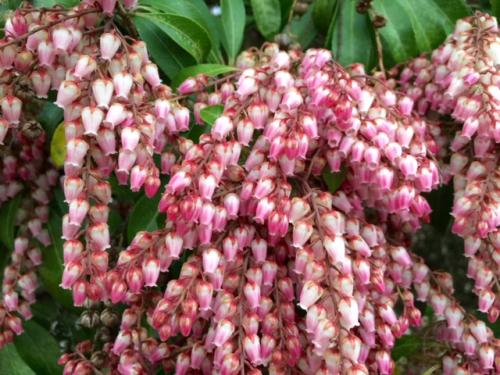
Well, that's all for the Japanese andromeda cultivation methods we've introduced for you. We hope the propagation methods we've supplemented for Japanese andromeda can be of help to you! Thank you for reading!
Morphological Characteristics and Ecological Habits of Japanese Andromeda Propagation Methods of Japanese Andromeda
Japanese andromeda (Pieris japonica): An evergreen shrub, 1-3 m tall. Leaves clustered at branch tips, thickly papery, oblanceolate or lanceolate-oblong, with fine serrations along the leaf margins; racemes; each inflorescence has 3-4 flower branches, densely bearing urn-shaped small flowers, pendulous, corolla white or white-green, capsule spherical. The entire plant is toxic, but the flowers and leaves have extremely high ornamental value, so large plantings are already difficult to find in the wild. It can be used for cut flowers, bonsai, hedges, and open-field garden cultivation;
The stems and leaves of Japanese andromeda are toxic. If ingested by humans or livestock, it can cause coma, difficulty breathing, and loss of motor coordination.
The leaves are highly toxic, and their water decoction can kill agricultural pests. The leaves are toxic and can be used as an insecticide. Toxic parts: stems, leaves, and seeds. Poisoning symptoms: Accidental ingestion by young children or livestock can cause coma, difficulty breathing, loss of motor coordination, and even systemic convulsions.
Origin of the name: When horses accidentally eat its branches and leaves, they become poisoned and appear intoxicated, hence the name "Japanese andromeda" (horse-intoxicating tree).
Morphological Characteristics of Japanese Andromeda
Shrub or small tree, about 4 m tall; bark brown, branchlets spreading, hairless; winter buds obovate, bud scales 3-8, imbricate. Leaves clustered at branch tips, thickly papery, oblanceolate or lanceolate-oblong, leaf margins finely serrate; leaves leathery, densely clustered at branch tips, elliptic-lanceolate, 3-8 cm long, 1-2 cm wide, apex shortly acuminate, base narrowly cuneate, margins with fine rounded teeth on more than 2/3, rarely nearly entire, hairless, dark green above, light green beneath, midvein raised on both surfaces, lateral veins sunken above, inconspicuous beneath, veinlets reticulate; petiole 3-8 mm long, with a deep groove on the upper side, rounded beneath, slightly pubescent. Racemes or panicles terminal or axillary, 8-14 cm long, erect or drooping, inflorescence axis pubescent; each inflorescence has 3-4 flower branches, densely bearing urn-shaped small flowers, pendulous, corolla white or white-green, capsule spherical. Sepals triangular-ovate, about 3.5 mm long, about 1 mm wide, sparsely short-pubescent inside, with a few glandular hairs or nearly hairless outside; corolla white, urceolate, 6-7 mm long, about 5 mm in diameter, hairless, upper part shallowly 5-lobed, lobes nearly circular; stamens 10, about 3.5 mm long, filaments slender, with long pubescence, more abundant at the base; ovary nearly spherical, hairless; style slender, about 6 mm long, stigma minute, capitate. Capsule nearly oblate, 3-5 mm in diameter, hairless. Flowering period: January to March; pale white-green; fruiting period: July to February, capsule, brown.
Evergreen shrub or small tree, 2-4 m tall. Bark brown, branchlets spreading, hairless; winter buds obovate, bud scales 3-8, imbricate. Leaves densely clustered at branch tips; petiole 3-8 mm long, with a deep groove on the upper side; leaf blade leathery, elliptic-lanceolate, or oblanceolate, 3-8 cm long, 1-2 cm wide, apex shortly acuminate, base narrowly cuneate, margins with fine rounded teeth on more than 2/3, rarely nearly entire, dark green above, glossy, light green beneath, midvein raised on both surfaces, lateral veins sunken above, inconspicuous beneath, veinlets reticulate. Racemes or panicles terminal or axillary, clustered at branch tips, 8-14 cm long, inflorescence axis pubescent; sepals triangular-ovate, about 3.5 mm long; corolla white, urceolate, upper part shallowly 5-lobed, lobes nearly circular; stamens 10, filaments with long pubescence; ovary 1, nearly spherical, style slender, stigma capitate. Capsule nearly oblate, 3-5 mm in diameter, dehiscing loculicidally, calyx and style persistent. Flowering period April-May, fruiting period July-September. Japanese andromeda prefers moist, semi-shaded environments, fears strong light and scorching sun, and is cold-hardy. It can overwinter outdoors at a low temperature of -27°C, tolerates pruning, and has strong sprouting ability. Most Japanese andromeda varieties have low environmental requirements and are easy to grow. Japanese andromeda prefers moist, semi-shaded environments, fears strong light and scorching sun, and is cold-hardy. It can overwinter outdoors at a low temperature of -27°C, tolerates pruning, and has strong sprouting ability.
Ecological Habits of Japanese Andromeda
Sunlight: When planting on flat ground, avoid direct exposure to strong sunlight at high temperatures
Management: The suitable growth temperature is about 15-25°C
Water: The cultivation soil is best as loam or sandy loam rich in humus, with good drainage required.
Japanese andromeda prefers moist, semi-shaded environments, fears strong light and scorching sun, and is cold-hardy. It can overwinter outdoors at a low temperature of -27°C, tolerates pruning, and has strong sprouting ability. Most Japanese andromeda varieties have low environmental requirements and are easy to grow.
Uses and Purposes of Japanese Andromeda
The entire plant is toxic, but the flowers and leaves have extremely high ornamental value, so large plantings are already difficult to find in the wild. It can be used for cut flowers, bonsai, hedges, and open-field garden cultivation; the stems and leaves are toxic, and if ingested by humans or livestock, it can cause coma, difficulty breathing, and loss of motor coordination. The leaves are highly toxic, and their water decoction can kill agricultural pests.
Variety Classification of Japanese Andromeda
Beautiful Japanese andromeda Pieris formosa (Wall.) D. Don
Beautiful Japanese andromeda (Iconographia Cormophytorum Sinicorum), Xingshan Japanese andromeda (Chinese Tree Taxonomy), Long-bracted Beautiful Japanese andromeda (Flora Xizangica, Flora Yunnanica)
Evergreen shrub or small tree, 2-4 m tall; branchlets cylindrical, hairless, with leaf scars on branches; winter buds relatively small, ovate, scales hairless outside. Leaves leathery, lanceolate to oblong, rarely oblanceolate, 4-10 cm long, 1.5-3 cm wide, apex acuminate or acute, margins finely serrate, base cuneate to obtuse-rounded, dark green above, light green beneath, midvein prominent, slightly pubescent above when young, shedding when old, lateral veins sunken above, inconspicuous beneath; petiole 1-1.5 cm long, with groove lines on the upper side, rounded beneath. Racemes clustered in the leaf axils at branch tips, or sometimes terminal panicles, 4-10 cm long, rarely reaching over 20 cm; pedicels pubescent; sepals broadly lanceolate, about 3 mm long; corolla white, urceolate, pubescent outside, upper part shallowly 5-lobed, lobe apices obtuse-rounded; stamens 10, filaments linear, about 4 mm long, with white pubescence, anthers yellow; ovary oblate, hairless, style about 5 mm long, stigma small, capitate. Capsule ovate, about 4 mm in diameter; seeds yellow-brown, fusiform, outer seed coat cells elongated. Flowering period May-June, fruiting period July-September.
Produced in Zhejiang, Jiangxi, Hubei, Hunan, Guangdong, Guangxi, Sichuan, Guizhou, Yunnan and other provinces and regions. Grows in thickets at an altitude of 900-2300 m. Also found in Vietnam, Myanmar, Nepal, Bhutan, and India.
Long-sepaled Japanese andromeda Pieris swinhoei Hemsl.
Shrub, 2-3 m tall; bark gray-brown, longitudinally fissured, branchlets slender, slightly pubescent; winter buds not seen. Leaves clustered at branch tips, leathery, narrowly lanceolate, 4.5-8 cm long, 1-1.5 cm wide, apex shortly acuminate, base narrowly cuneate, margins with sparse serrations above the middle, slightly revolute after drying, dark green above, light green beneath, hairless on both surfaces, midvein prominent above, raised beneath, lateral veins nearly horizontally spreading, veinlets reticulate, distinct; petiole very short, 2-7 mm long. Racemes or panicles borne at branch tips or leaf axils, erect, 15-20 cm long; pedicels about 5 mm long, pubescent; sepals long, leathery, lanceolate, 5-7 mm long, 3-4 mm wide, short-pubescent inside, especially near the apex; corolla white, tubular-urceolate, about 1 cm long, about 5 mm in diameter, hairless, upper part shallowly 5-lobed, lobe apices obtuse-rounded; stamens 10, included, about 6 mm long, filaments linear, nearly hairless; ovary conical, about 2 mm long, about 1.5 mm in diameter, densely yellow-brown short-pubescent; style slender, about 7 mm long, stigma minute, slightly pubescent. Capsule nearly spherical, about 5 mm in diameter. Flowering period April-June, fruiting period July-September.
Produced in Fujian, Guangdong, Hong Kong, China. Grows in thickets. Type specimen collected from Xiamen, Fujian.
Variegated Japanese Andromeda
Variegated Japanese andromeda is the most popular courtyard variegated-leaf tree species in Europe, America, and Japan. It can be appreciated both for its foliage and its flowers, meets the requirements of Chinese garden applications for new superior varieties, and has great market potential.
Variegated Japanese andromeda is the collective name for cultivated variants or cultivars of Japanese andromeda (Pieris japonica) as well as hybrids between Japanese andromeda and Taiwan andromeda (Pieris taiwanensis). It belongs to the Ericaceae family and is an evergreen broad-leaved shrub or tree. Its cultivated variants and cultivars are numerous, and the leaf colors vary. The varieties introduced in China can be broadly divided into two major series: foliage-appreciation and flower-appreciation. The foliage-appreciation series can be divided by leaf color into three major series: red-leaf, variegated-leaf, and green-leaf. The flower-appreciation series can be divided into two major series: red-flowered and white-flowered. In full bloom, the red-flowered series is a profusion of brilliant colors; the white-flowered series is like flowing clouds and cascading waterfalls, fresh and elegant. The bark of variegated Japanese andromeda is gray or brown, with longitudinal striations and scaly patterns.
The leaves of variegated Japanese andromeda are leathery and flexible, mostly alternate, lanceolate to oblanceolate, or long-elliptic, with serrations. Young shoots are often red, bronze, copper, orange, or yellow. The leaf color of most Japanese andromeda cultivars changes with different growth stages, and the same plant can simultaneously have red, pink, tender yellow, green, and other leaves in a colorful display, with extremely high ornamental value. The flowers of variegated Japanese andromeda have a unique charm, with small pure white flowers borne on racemes or panicles, resembling hanging bells. Inflorescences are terminal or axillary, erect or drooping. Flowers are mostly white, sometimes pink, and fragrant. Flowering period February to May, calyx yellow-green or yellow-brown, sometimes light reddish-brown.
Propagation Methods of Japanese Andromeda
Seed, cutting, or division propagation.
Planting and Care of Japanese Andromeda
Japanese andromeda has a graceful plant form, variable leaf colors, and pink inflorescences, very charming. It is cold-resistant, wind-resistant, pollution-resistant, and has strong sprouting ability. It is an excellent foliage evergreen shrub for cities and is also widely used in Europe and Japan for indoor potted plants and small courtyard ornamentals. Japanese andromeda is native to China and Japan. It is an evergreen shrub, 4 m tall, 3 m wide, with narrow obovate to elliptic leaves; terminal panicles about 15 cm long, flowers bell-shaped, white, drooping or semi-erect, flowering in late winter and spring; it can tolerate a low temperature of -15°C.
I. Propagation Techniques. 1. Seed propagation. Sow in pots in spring and autumn, germination suitable temperature 13°C-18°C, germination 30-40 days after sowing. 2. Cutting propagation. Use softwood cuttings in early summer and semi-ripened wood cuttings in late summer, cutting length 8 cm-10 cm, room temperature maintained at 20°C-24°C, rooting 25-30 days after cutting. Treating the base with 5 g/L indolebutyric acid for 2-3 seconds can promote rooting.
II. Soil Selection. The young leaves of Japanese andromeda are colorful, with red, pink, pink-green, tender yellow, orange-yellow and other colors. When planting in small courtyards, it is advisable to choose high terrain, good drainage, fertile, humus-rich acidic sandy loam, with a plant spacing of 2 m-3 m. For potted plants, garden soil, sand, and barnyard manure can be mixed in a ratio of 6:2:2.
III. Scientific Fertilization. It prefers warm, moist, and semi-shaded environments. During the growth period, keep the soil moist and apply an acidic fertilizer such as Huiyou 21-7-7 once a month. In winter, dig a trench around the outer edge of the canopy to apply fertilizer, and cover with a layer of bark chips to keep warm for overwintering.
IV. Suitable Temperature. Japanese andromeda is relatively cold-hardy, fears high temperatures and strong light exposure. The growth temperature is 10°C-15°C. Cold-hardy species can tolerate 15°C, and general species can tolerate 5°C.
Flower Language of Japanese Andromeda
Sacrifice, Danger, Pure Love
After reading the above introduction about the morphological characteristics and ecological habits of Japanese andromeda, do you have a better understanding of its morphological characteristics? If you want to know more about Japanese andromeda, please continue to follow us.
How to Propagate Japanese Andromeda
Propagation Methods of Japanese Andromeda
Japanese andromeda has multiple propagation methods, including seed propagation and cutting propagation.
Cutting Propagation of Japanese Andromeda
The most commonly used and most frequently used method for Japanese andromeda is cutting propagation. First, cutting propagation should be carried out in early summer. First select cuttings, using new tender branches, cut the branches into cuttings of about 10 cm, then store the cuttings in a cool place for about 3 days.
Next, prepare the potting soil for cuttings, which needs good drainage and should be fertile acidic sandy soil containing humus.
Finally, take out the stored cuttings, apply 5 g/L indolebutyric acid to the base of the cuttings, and then insert them into the potting soil to help rooting.
Seed Propagation of Japanese Andromeda
Seed propagation of Japanese andromeda should be carried out by pot sowing in spring and autumn. When sowing, select healthy seeds free of pests and diseases for sowing. The temperature for sowing and post-sowing growth should be around 18 degrees to promote rooting and sprouting after sowing.
After sowing Japanese andromeda, water immediately, then place it in a warm environment with light for cultivation, pay attention to ventilation, and after one month, Japanese andromeda will take root and sprout.
Propagation Management of Japanese Andromeda
The propagation and growth of Japanese andromeda require fertile soil with excellent drainage, so attention should be paid to soil selection when propagating and planting.
During the propagation and growth period, scientific and reasonable fertilization should be carried out. First, ensure the soil is moist. When the soil looks dry, water it, but do not let water accumulate, then fertilize. The fertilization management for Japanese andromeda is to apply an acidic fertilizer such as Huiyou 21-7-7 once a month.
Secondly, in winter, dig a shallow trench around the outer edge of the planting area, scatter the fertilizer in, then cover with a thin layer of soil, and then cover with dry grass or bark chips to ensure safe overwintering.
Finally, pay attention to temperature management. Warm conditions with sufficient light are sufficient. Avoid strong light exposure and burning hot temperatures. When temperatures are high, ventilate and spray water on the leaves to cool down the growing environment for Japanese andromeda.