What are the common types of Serissa bonsai?
Because the branches of Serissa are very soft and flexible, they can withstand wiring, so bonsai styles are generally divided into straight trunk style, twisted style, cascade style, and so on. But if the pot is relatively tall, it can be cultivated into a cascade style. Cascade style is further divided by degree of inclination into semi-cascade, full cascade, and small cascade. So-called semi-cascade means the trunk basically extends horizontally beyond the pot rim; for full cascade the trunk must hang down 45 degrees below the pot rim; for small cascade the trunk generally hangs down about 30-40 degrees.
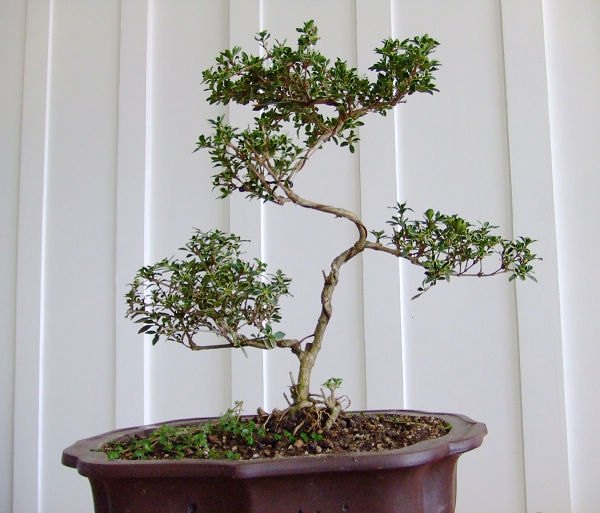
Serissa bonsai is not only elegant and beautiful in form, but the leaves of golden-edged Serissa have yellow margins, as if inlaid with a ring of gold, contrasting beautifully with the white Serissa flowers that bloom in summer. It looks wonderful!
Serissa Bonsai Serissa Bonsai Pictures and Production Methods
SixSerissa is one of the trees commonly used in Chinese bonsai. It has the characteristics of fine leaves, dense branches, thick trunks, and exposed roots, so it is an excellent material for bonsai and is loved by gardening enthusiasts. Today we have prepared some Serissa bonsai pictures for you. Welcome to comment and appreciate.
[Recommended reading] Lily Kalanchoe Globe Amaranth Gardenia Clivia Guzmania Balloon Flower Mulberry Winter Jasmine Mimosa
Serissa Bonsai Pictures and Production Methods
——————————————————————————————————————————————
[Plant Profile]
——————————————————————————————————————————————
Chinese name:Serissa
Scientific name:Serissa foetida
Aliases:Suiye Dongqing, Baimagu, Suxin, Ximing
Family:Rubiaceae Rubiaceae
Genus:Serissa genus Serissa Comm. ex Juss.
Origin and distribution:Native to subtropical regions; in temperate regions it can be grown as an indoor plant.
Morphological characteristics:It is an evergreen shrub that blooms star-shaped white flowers every summer, like snow accumulated on the tree. Some leaves are green, small and smooth on the surface. Flowers can be single-petaled or double-petaled. In modern cultivation, varieties with purple flowers and cultivars with variegated leaves have been developed.
Serissa Bonsai Styling Types
——————————————————————————————————————————————
Serissa branches are soft but tough and can withstand wiring. They are divided into straight trunk style, twisted style, cascade style, and so on. If the pot is tall, it can be grown into cascade style. Cascade style is further divided by degree of inclination into semi-cascade, full cascade, and small cascade. So-called semi-cascade means the trunk basically extends horizontally beyond the pot rim. For full cascade the trunk must hang down 45 degrees below the pot rim. For small cascade the trunk generally hangs down about 30-40 degrees.
Serissa Bonsai Production Methods and Picture Appreciation
——————————————————————————————————————————————
▲ Source of stump material: carry out division propagation in March, and cutting propagation from April to October.
▲ Processing and styling: use the "grow wood and truncate trunk method" for processing, or use the "combination of pruning and wiring method." Wiring is often carried out from winter semi-deciduous period to before spring bud break. The main trunk and main branches of Serissa are wired with metal wire, and the small branches are shaped through fine pruning.
▲ Transplanting into pots: best done in February-March. Choose a relatively shallow purple clay pot or glazed pot; the pot color should be slightly darker to contrast with the flower color. The potting soil should be sandy loam rich in organic matter, loose and fertile, with good drainage and air permeability.
▲ Light and temperature requirements: during the growing period, Serissa should be placed in a sunny, warm and humid, well-ventilated place. In summer and early autumn, shade should be 50%-70%. In winter in the north, room temperature should be maintained at 5-12°C.
▲ Water and fertilizer management: during the growing season, Serissa bonsai should be watered frequently, and it should not be too dry or too wet for long periods. In summer, spray water on the leaves 1-2 times a day; in winter reduce watering frequency and keep the potting soil moist and slightly on the dry side. From April to May each year, apply 2-3 times a 0.5% concentration phosphorus-potassium fertilizer solution; in late winter apply 1-2 times a thin organic fertilizer solution. Do not fertilize in other seasons. Avoid applying concentrated fertilizer.
▲ Repotting and pruning: repot once every 1-2 years, in spring February-March or during late autumn. Remove all old soil and appropriately prune the roots. Root raising can be carried out together with repotting to form exposed roots and increase ornamental value. Every year after the winter semi-deciduous period and before the next spring bud break, carry out shaping and pruning: shorten long branches and leggy branches, thin out overly dense fine weak branches, and cut off diseased and pest-damaged branches as well as other messy branches that affect the display; during the growing period, timely pinch tips, remove buds, and remove side branches to maintain a beautiful shape.
▲ Pest and disease control: Serissa bonsai occasionally has aphids and snails. Aphids can be killed by spraying a 500-600 times diluted solution of essential balm; snails can be killed by spraying 58% Fengleiji emulsifiable concentrate at 1500 times dilution. Sometimes root rot occurs. At the initial stage, use 12% copper abietate emulsifiable concentrate at 600-1000 times dilution, or 50% Genfuling at 800 times dilution to drench the roots and spray the leaves for control, spraying (drenching) once every 3-5 days, for 3-4 consecutive times.
"Conclusion:Serissa bonsai is not only elegant and beautiful in form, but the leaves of golden-edged Serissa have yellow margins, as if inlaid with a ring of gold, contrasting with the white Serissa flowers that bloom in summer. It is really beautiful.
【More Plant Encyclopedia】
Poppy Flower Four O'Clock Flower Rose Azalea Lavender Pothos Asparagus Fern Peperomia Hyacinth Anthurium Cherry Blossom Calla Lily
African Jasmine Rose Spring Festival Flowers Succulents Tropical Plants Rosa rubus Agave Canna Lycoris Forget-me-not Dandelion
Dendrobium officinale Chinese Yew Kapok Osmanthus Begonia Hydroponic Plants Home Feng Shui Plants Bedroom Feng Shui Plants Plum Aloe
Jasmine Anti-radiation Plants Pennywort Potted Plants Bonsai Making Drug Plants Mistletoe Indoor Flowers Money Tree Evergreen Lucky Bamboo
Potted Plant Making Anthurium Mint Lithops Geranium Garden Crab Claw Orchid Peace Lily Snake Plant Kunlun Snow Chrysanthemum Water Lily Blue Enchantress
How to make Serissa bonsai? Serissa bonsai pictures
How to make Serissa bonsai?
Serissa grows in clumps with short trunks, fine branches, and green leaves, and in summer it blooms all over with small white flowers. Its short trunk and twisted branches, with sparse foliage, are easy to wire and shape, creating the image of gnarled roots and an aged appearance. Old tree stumps dug from the wild are planted and cultivated after branch and root trimming. Through branch and trunk shaping, they are grown into straight trunk style, horizontal trunk style, twisted style, and other shapes. Later, through repotting and root raising, they can be shaped into the form of a vigorous old tree.
Serissa Bonsai Production and Care
SixSerissa is one of the trees commonly used in Chinese bonsai. It has the characteristics of fine leaves, dense branches, thick trunks, and exposed roots, so it is an excellent material for bonsai and is loved by gardening enthusiasts. Today we have prepared some Serissa bonsai pictures for you. Welcome to comment and appreciate. Commonly cultivated forms include golden-edged Serissa (leaf margins golden yellow), variegated-leaf Serissa, and double-petaled Serissa.
Serissa Bonsai Pictures and Production Methods
[Plant Profile]
Botanical Knowledge
Belongs to Rubiaceae, Serissa genus. Evergreen small shrub, with many and dense branches. Leaves small, opposite, slightly leathery, ovate or oblong, entire, dark green on the surface. In summer from June to July, small white flowers grow in leaf axils or at the tips; flowers white with a red tinge or pale pink-purple, solitary or in clusters, corolla funnel-shaped. When in full bloom, like snowflakes falling, hence the name "Serissa."
Main varieties
1.Double-petaled Serissa,Flowers are double-petaled.
2.Double-layered Serissa,Flowers are double-layered petals.
3.Variegated-leaf Serissa,Also called spotted-leaf Serissa. The leaf surface has white markings.
4.Golden-edged Serissa,Leaves have yellow margins.
There are two common types on the market: one is the clumping type, with slightly reddish flowers and trumpet-shaped flowers, which is a coarse variety; the other is the single-trunk small tree form, with pure white double-petaled flowers, which is a superior variety.
Related species
Baimagu,Very similar to Serissa, but this species' corolla is twice the length of the sepals, while Serissa's corolla and sepals are nearly equal in length, which can distinguish them. It is also often used in bonsai.
Yinmu,Smaller than the original species, with thicker leaves, small branches growing upright, leaves relatively small and dense at the ends of small branches, and flowers relatively sparse.
Serissa is produced in Jiangsu, Anhui, Zhejiang, Jiangxi, Hubei, Hunan, Fujian, Guangdong, Taiwan, China, and other provinces. It is a common tree species under subtropical forests. It is also distributed in Japan.
It likes shade and tolerates moisture, and fears strong light, so wild plants mostly grow under forests, beside ditches, or in thickets. It likes a warm climate and is not tolerant of severe cold. It is suitable for growing in loose, well-drained loam and can adapt to neutral and slightly acidic soils. It has strong sprouting ability and tolerates pruning.
It is an evergreen shrub that blooms star-shaped white flowers every summer, like snow accumulated on the tree. Some leaves are green, small and smooth on the surface. Flowers can be single-petaled or double-petaled. In modern cultivation, varieties with purple flowers and cultivars with variegated leaves have been developed.
Serissa Bonsai Styling Types
Serissa branches are soft but tough and can withstand wiring. They are divided into straight trunk style, twisted style, cascade style, and so on. If the pot is tall, it can be grown into cascade style. Cascade style is further divided by degree of inclination into semi-cascade, full cascade, and small cascade. So-called semi-cascade means the trunk basically extends horizontally beyond the pot rim. For full cascade the trunk must hang down 45 degrees below the pot rim. For small cascade the trunk generally hangs down about 30-40 degrees.
Serissa Bonsai Production Methods
▲ Source of stump material: carry out division propagation in March, and cutting propagation from April to October.
▲ Processing and styling: use the "grow wood and truncate trunk method" for processing, or use the "combination of pruning and wiring method." Wiring is often carried out from winter semi-deciduous period to before spring bud break. The main trunk and main branches of Serissa are wired with metal wire, and the small branches are shaped through fine pruning.
▲ Transplanting into pots: best done in February-March. Choose a relatively shallow purple clay pot or glazed pot; the pot color should be slightly darker to contrast with the flower color. The potting soil should be sandy loam rich in organic matter, loose and fertile, with good drainage and air permeability.
▲ Light and temperature requirements: during the growing period, Serissa should be placed in a sunny, warm and humid, well-ventilated place. In summer and early autumn, shade should be 50%-70%. In winter in the north, room temperature should be maintained at 5-12°C.
▲ Water and fertilizer management: during the growing season, Serissa bonsai should be watered frequently, and it should not be too dry or too wet for long periods. In summer, spray water on the leaves 1-2 times a day; in winter reduce watering frequency and keep the potting soil moist and slightly on the dry side. From April to May each year, apply 2-3 times a 0.5% concentration phosphorus-potassium fertilizer solution; in late winter apply 1-2 times a thin organic fertilizer solution. Do not fertilize in other seasons. Avoid applying concentrated fertilizer.
▲ Repotting and pruning: repot once every 1-2 years, in spring February-March or during late autumn. Remove all old soil and appropriately prune the roots. Root raising can be carried out together with repotting to form exposed roots and increase ornamental value. Every year after the winter semi-deciduous period and before the next spring bud break, carry out shaping and pruning: shorten long branches and leggy branches, thin out overly dense fine weak branches, and cut off diseased and pest-damaged branches as well as other messy branches that affect the display; during the growing period, timely pinch tips, remove buds, and remove side branches to maintain a beautiful shape.
▲ Pest and disease control: Serissa bonsai occasionally has aphids and snails. Aphids can be killed by spraying a 500-600 times diluted solution of essential balm; snails can be killed by spraying 58% Fengleiji emulsifiable concentrate at 1500 times dilution. Sometimes root rot occurs. At the initial stage, use 12% copper abietate emulsifiable concentrate at 600-1000 times dilution, or 50% Genfuling at 800 times dilution to drench the roots and spray the leaves for control, spraying (drenching) once every 3-5 days, for 3-4 consecutive times.
Serissa Cultivation Methods
Serissa is a rather cute plant, with lovely white flowers when blooming, very suitable for decorating the home. Below let us learn about Serissa cultivation methods:
Basic information about Serissa:
Serissa (scientific name: Serissa japonica), also called Baimagu, Mantianxing, Suiye Dongqing, Suxin, Ximing, is an evergreen small shrub that generally blooms in June. From a distance it looks like silver-wrapped white, like snow falling in June, elegant and lovely.
It likes sunlight and is also relatively shade-tolerant. It fears fierce wind and scorching sun, and in high-temperature midsummer it should have light shade. In June it opens fine white flowers. The tree is very small with sparse branches and leaves, full of quiet charm, and can be made into potted plants. It likes light shade and fears the sun; it is often found under trees and leaves in deep mountains. It is divided and planted in spring, or cuttings are taken during the yellow plum rain season, and it is suitable to water with light tea. It has no strict temperature requirements; in South China it is evergreen, and in the Southwest it is semi-evergreen. It has strong drought tolerance and no strict soil requirements. For pot cultivation, it is best to use a slightly acidic, moist culture soil containing humus, loose and fertile, with strong permeability, and it will grow well.
Serissa Cultivation Methods:
1. Soil:It has strong drought tolerance and no strict soil requirements. For pot cultivation, it is best to use a slightly acidic, moist culture soil containing humus, loose and fertile, with strong permeability, and it will grow well.
2. Watering:Do not water too frequently or too much. Keep the potting soil moist and water again when it is dry. In the rainy season, do not allow water to accumulate in the pot, to avoid root rot. In hot and dry summer weather, spray water on the leaves in the morning and evening to cool them and increase air humidity, so as to help its growth.
3. Sunlight:Cultivation and care of Serissa is relatively simple. Because it fears scorching sun exposure, during the growing period it should be placed in semi-shade under tree shade or in a shade shed. It should not be kept in too strong light, otherwise it will affect the growth of branches and leaves.
4. Temperature:Before winter, move it indoors in time to keep it warm, and maintain room temperature above 5°C. At the same time, reduce watering and keep the potting soil half-dry, which can achieve a lush, green, and smooth effect on the plant.
5. Fertilizing:Serissa relatively likes fertilizer, but if too much fertilizer is applied it will cause excessive growth of branches and leaves and affect the beauty of the tree shape. It is enough to apply decomposed cake fertilizer water once each before winter and after flowering.
6. Pruning:Serissa has very strong sprouting ability. When branches and leaves are too dense, timely prune excess new branches, so as not to affect the beauty of the tree shape and consume nutrients. After flowering, messy branches protruding beyond the crown must also be pruned so they do not affect the display.
Serissa Propagation Methods:
Cutting and division are often used for propagation, and layering can also be used. Cutting can be done throughout the year, with hard branch cuttings in February-March and soft branch cuttings during the plum rain season having the highest survival rate. Cuttings taken during the plum rain season should be shaded, and cuttings in winter need protection from cold. Division is best done in early spring before budding, or in late autumn when growth has stopped. Dormant branch cuttings are carried out in February-March, and semi-mature branch cuttings in June-July.
Serissa Efficacy and Functions:
Serissa, also called Mantianxing, Ririyou, etc., is a medicinal flowering plant in the Rubiaceae family. Its nature and flavor are bitter and cool. It has the functions of dispelling wind and promoting diuresis, relaxing muscles and activating collaterals, clearing heat and detoxifying, and regulating the spleen and qi. It has certain therapeutic effects on rheumatism pain, migraine, toothache, sore throat, stomatitis, neurodermatitis, damp-heat jaundice, herpes zoster, leukorrhea and turbid urine, and other conditions.
When Serissa blooms, it is all white and looks rather elegant and lovely. It has a relatively good effect when used in home decoration, appearing fresh and natural. Serissa cultivation methods are introduced here for everyone, and we hope it is helpful to everyone.
Serissa bonsai is not only elegant and beautiful in form, but the leaves of golden-edged Serissa have yellow margins, as if inlaid with a ring of gold, contrasting with the white Serissa flowers that bloom in summer. It is really beautiful.
Serissa is also called Mantianxing, Suiye Dongqing, Baimagu, Suxin, Ximing.
It is a low plant with a beautiful tree shape. In hot summer it blooms all over with small white flowers, white as snow, hence the name. Using it to beautify the room not only gives people aesthetic enjoyment, but also suddenly makes the air feel cool, giving a feeling of forgetting the summer heat in June.
1. Advantages:
1 Beautiful tree shape, low plant, elegant branches and dense nodes, small leaves;
2 Elegant and free-spirited, varied postures, unique charm;
3 Well-developed root system, exposed roots and claws, often giving a sense of vigor and age;
4 Cracked bark, beautiful texture;
5 Can be propagated by cuttings in all four seasons, good for propagation;
6 Strong sprouting ability, rapid growth, tolerates pruning;
7 Wide range of uses, can make many different forms of bonsai. Especially suitable for forest, landscape, cascade, clasping (attached) rock, and other combinations.
2. Habits:
1 Likes loose, fertile, breathable, slightly acidic soil;
2 Likes a semi-shaded and semi-sunny, well-ventilated, high-temperature and high-humidity environment;
3 Likes moisture but cannot have water accumulation, fears dryness, fears scorching sun exposure;
4 Not tolerant of low temperatures; protection is needed below 5 degrees;
3. Key production points: collect stumps in the south, take cuttings in the north.
1 Collecting stumps: conventional method.
2 Cuttings: conventional method, can be done in all four seasons. Generally takes shape in three years and becomes a finished landscape in five years.
3 Pruning: conventional method. Serissa (June snow) has strong sprouting ability and grows rapidly, tolerates pruning well, and can be pruned frequently as needed except in winter.
4 Wiring: Serissa branches are soft, which is good for wiring. In the early stage, pull and wire the framework well, set the main trunk and main branches, then let them grow freely to thicken.
5 Root exposure: The roots are a major feature of Serissa and must be treated carefully. Organizing, pruning and raising the roots should be done once a year.
6 Stone placement: Serissa has a well-developed root system with exposed hanging roots and claws. During the maintenance stage, arranging the roots and placing stones is very important. The design plan and stone selection must be done carefully; once the landscape is formed, it is difficult to modify.
7 Pot selection: Because Serissa plants are low and compact, with tender green branches all over and white flowers covering the tree, dark-colored shallow pots are mostly used.
8 Combined planting: Binding Serissa together for combined planting can quickly form a style resembling southern banyan trees and large potted trees from Japan and Taiwan, China.
IV. Key maintenance points:
1 During the trunk-growing period, manage with heavy fertilizer and heavy water; during the shaping period, control according to the situation;
2 Create a maintenance environment according to the desired form;
3 Never let it lack water. Serissa is very sensitive to this; in mild cases branches wither, in severe cases the trunk dies.
4 Winter frost protection is the key to growing Serissa well and must not be taken lightly.
The flower language of Serissa is:
Willing to be a supporting role in love, endless love, care, bringing good luck, a pure heart.