Care Methods and Precautions for Serissa
After the cuttings are finished, the subsequent care is also very important. In the early stage, the cuttings are very afraid of being exposed to the sun, so we must promptly set up a shade shelter for them, and also pay attention to watering to keep the substrate moist at all times, so that the cuttings can take root more easily. After the cuttings have taken root, they can normally enjoy some light, but be careful that the light is not too strong.
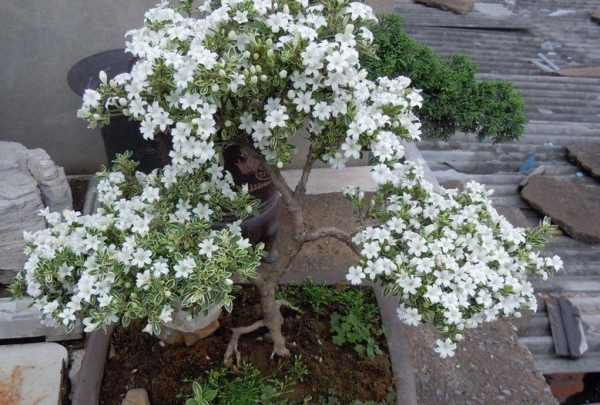
Key Care Points for Serissa - Precautions for Growing Serissa
Serissa has a very ancient legend, and the story of Dou E's Injustice is one of the most representative. In real life, Serissa is just like its name, pure and white as snow, extremely beautiful. Growing Serissa requires careful tending before you can see it at its most flourishing. Serissa grows wild in the Yangtze River basin of China and areas beyond, distributed in forests or beside streams, mostly on shady slopes. Let's take a look below at how to grow Serissa.
I. About Serissa
Serissa, also called Ximing, also called Su Xin. It opens fine white flowers in June; the tree is very small with sparse branches and leaves, full of elegant charm, and can be made into a potted specimen. It likes light shade and fears the sun, and is often found under the trees and foliage of deep mountains. It is divided and planted in spring, or propagated by cuttings during the yellow plum rain season, and is best watered with weak tea. It is an evergreen small shrub that blooms in June, looking from afar like it is wrapped in silver, just like snow falling in June, elegant and lovely, hence the name. It mostly grows wild among mountain forests and beside streams and rocks. It is a subtropical tree species, fond of warm and humid climate conditions and semi-shaded, loose and fertile, well-drained soil, with neutral and slightly acidic soil being especially suitable; its cold resistance is not strong.
Serissa fears strong light. It likes a warm climate, and can also somewhat tolerate cold and drought. It likes well-drained, fertile, moist and loose soil, has low requirements for the environment, and has strong growth vigor. It grows beside rivers and streams or in mixed forests of hills. The roots, stems and leaves of Serissa can all be used as medicine. Mild, slightly pungent, cool. It soothes the liver and relieves depression, clears heat and drains dampness, reduces swelling and draws out toxins, stops cough and transforms phlegm. It is used for acute hepatitis, rheumatic waist and leg pain, carbuncles, swellings and malignant sores, snake bites, diarrhea due to spleen deficiency, infantile malnutrition, leukorrhea, eye cataracts, intestinal abscess, and rabies.
It likes sunlight by nature, and is also fairly shade-tolerant; it avoids fierce winds and scorching sun, and in hot summer weather it should be given dappled shade. It opens fine white flowers in June; the tree is very small with sparse branches and leaves, full of elegant charm, and can be made into a potted specimen. It likes light shade and fears the sun, and is often found under the trees and foliage of deep mountains. It is divided and planted in spring, or propagated by cuttings during the yellow plum rain season, and is best watered with weak tea. It has low requirements for temperature; in South China it is evergreen, and in Southwest China it is semi-evergreen. It has strong drought tolerance and low requirements for soil.
Serissa opens fine white flowers, and the tree is very small with sparse branches and leaves. It likes light shade and fears the sun, and is often found under the trees and foliage of deep mountains. It is divided and planted in spring, or propagated by cuttings during the yellow plum rain season, and is best watered with weak tea. It has low requirements for temperature; in South China it is evergreen, and in Southwest China it is semi-evergreen. It has strong drought tolerance and low requirements for soil. For pot cultivation, it is best to use a slightly acidic, moist potting soil rich in humus, loose and fertile, with strong permeability, and it will grow well.
II. How to Grow Serissa
1. Transplanting into pots: Generally, February to March is the best season for transplanting, though the plum rain season and late autumn are also good seasons. When transplanting, it is advisable to choose purple clay pots or glazed pots, and the pot color should be dark so it can form a sharp contrast with the flower color. The potting soil should be sandy soil, preferably loose, rich in organic matter, and well drained and aerated. In addition, for fertilizer selection, pine needle soil, leaf mold and peat can be mixed together, and adding about 10% rice husk ash is best.
2. Water and fertilizer management: The water and fertilizer management for Serissa should be appropriate; it must not be too dry or too wet, and the potting soil moisture should be kept moderate. In winter, the frequency of watering should be reduced, while in summer water is generally sprayed on the leaves, 1 to 2 times is fine. In addition, April to May every year is the best time for fertilizing, and it can be watered with a 0.5% phosphorus-potassium fertilizer solution. In winter, an additional topdressing can be given, and thin organic fertilizer can be applied, but other than that no fertilizer should be applied. Concentrated fertilizer is a major taboo.
3. Light and temperature requirements: Serissa likes sunlight, likes warmth, likes moisture, and likes ventilation. Therefore, during the growing season it should be cared for under these conditions. In summer it should be properly shaded, and must never be placed in direct sunlight; in winter it should be moved indoors and kept at a certain temperature, for example 5 to 12 degrees Celsius is fine.
4. Repotting and pruning: Repotting every other year can make the soil looser and more suitable for the plant's growth. At the same time, removing the old soil and properly pruning the roots can also increase its ornamental value. In winter, shaping and pruning should be carried out, trimming long and short branches and thinning or thickening dense branches, which can both remove messy branches and leaves to improve the ornamental beauty and also cut off branches and leaves affected by pests and diseases. At the same time, through pinching, bud removal, and removal of side shoots, a certain shape can be maintained, elegant and graceful.
5. Pest and disease control: Serissa generally has few pests and diseases, though occasionally there may be aphids. At this time, it can be sprayed with essential balm to kill the aphids, but the concentration must not be too high; diluting 500 to 600 times is more appropriate. In addition, root rot sometimes occurs; at this time use 800 times solution of root rot remedy or 600 to 1000 times solution of 12% copper abietate emulsifiable concentrate to irrigate it, spraying once every few days, three times in succession is enough.
III. Key Care Points for Serissa
In summer when it is hot and dry, in addition to watering every day, water should be used to rinse the leaves and nearby ground in the morning and evening to lower the temperature and increase air humidity. The plant should be placed under a shade shelter, and must not be kept in strong sunlight for long periods. After autumn, as the temperature drops, the amount of watering should be gradually controlled, watering once every 2 to 3 days. In winter, move it into a cold room or indoors to overwinter, where the temperature is not lower than 0 degrees C, and water once every 20 to 30 days; if the room temperature is above 15 degrees C, it remains evergreen and does not drop leaves, so water once every 7 to 10 days, and maintain moist air and give it sunlight exposure. During severe cold it must not be allowed to freeze, otherwise it easily dies. Before taking it out in March every year, repot it with leaf mold soil, and use hoof and horn pieces as base fertilizer at the bottom of the pot.
There are relatively few pests and diseases. Occasionally aphids cause damage, and they can be killed by spraying with 1500 times solution of omethoate. The basic work of managing it is watering and fertilizing. The principle of watering is not to water when not dry, and never to overwater; if the pot surface stays wet for a long time, the roots will have difficulty breathing and are prone to rot and death. Fertilizing emphasizes frequent but light applications, applying decomposed liquid fertilizer; do not fertilize in summer, and do not fertilize during the flowering period, so as to avoid excessive growth that distorts the shape. From May to June, shoot tips should be pinched off, and new buds in July should be removed.
Potted flowers should be fixed in position and should not be moved here and there; Serissa is particular about phototropism. In summer under the scorching sun, shade it from above and keep it ventilated, spraying water on its leaves 1 to 2 times a day to maintain air humidity. In severe winter, it can be wrapped briefly with straw (when around -10 degrees C) to avoid freezing to death. The pests and diseases of Serissa are generally scale insects. They can be controlled by spraying 1000 to 1500 times solution of 40% omethoate or 1000 to 1500 times solution of 25% phosmet.
Finally, the above are the growing methods and precautions for Serissa. Whether in legend or in reality, Serissa has left a deep impression on people. Growing it indoors brings not only beauty but also a penetrating fragrance. I hope everyone will love this plant and raise it well.
Key Care Points for Serissa
Serissa (Suiye Dongqing, Mantianxing)
Scientific name: Serissia foetida
Aliases: Suiye Dongqing, Baimagu, Su Xin, Ximing, Serissa; also called Ximing, also called Su Xin.
Family and genus: Rubiaceae, Serissa
Origin and distribution: Southeast Asia.
Key care points: Evergreen small shrub. Less than 1 m tall, with many branches, small leaves, and small white or light purple flowers. It is a good material for making plant bonsai, especially suitable for miniature bonsai. Plant in small pots with peat soil or leaf mold; repot once every 2 to 3 years; fertilize once every 2 to 3 weeks during the growing season; requires sufficient water and relatively high air humidity; likes semi-shaded light, and in summer grow it under a shade shelter. It likes a warm environment, and the minimum overwintering temperature is about 5 degrees C. The finished bonsai should be pruned at least 1 to 2 times a year to maintain its original shape. There are cultivated varieties with variegated leaves and double flowers.
Commonly cultivated forms include golden-edged Serissa (leaf margins golden yellow), variegated-leaf Serissa and double-flowered Serissa.
Garden application: In southern gardens it is often planted in the open under tree canopies or among shrubs; in the north it is mostly grown in pots for ornament and overwintered indoors. It is also a good bonsai material.
Efficacy and effects: The whole plant is used as medicine, strengthening the spleen and draining dampness, soothing the liver and invigorating blood.
Propagation: Cuttings.
Light: Likes strong light, not shade-tolerant (sufficient light).
Water: Grows in moist soil.
Temperature: Somewhat cold-tolerant, can withstand low temperatures of -5 to 0 degrees C.
Humidity: Relative humidity medium, 50% to 60%.