What are the propagation methods for Serissa? A complete guide in one article
Division method
Division is often carried out around March in early spring before budding, or at the end of autumn when growth has stopped, which is better. Dig the mother plant out of the soil with its roots, divide it by hand or with scissors into several small clumps, each small clump must have 1-3 branches with roots at the bottom, and transplant them separately into flower pots.
Scatter-cutting method
Use open ground, loosen the soil, break up the clods finely and level it. Take cut branches of one to two nodes (about three cm) and evenly scatter them on the previously prepared ground, press the surface soil firmly with your feet or with an object, and water thoroughly. Spray water once every other day; after about ten days they begin to take root and sprout new buds; after twenty-five days apply the first diluted liquid fertilizer; after fifty days apply 1:1000 urea once to promote seedling growth; after two months they can be transplanted and planted out; after four months they can be potted for cultivation. After about one year, a fairly ideal bonsai with exposed roots can be formed; if used as a hedge, it can take shape in half a year.
If you want to improve the survival rate, the care after propagating Serissa is also very important.
How to propagate Serissa? An introduction to Serissa propagation methods
Serissa is also known as Mantianxing, Baimagu, Suiye Dongqing, etc. It is an evergreen small shrub of the genus Serissa in the family Rubiaceae. It fears strong light, likes a warm climate, and is also slightly tolerant of cold and drought. It likes well-drained, fertile, moist and loose soil. It has low requirements for the environment and strong growth vigor. Cutting and division methods are often used for propagation. Now let us take a look at Serissa propagation methods together!
Cutting propagation
Serissa is very tough and very easy to root from cuttings. For cutting time, dormant branches are used in February-March, and semi-mature branches in June-July. Cut 6-8 cm long cuttings and insert them into slightly acidic fine sandy loam, build a shade frame, water carefully after inserting, and keep the seedbed moist. The cuttings root extremely easily. Several cuttings can also be inserted together. By October-November they can be potted and transplanted, and the seedlings inserted together can be divided and transplanted individually. In summer and early autumn, softwood cuttings can also be carried out.
Division propagation
Serissa division propagation is often carried out in March in spring. Transplanting can be done in all four seasons, with February-March in spring being the best.
Scatter-cutting propagation
Serissa can also use scatter-cutting propagation. Use open green space, loosen the soil, break up the clods finely and level it. Take the pruned branches of one to two nodes (about three cm) and evenly scatter them on the previously prepared ground, press the surface soil firmly with your feet or with an object, and water thoroughly. Afterward, spray water once every other day. After ten days they begin to take root and sprout branches and buds. After twenty-five days apply the first diluted liquid fertilizer. At fifty days apply 1:1000 urea once to promote seedling growth. After two months they can be transplanted and planted out. After four months they can be potted for cultivation and initial insertion can also be carried out. After one year, a fairly ideal bonsai with exposed roots can be formed. If used as a hedge, it takes only half a year to take shape.
Serissa Serissa foetida Serissa illustrated guide: how to grow Serissa / how to propagate Serissa
Serissa profileSerissa Serissa foetida
Serissa cultivation methods and precautions, an introduction to Serissa
Serissa, an evergreen small shrub, blooms in June. From a distance it looks as if wrapped in silver, like snow falling in June, elegant and lovely, hence the name. It is also known as Suiye Dongqing, Baimagu, Suxin, Ximing, and Serissa. One name is Ximing, another is Suxin. In June it opens fine white flowers. The tree is among the smallest but its branches and leaves are spread out, full of elegant charm, and it can be used as a potted ornament. It likes light shade and fears the sun. It is often found under leafy trees in deep mountains. In spring it is divided and planted, or cuttings are taken during the yellow plum rain season. It is suitable to water it with weak tea. -------quoted from Qing dynasty, Chen Haozi's "Hua Jing, Volume Three, Flower and Tree Category"
Serissa (scientific name: Serissa foetida) is the only species of the genus Serissa in the family Rubiaceae. It is an evergreen shrub plant and one of the trees commonly used in Chinese bonsai. This tree species is native to subtropical regions. Every summer it blooms with star-shaped white flowers, like snow accumulated on the tree. The flowers can be divided into single-petaled and double-petaled types. Some leaves are green, small and smooth on the surface. In modern times, purple-flowered cultivars and variegated-leaf cultivars have been cultivated. In temperate regions it can be grown as an indoor plant. Serissa is a common ornamental flowering and foliage plant. In midsummer, the plain and refined small white flowers bloom in profusion among the green leaves. Seen up close they are like a sky full of stars, hence it is also called Mantianxing.
Morphological characteristics of Serissa
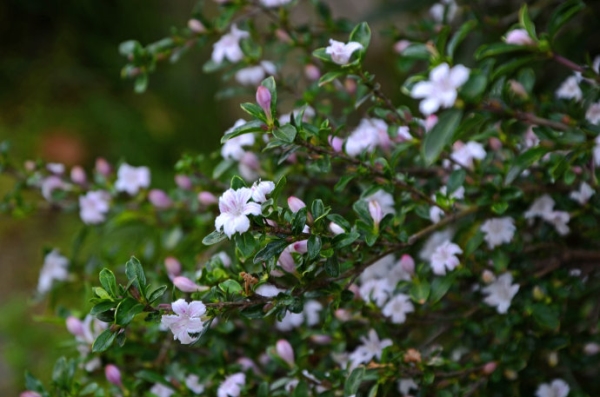
Evergreen or semi-evergreen clumping small shrub. The plant is low, less than 1 m tall, with many dense branches, appearing messy. Young branches are green with fine hairs and have a foul odor when rubbed. Old stems are brown with obvious wrinkles. Young branches are slender and upright, green. Leaves are opposite or clustered on small branches, long elliptic or long elliptic-lanceolate, about 0.7 cm to 1.5 cm long, entire. Flowers are white with a red tinge or pale pink-purple, solitary or several clustered, with a funnel-shaped corolla. Entire, apex obtuse, thick leathery, dark green, glossy. Flowers are small, densely borne at the tips of small branches. The corolla is about 7 mm long, funnel-shaped, pubescent, white with a slight red tinge. The calyx is green with lobed teeth and a hard texture. The small drupe is nearly spherical. Flowering period is June to July. Commonly cultivated forms include golden-edged Serissa (leaf margins golden yellow), variegated Serissa and double-petaled Serissa. In midsummer, the plain and refined small white flowers bloom in profusion among the green leaves. Seen up close they are like a sky full of stars, hence it is also called Mantianxing.
Serissa branches are delicate and elegant, exquisite and clear. The glossy round leaves are like floating clouds. If made into potted plants or bonsai and placed indoors, it stays evergreen through the four seasons, with exposed roots and clutching roots, twisting branches and interlaced nodes, ancient and plain. Especially in the scorching midsummer, it not only gives people the enjoyment of natural beauty and artistic beauty, but also makes people feel cool and comfortable, relaxed and happy. The modern person Chen Changming once wrote the tune "Shui Xian Zi" praising it: "In deep mountains and forest edges was its old home, in June it opens fine broken flowers, like pieces drifting down from the distant sky. It loves clear shade and shows understated elegance, arranged on courtyard steps with charm beyond compare. It does not demand a thousand gold in price, personally offered with a cup of tea, the heat is dispelled, far better than floating melon."
Serissa is not only an excellent material for potted plants and bonsai, but also suitable for flower beds, roadsides, flower hedges and boundary planting.
Serissa belongs to the family Rubiaceae. It is also called "Mantianxing" and is similar to Baimagu, but its corolla is longer and it can be used for ornamental purposes. It is produced in the provinces south of the Yangtze River in China.
Evergreen small shrub with many branches. Leaves are small, opposite, elliptic and pointed, slightly leathery, apex gradually pointed with a short stalk, often clustered on the upper part of small branches. Stipules are membranous, broad at the base, with several spiny hairs at the top. Flowers are small and white, numerous, looking like snow from afar. Flowering period is June, hence the name Serissa. There are single-petaled and double-petaled types. There is also a Peking opera title with the same name. It evolved from the Yuan dynasty zaju "The Injustice to Dou E" by Guan Hanqing. It is also called "Zhan Dou E", "Jin Suo Ji", and "Yang Du Tang".
Ecological habits of Serissa
It likes sunlight and is also fairly shade-tolerant. It fears fierce wind and scorching sun, and in hot midsummer it should have light shade. In June it opens fine white flowers. The tree is among the smallest but its branches and leaves are spread out, full of elegant charm, and it can be used as a potted ornament. It likes light shade and fears the sun. It is often found under leafy trees in deep mountains. In spring it is divided and planted, or cuttings are taken during the yellow plum rain season. It is suitable to water it with weak tea. It is not strict about temperature. In South China it is evergreen, and in Southwest China it is semi-evergreen. It has strong drought tolerance and is not strict about soil. For potting, use a moist culture soil containing humus, loose, fertile and highly permeable, slightly acidic, and it will grow well.
It likes warm and humid climatic conditions and semi-shaded, loose, fertile, well-drained soil, especially neutral and slightly acidic soil. Its cold resistance is not strong, and overwintering in a greenhouse in winter requires temperatures above 0°C. Its sprouting ability and tillering ability are fairly strong, so it tolerates pruning and is also easy to shape. In southern gardens it is often planted in the open under tree canopies and among shrubs; in the north it is mostly grown in pots for ornament and overwinters indoors. It is also a good bonsai material. Cutting seedlings bloom 2-3 years after planting out.
Uses and purposes of Serissa
Its tree form is graceful, with spread branches and leaves, exquisite and elegant. It is a beautiful flowering and foliage tree species in landscaping, and also an excellent bonsai material. It is one of the five famous trees in Lingnan bonsai, and has long been praised as one of the "Eighteen Scholars" of trunk bonsai. It is one of the bonsai plants exported to the United States after China's accession to the WTO.
Distribution area of Serissa
Serissa is native to the provinces south of the Yangtze River in China, with wild distribution from Jiangsu to Guangdong. It mostly grows at forest edges, in thickets, roadsides, grassy slopes and by streams.
Serissa is mainly distributed in the southeastern and central provinces of China such as Jiangsu, Zhejiang, Jiangxi and Guangdong. It is also distributed in Japan and Taiwan, China. It is mostly wild in mountain forests and by streams and rocks. It is a subtropical tree species. It likes warm and humid climatic conditions and semi-shaded, loose, fertile, well-drained soil, especially neutral and slightly acidic soil. Its cold resistance is not strong, and overwintering in a greenhouse in winter requires temperatures above 0°C. Its sprouting ability and tillering ability are fairly strong, so it tolerates pruning and is also easy to shape. In southern gardens it is often planted in the open under tree canopies and among shrubs; in the north it is mostly grown in pots for ornament and overwinters indoors. It is also a good bonsai material.
Variety classification of Serissa, common varieties
The number of Serissa planted in North China is developing, and garden departments have transported in more from the south. There are two common types on the market: one is the clumping type, with slightly red flowers and trumpet-shaped flowers, which is a coarse variety; the other is a single-trunk small tree form, with pure white double-petaled flowers, which is a superior variety.
Related varieties
The varieties of Serissa include:
(1) Yinmu, shorter than the original species, with thick leaves, small branches growing upright, leaves relatively small, densely clustered at the ends of small branches, and flowers relatively sparse.
(2) Golden-edged Serissa, with larger leaves and narrow golden-yellow margins.
(3) Double-petaled Serissa, with pointed buds, pale purple, turning white when open, double-petaled flowers, and a relatively thick texture.
(4) Double-petaled Yinmu, with double-petaled flowers.
Main varieties
1. Double-petaled Serissa (var. pleniflora Makino), with double-petaled flowers.
2. Double-petaled Serissa (var. duplex Makino), with double double-petaled flowers.
3. Variegated Serissa (var. variegata Hort.), also called spotted-leaf Serissa. The leaf surface has white markings
4. Golden-edged Serissa (var. aureo-marginata Hort.), with yellow leaf margins.
Additional species
Baimagu (Serissa serissoides (DC.) Druce) is very similar to Serissa, but this species has a corolla twice as long as the sepals, while Serissa has a corolla nearly equal in length to the sepals, so they can be distinguished. It is also often used in bonsai.
Serissa is produced in Jiangsu, Anhui, Zhejiang, Jiangxi, Hubei, Hunan, Fujian, Guangdong, Taiwan, China and other provinces. It is a common tree species under subtropical forests. It is also distributed in Japan.
It likes shade and tolerates moisture, and fears strong light, so wild plants mostly grow under forests, by ditches or in thickets. It likes a warm climate and is not tolerant of severe cold. It is suitable for growing on loose, well-drained loam, and can adapt to both neutral and slightly acidic soil. Its sprouting and tillering ability is very strong, and it tolerates pruning.
Medicinal or dietary therapeutic value of Serissa
The medical information and health dietary information on Huahua Network is for reference only and cannot be used as a basis for diagnosis or medical treatment. Any health problem should be consulted with professional medical personnel, and treatment of any disease should follow doctor's advice.
Ultimate flower-protecting mission: to love yourself, start from reality and strictly follow doctor's advice. For illness, do not be careless, do not delay, do not give up hope, face it bravely, warm the silent world with love, and care for the flower field in your heart with your heart.
Medicinal value
[Aliases] Baimagu, Lubianjiang, Tianxingmu, Lubianjing, Jiguchai
[Source] It is the whole plant of Serissa serissoides (DC.) Druce, a plant of the genus Serissa in the family Rubiaceae, used as medicine. It can be collected throughout the year. Wash and use fresh, or cut into sections and dry in the sun.
Note: The related plant Baimagu Serissa foetida Comm. is also used as Serissa in medicine, with similar effects.
[Source morphology] Evergreen small shrub, usually 1 m tall, much branched, roots slender, outer bark yellow. Branches stout, gray-white or blue-gray, young branches with fine hairs and a foul odor when rubbed. Leaves opposite or clustered on short branches, nearly leathery, obovate, elliptic or oblanceolate. In August it opens small white flowers. Drupe small, spherical.
[Nature, flavor and meridian entry] Bland, slightly pungent, cool.
[Functions and indications] Strengthen the spleen and drain dampness, soothe the liver and invigorate blood. Used for infantile malnutrition, acute and chronic hepatitis, amenorrhea, leukorrhea, and rheumatic lumbago.
[Usage and dosage] Internal use: decoct in water, 3-5 qian (1-2 liang if fresh). External use: burn to ash, drip the liquid and apply; decoct in water and wash, or mash and apply.
[Adverse reactions] Do not take together with tea, red wine, etc. There may be mild adverse reactions such as slight headache and dry mouth.
[Excerpt] "Compilation of National Chinese Herbal Medicines"
Literature discussion
① "Bencao Shiyi": "Stops watery dysentery."
② "Shengcao Yaoxing Bei Yao": "Treats typhoid, heatstroke, manic raving, fire syndromes, and also reduces body heat."
③ "Ningxiang County Annals": "Stems: can treat infantile convulsions and abdominal pain; branches: burned to ash can be used to dot eye films."
④ "Zhiwu Mingshi Tukao": "Treats heat syndromes, sores and hemorrhoids, and women's leukorrhea."
⑤ "Lingnan Caiyao Lu": "Relieves summer heat, dissipates stagnation, stops dysentery; also treats typhoid, seasonal epidemics, carbuncles on the back, dissipates abscesses, and draws out toxins."
⑥ "Nanjing Folk Herbs": "Stops vomiting blood."
⑦ "Experimental Research on Traditional Chinese Medicine": "Treats red, swollen and painful eyes."
⑧ "Anhui Medicinal Materials": "Boiled with old hen, it can treat chronic nephritis edema."
⑨ "Guizhou Folk Medicines": "Clears heat and resolves toxins, soothes meridians and activates collaterals. Treats knife wounds, paralysis, weakness syndromes in men and women, and feiding."
⑩ "Guangxi Traditional Chinese Medicine Annals": "Treats sore throat."
⑾ "Sichuan Traditional Chinese Medicine Annals": "Clears heat, removes wind. Treats dizziness and vertigo and pathogenic heat in the chest and diaphragm."
⑿ Guangzhou Army "Common Chinese Herbal Medicine Manual": "Soothes the liver and relieves depression, clears heat and drains dampness, reduces swelling and draws out toxins. Treats acute and chronic hepatitis, rheumatic waist and leg pain, abscesses and malignant sores, and snake bites."
⒀ "Shanghai Common Chinese Herbal Medicine Manual": "Invigorates blood, reduces swelling, dispels wind, resolves dampness, and also has a tonic effect. Treats amenorrhea in women, excessive leukorrhea, dizziness and weakness."
⒁ "Jiangsu Proven Folk Herbal Selections": "Treats chyluria. Decocted with Shidachuan, it treats facial nerve paralysis."
⒂ "Zhejiang Folk Common Herbal Medicines": "Calms the liver, drains dampness, strengthens the spleen, stops diarrhea."
Medicinal value
Serissa uses the whole plant as medicine. Its nature and flavor are bland, slightly pungent, cool; it has the effects of dispelling wind and releasing the exterior, clearing heat and draining dampness, and soothing tendons and activating collaterals. Specific selected formulas include:
① To treat acute icteric hepatitis: Serissa 30 g, gardenia and iris 10 g each, Fozhijia 30 g, Scutellaria barbata 15 g, decoct in water, 1 dose daily.
② To treat common cold: Serissa 30 g, honeysuckle and chrysanthemum 10 g each, decoct in water and take; or Serissa, Fengweicao, and Jingucao 30 g each, decoct in water and take.
③ To treat enteritis and diarrhea: Serissa and rose root 30 g each, decoct in water and drink as tea.
④ To treat acute keratitis and corneal opacity: Remove the rough bark from Serissa root, take the second-layer bark, add an appropriate amount of milk, mash and extract the juice, then filter with gauze, and drop into the eyes 3-5 times daily, 1-2 drops each time.
⑤ For red, swollen and painful eyes: Serissa 40 g, chrysanthemum 10 flowers, decoct in water and take; at the same time use Serissa decoction to fumigate and wash the affected area.
Commonly used selected formulas
① To treat watery dysentery: Boil the stems and leaves of Baimagu in water and take. ("Bencao Shiyi")
② To treat hepatitis: Serissa 2 liang, Guoluhuang 1 liang, decoct in water and take. ("Zhejiang Folk Common Herbal Medicines")
③ To treat bone-steaming consumptive fever and infantile malnutrition: Serissa 1-2 liang, decoct in water and take. ("Zhejiang Folk Common Herbal Medicines")
④ To treat red, swollen and painful eyes: Lubianjing stems and leaves 1-2 liang, decoct and take; decoct the residue again for fumigation and washing. ("Experimental Research on Traditional Chinese Medicine")
⑤ To treat migraine: Fresh Baimagu 1-2 liang, decoct in water with a little table salt and take. ("Quanzhou Bencao")
⑥ To treat pharyngitis: Serissa 3-5 qian, decoct in water, 1 dose daily, taken in 2 portions. (Guangxi "Collection of Prescriptions for New Medical Methods with Chinese Herbal Medicine")
⑦ To treat toothache: Baimagu 1.5 liang, stewed with dried cuttlefish and taken. ("Quanzhou Bencao")
⑧ To treat thrush: A handful of Baimagu leaves, slightly mashed, soaked in rice washing water, take the juice and wash inside the mouth. ("Mindong Bencao")
⑨ To treat malignant sores, scrofula, eroded polyps, and vitiligo: Baimagu, Coptis chinensis, Asarum, Baidiao (one version says 'Baizhi'), Achyranthes bidentata, chicken mulberry bark, yellow vitex, etc. Burn into powder, drip the liquid, scrape the area open with an object and apply. ("Bencao Shiyi")
Propagation methods of Serissa
Propagation is mainly by cuttings, and layering and division can also be used.
UseCutting propagation. Dormant branch cuttings are carried out in February-March, and semi-mature branch cuttings in June-July. Cut 6-8 cm long cuttings and insert them into slightly acidic fine sandy loam, build a shade frame, water carefully after inserting, and keep the seedbed moist. The cuttings root extremely easily. Several cuttings can also be inserted together. By October-November they can be potted and transplanted, and the seedlings inserted together can be divided and transplanted individually. In summer and early autumn, softwood cuttings can also be carried out. Generally, hardwood is used in early spring, but in the plum rain season hardwood and old branches can both be used, and all require a shade frame. After inserting, water carefully and keep the seedbed moist; they root extremely easily. When making small or miniature bonsai, in order to promote shaping as quickly as possible, cuttings are often taken in the plum rain season in June-July from perennial branches with graceful posture and a large-tree form. Cut the lower incision into a horseshoe shape, insert into vermiculite or sand, cover with film to keep warm, spray water carefully, and they can root in about 40 days. At this time transplant them, and with slight tying and pruning they can be shaped. Because this plant is easy to find in mountains and wild places, some flower growers often dig it directly from the forest and pot it.
Can also useScatter-cutting method: Use open green space, loosen the soil, break up the clods finely and level it. Take the pruned branches of one to two nodes (about three cm) and evenly scatter them on the previously prepared ground, press the surface soil firmly with your feet or with an object, and water thoroughly. Afterward, spray water once every other day. After ten days they begin to take root and sprout branches and buds. After twenty-five days apply the first diluted liquid fertilizer. At fifty days apply 1:1000 urea once to promote seedling growth. After two months they can be transplanted and planted out. After four months they can be potted for cultivation, and initial insertion can also be carried out. After one year, a fairly ideal bonsai with exposed roots can be formed. If used as a hedge, it takes only half a year to take shape.
Division
Often carried out in March in spring. Transplanting can be done in all four seasons, with February-March in spring being the best.
Cultivation techniques for Serissa
Open-ground management of Serissa is simple and extensive. In the south it can be planted in patches in gardens to form shrubbery. In summer it looks white as snow from afar, giving a feeling of coolness and elegance. It is usually mostly used for shaped potted ornament or for making trunk bonsai. First train the plant into a single-trunk form, then according to the styling concept prune and wire the side branches to make various bonsai, all of which can achieve ideal effects. In summer it should be placed outdoors for care. If placed indoors, it must be bright and ventilation must be increased, otherwise the branches will grow leggy, the leaf color will turn yellow, and the lower leaves will often drop in large numbers. Throughout the year, care should keep the pot soil moderately moist and dry. In scorching summer and dry seasons, the pot soil should often be kept moist, and water should be sprayed on the leaves to keep the branches and leaves fresh. During the growing season, liquid fertilizer can be applied 3-4 times. In winter, if it is not to be viewed further, it can be allowed to shed its leaves, then moved into a cellar or entirely buried in soil to overwinter. If moved into a low-temperature greenhouse to overwinter, it can remain evergreen; the room temperature must not be lower than 6°C, and good ventilation and sufficient light should be maintained. Before taking it out in early spring, potted plants should be short-pruned and pinched to keep the plant form well-proportioned and full, while bonsai need pruning and shaping for artistic processing.
It likes semi-shade, fears scorching sun, has strong sprouting ability, is quite tolerant of pruning, is easy to plant, and is extensively managed. Artificial cultivation is done in fertile sandy loam. Move into the greenhouse in mid-October, keep the room temperature at 10-15°C, water thoroughly once a week, and move out of the greenhouse in late April to be placed under a shade frame for care. It does not need heavy fertilizer; apply diluted liquid fertilizer once a month and keep the pot soil moist and it will grow well. If Serissa is kept above 5°C in winter, its branches and leaves will remain lush and evergreen, but the soil must not be too dry and should be kept slightly moist. Because Serissa has particularly strong sprouting ability, many new shoots will sprout from the main trunk and roots, and excess new shoots should be removed promptly to avoid consuming nutrients and disrupting the normal development of the tree form. Branches that sprout after flowering and protrude beyond the crown should also be pruned, otherwise ornamental value will be affected.
Cultivation key points
(1) Watering
Move indoors in mid-October and water thoroughly once a week. Move outdoors to a sheltered place in late April and keep the pot soil moist.
(2) Fertilizing
After potting, apply diluted liquid fertilizer once every 1-2 weeks to promote robust branches and leaves and abundant flowering.
(3) Repotting
Serissa likes a warm climate and a shady, humid environment, and is not tolerant of severe cold. It is not strict about soil, but likes fertile sandy loam. For potted Serissa, after potting first place it in semi-shade, and after it adapts move it to open ground for care. Repotting is generally done once every 2-3 years, in March. Repotting should be chosen on a sunny day, when the pot soil is slightly dry. After repotting, temporarily place it in a cool, ventilated place, and resume normal management after one week.
(4) Pruning
Serissa has strong sprouting ability, tillering ability and adaptability, and tolerates pruning and shaping.
Serissa should be pruned twice a year: the first time in mid-April to remove spring shoots, and the second time after flowering, cutting off the tips of flowering branches. Buds should be pinched off regularly in normal care.
Material sourcing and propagation measures Artificial propagation: Propagation is usually by cuttings or division. Cuttings can be taken from hardwood or softwood. Hardwood cuttings are taken from February to March, using dormant branches as cuttings; softwood cuttings are taken during the plum rain season in June to July, using semi-ripened branches as cuttings. The seedbed soil should be deep, fertile and moist. Cuttings should be 6-8 cm long and inserted to 1/2 their depth; after insertion they need a shade frame, watering, and keeping the soil layer moist. They root very easily and can be transplanted the following spring. Division propagation is carried out in March in spring: dig up the suckering plants at the roots together with their roots, divide them with a sharp knife, and replant them with roots; they also root easily.
Collection from the wild: Serissa grows abundantly in the wild in mountainous areas. Old stumps with thick roots and stems can be selected, dug up, and cultivated in a shaded, moist, fertile spot. Once the root system has resumed growth and the branches and leaves are luxuriant, they can be transplanted into pots.
Potting process
Pot selection: Serissa is mostly grown in relatively shallow rectangular or oval pots; the material can be purple clay pottery or glazed pottery, and the color should preferably be darker.
Soil: Serissa prefers loose, well-drained, slightly acidic loam rich in humus. For pot cultivation, use leaf mold or pond mud that has been dried and allowed to freeze and loosen. Line the bottom of the pot with a layer of river sand and leaves to improve drainage.
Planting: It can be transplanted into pots in early spring or late autumn. When planting, part of the long roots can be cut off. If it is a wild old root stump, the roots can be raised appropriately to show an aged appearance.
Styling techniques
Processing: Serissa is generally shaped by a combination of pruning and wiring; only the main branches need some wiring, while the rest are shaped by pruning. Palm fiber is best for wiring, and care should be taken not to damage the branches and bark when bending them into shape. Old root stumps can also be given raised-root treatment to add to the beauty of the tree form.
Tree forms: Common Serissa bonsai forms include slanting trunk, curved trunk, cascade, forest, and raised-root styles. Serissa is also suitable for use in landscape bonsai and water-and-land bonsai. Its branches and leaves spread horizontally and are best shaped into a steamed-bun form, but not too regular; pay attention to variations in density. Side branches can droop appropriately, which is quite picturesque. Serissa can also be made into root-over-rock bonsai, with roots gripping rock crevices, suspended roots and exposed claws, and gnarled, interlocking branches, ancient and peculiar, full of natural wild charm.
Key maintenance points
In summer, when it is hot and dry, in addition to watering every day, sprinkle clear water on the leaves and nearby ground in the morning and evening to lower the temperature and increase air humidity. The plant should be placed under a shade frame, and must not be left in strong sunlight for long periods. After autumn, as temperatures drop, gradually control the amount of watering, watering once every 2 to 3 days. In winter, move it to a cold room or indoors for overwintering where the temperature does not fall below 0°C, watering once every 20 to 30 days; if the room temperature is above 15°C and it stays evergreen without dropping leaves, water once every 7 to 10 days, and maintain moist air and give it sunlight. During severe cold, it must not be allowed to freeze, otherwise it easily dies. Before taking it outdoors each March, repot it with leaf mold, and use hoof and horn pieces at the bottom of the pot as base fertilizer.
Transplanting can be done in all four seasons, but March to April in spring is best. It can also be grown in pots. The potting soil must be rich in humus, loose and airy, and well drained; it can be prepared with 4 parts decomposed cow manure, 1 part decomposed cake fertilizer, 4 parts garden soil, and 1 part coal ash. After potting, it should first be placed in semi-shade, and the potting soil should be kept moist. Tap water must be exposed to sunlight before use. It has a certain drought tolerance, but is not tolerant of waterlogging. Watering should follow the principle of watering when dry and not watering when not dry. In the rainy season, prevent water from accumulating in the pot; in rainy weather, the pot should be placed on its side. In hot, dry summer weather, spray water on the leaves in the morning and evening to cool them and increase air humidity, so as to promote growth and flowering. Every half month, water can also be given with 1% edible vinegar water to prevent soil alkalization and plant yellowing. During the growing season, apply a dilute liquid fertilizer once every 10-15 days, or fertilize with water, that is, mix dilute liquid fertilizer into the water each time you water. In addition to soil fertilization, foliar feeding should also be done regularly, spraying the leaves with a 1% potassium dihydrogen phosphate solution to adjust pH and increase plant nutrition. In summer, the plant should avoid scorching sun; a shade frame with small-hole nylon netting or plastic window screening that lets through half the light can be built to create a suitable microclimate for plant growth, which is especially important for golden-edged Serissa.
Serissa can be trained by wiring into bonsai trunks with varied and highly distinctive forms. Select a Serissa clump with thick stems and a certain shape, dig it out in March or April, divide it into different plantings with single trunks, double trunks, or multiple trunks, cut off excess branches and stems, and tie the roots with bamboo strips or other easily rotted rope into a dragon-claw shape before potting. In daily management, pay attention to providing appropriate moisture. When the young branches grow to 8-10 cm long, apply decomposed oil cake fertilizer to promote growth, and at the same time keep only a few buds sprouting from the stems or roots and remove the rest; excess buds on stems and branches should also be removed at any time. About 3 months after potting, the tree material can be shaped; palm fiber can be used for wiring. Pay attention to coordination between high and low, and to staggered arrangement front and back, carefully shaping each branch. After wiring, in addition to normal watering, fertilizing, and pest and disease control, buds should also be pinched in time, pruning and rewiring done, and the wire can be removed the following year.
Pest and disease control of Serissa Dodder disease
Dodder is a climbing herbaceous plant that parasitizes Serissa, winding its vine stems around the trunk and branches. The entwined branches develop constriction marks, and the vine stems form haustoria at the constriction marks to absorb nutrients from the tree. The vine stems grow rapidly, continuously branching and entwining the host plant, and interweaving with one another to cover the entire canopy. The pests and diseases of Serissa are generally scale insects. They can be controlled by spraying 40% omethoate 1000-1500 times solution or 25% phosmet 1000-1500 times solution.
Garden control methods: In severely affected plots, deep plow every year; seeds buried below 3 cm are unlikely to emerge. In late spring and early summer, inspect in time; when dodder is found, remove and destroy it together with weeds and the affected parts of the host, and clear away sprouting branches and wild plants that serve as bridges. Chemical control method: during the peak germination period of seeds, spray the ground with 1.5% sodium pentachlorophenate and 2% prometryn solution, then spray once every 25 days, for a total of 3-4 sprays, to kill dodder seedlings.
There are relatively few pests and diseases. Occasionally aphids cause damage, which can be killed by spraying with 1500 times omethoate solution.
The basic tasks in managing it are watering and fertilizing. The principle of watering is not to water when not dry, and never water excessively. If the pot surface stays wet for a long time, the roots have difficulty breathing and are prone to rot, which can kill the plant. Fertilizing should be frequent and light; apply decomposed liquid fertilizer. Do not fertilize in summer, and do not fertilize during the flowering period, so as to avoid excessive growth and loss of form. From May to June, pinch off shoot tips, and remove new buds in July.
Potted flowers should be kept in a fixed position and should not be moved around; Serissa is particular about light orientation. In summer, provide shade above it under strong sun, maintain ventilation, and spray its leaves once or twice a day to maintain air humidity. In severe winter, it can be lightly wrapped with rice straw (when the temperature is around -10°C) to prevent it from freezing to death.
Bonsai making of Serissa Bonsai making
It likes semi-shade, fears waterlogging, is afraid of scorching sun, and has strong resistance. For pot cultivation, soft mountain soil must be used, and it should be placed in a sunny spot, not kept indoors for long periods. During the growing period, fertilizer should be applied 1-2 times; the potting soil should preferably be on the dry side, as too much or too concentrated fertilizer and water will cause excessive growth of branches and leaves. It has the characteristics of fine leaves, dense branches, thick trunks, and exposed roots, so it is one of the best materials for bonsai. The branches and stems of Serissa are soft and tough and can withstand wiring, and are divided into straight trunk, twisted, cascade, and other styles. If the pot is tall, it can be grown into a cascade style. Cascade style is further divided into semi-cascade, full cascade, and small cascade depending on the degree of slant. Semi-cascade means the trunk basically extends horizontally past the pot rim. In full cascade, the trunk hangs down 45 degrees below the pot rim. In small cascade, the trunk generally hangs down about 30 to 40 degrees. A natural style with slight trimming is also possible.
Propagation is mainly by cuttings, and layering, division, and cuttings can also be used. Generally, hardwood is used in early spring, but in the plum rain season, softwood or old branches can both be used. When making small or miniature bonsai, in order to hasten shaping, often in the plum rain season of June-July, take perennial branches with beautiful form and a large-tree shape, cut the lower end into a horseshoe shape, insert them into vermiculite or sand, cover with film to keep warm, and pay attention to spraying water. They can root in about 40 days, at which point they can be transplanted; with slight tying and pruning they can be shaped. Because this plant is easy to find in mountainous and wild places, some flower growers often dig it directly from the woods and bring it back for potting.
Serissa has strong adaptability and is relatively simple to cultivate and maintain, but because it fears scorching sun, during the growing period it should be placed in semi-shade and moist places such as under tree shade; otherwise, too strong light will affect growth and reduce its ornamental value. Although this plant somewhat likes fertilizer, if too much fertilizer is applied, branches grow too vigorously and new shoots are prone to excessive growth, so generally apply decomposed cake fertilizer water only once before winter and once after flowering. It has a certain drought tolerance, but is not tolerant of waterlogging. Watering should follow the principle of watering when dry and not watering when not dry. In the rainy season, prevent water from accumulating in the pot; in rainy weather, the pot should be placed on its side. In hot, dry summer weather, spray water on the leaves in the morning and evening to cool them and increase air humidity, so as to promote growth and flowering.
Because Serissa has extremely strong sprouting ability, many new shoots sprout from both the trunk and roots, and excess new shoots should be removed in time to avoid consuming nutrients and disrupting the normal development of the tree shape. Branches that sprout after flowering and protrude beyond the canopy should also be pruned, otherwise the ornamental value is affected.
If Serissa is kept above 5°C in winter, its branches and leaves remain green and evergreen, but the soil must not become too dry; keep it slightly moist.
[Bonsai making method]:
Sources of stump material: carry out division propagation in March in spring, and cutting propagation (branch cuttings or root cuttings) from April to October. If protected cultivation (seedbed) is used, cuttings can be taken from November to January of the following year. In the southeastern and central provinces and regions of China, wild tree stumps can also be dug from the field for cultivation and shaping.
Processing and shaping: The "grow wood and trunk-cut method" can be used for processing, and the "combined pruning and wiring method" can also be used for shaping. Wiring is often done from after half-leaf fall in winter to before bud break in spring; the trunk and main branches are wired with metal wire, and the small branches are shaped by fine pruning.
Transplanting and potting: It is best to transplant and pot in February-March, and it can also be done in the plum rain season and late autumn. Choose relatively shallow round, square, or oval purple clay pots or glazed pots; the pot color should preferably be somewhat darker to contrast with the flower color. The potting soil should be sandy loam rich in organic matter, loose and fertile, and with good drainage and air permeability; it can be prepared by mixing humus soil, pine needle soil, and peat with 40% sand or rice husk ash.
Water and fertilizer management: During the growing season, water frequently to keep the potting soil moist, but do not let it stay too dry or too wet for long periods. Never allow water to accumulate in the pot or the potting soil to dry out. In summer, spray water on the leaves 1-2 times a day; in winter, appropriately reduce watering frequency and keep the potting soil moist and slightly dry. From April to May each year, apply 2-3 times a 0.5% phosphorus-potassium fertilizer solution; in the depths of winter, apply 1-2 times a dilute organic fertilizer solution; do not fertilize in other seasons. Do not apply concentrated fertilizer.
Light and temperature requirements: During the growing period, it is best maintained in a place with ample sunlight, warmth and humidity, and good ventilation. In summer and early autumn, provide 50%-70% shade and avoid scorching sun. In winter, it can overwinter outdoors in the south, but in the north it should be moved indoors, with the room temperature kept at 5-12°C.
Repotting and pruning: Repot once every 1-2 years, in February-March in spring or during late autumn. Remove all old soil and appropriately prune the roots. Raised-root treatment can be combined with repotting to form suspended roots and increase ornamental value. Each year, from after half-leaf fall in winter to before bud break the following spring, carry out one shaping and pruning: shorten long branches and water sprouts, thin out overly dense fine weak branches, and cut off diseased and pest-damaged branches as well as other messy branches that affect the ornamental appearance. During the growing period, pinch, disbud, and remove branches as appropriate to maintain a beautiful shape. Healthy branches cut off can be used for cutting propagation.
Pest and disease control: Serissa bonsai has relatively few pests and diseases, with occasional occurrence of aphids and snails. Aphids can be killed by spraying with essential balm diluted 500-600 times; snails can be killed by spraying with 58% Fenglei Ji emulsifiable concentrate 1500 times solution. Root rot sometimes occurs; at the initial stage, use 12% copper abietate emulsifiable concentrate 600-1000 times solution, or 50% Genfuling 800 times solution, to drench the roots and spray the leaves for control, spraying (drenching) once every 3-5 days, for 3-4 consecutive sprays (drenches).
Cultural background of Serissa Related legends
Before her death, Dou E said that she had been wronged and that the heavens in the sixth month would testify for her and it would snow. Sure enough, when she died, heavy snowflakes fell in the sixth month. Later, people used "snow in the sixth month" to describe "Dou E's injustice." But as history progressed, Serissa came to be used by lovesick men and women or literati to describe a snowflake-like mood: both cold and drifting with romantic catkins.
Peking opera
"The Tale of the Golden Lock," also known as "Snow in the Sixth Month," premiered on April 13, 1924 at the Sanqing Garden. Cheng Yanqiu played Dou E, Wang Youquan played Cai Changzong, Guo Zhongheng played Hai Rui, Wen Liangchen played Cai's mother, Cao Ergeng played Zhang Luer, Ci Ruiquan played the prison woman, Ci Shaoquan played the magistrate of Shanyang County, and Li Siguang played Zhang's mother. Records are in circulation. This was the first new play compiled by Cheng Yanqiu by rearranging an old play, adding to its beginning and end. The source of the story is known to all as the zaju "The Injustice to Dou E That Moved Heaven and Earth" by Guan Hanqing of the Yuan dynasty, and the chuanqi "The Tale of the Golden Lock" by Ye Xianzu of the Ming dynasty. The national opera script has only two scenes, "Prison Visit" and "Execution Ground," and was originally an old qingyi play. Performing only "Prison Visit" could be staged as a mid-program piece; if "Execution Ground" was included, it was substantial enough for the finale. Mei Lanfang and Shang Xiaoyun both often sang "Snow in the Sixth Month" with the Execution Ground scene in their early years. After Cheng Yanqiu adapted "Snow in the Sixth Month" into "The Tale of the Golden Lock," Mei and Shang avoided it, and "Snow in the Sixth Month" became a Cheng-school play.
Cheng's version of "The Tale of the Golden Lock" begins with Cai Changzong (Dou E's husband) going to the capital for the imperial examination, with the son of the household servant Zhang, Zhang Luer, following him. Midway, Zhang Luer pushes Changzong into the Huai River and returns home falsely claiming that Changzong drowned (in fact Changzong was rescued and did not die, which Zhang Luer did not know). Cai's mother grieves and falls ill, and wants to eat tripe soup. Zhang Luer secretly puts poison in the soup to murder Cai's mother, but unexpectedly his own mother Zhang eats it by mistake and dies immediately. Luer takes the opportunity to extort and tries to force Dou E to marry him. The case is brought to the authorities, and the county magistrate fails to examine Luer's false accusation and applies torture to Cai's mother to extract a confession. Dou E cannot bear to see her mother-in-law suffer, so she steps forward and falsely confesses, and is sentenced to beheading. The execution takes place in the sixth month, when suddenly heavy snow falls. Hai Rui, traveling as imperial inspector, arrives and, knowing there is a wrongful case, orders the execution stopped. After retrial, the truth of the case is revealed, and Zhang Luer is executed by slow slicing. At this time Cai Changzong returns after passing the imperial examination as top scholar, and the whole family is reunited. This play premiered on April 13, the 13th year of the Republic of China, as a matinee by the Hesheng Society at the Sanqing Garden.
"The Tale of the Golden Lock" is one of the successful works among Cheng Yanqiu's new plays, popular in both north and south. Whether dan performers sang "Snow in the Sixth Month" or the full "The Tale of the Golden Lock," none did not take Cheng's performance method as the model. Because Cai Changzong used a golden lock as betrothal gift to marry Dou E, the play is titled "The Tale of the Golden Lock." When the female actor Du Liyun performed it, it was billed as the full "Tripe Soup," seeking to be unconventional, but this was not as elegant as the original title. Cheng's own strengths in this play will be discussed in detail later when discussing his theatrical art. That this play was often performed and always full, making people never tire of hearing it again and again, was also closely related to its strong cast. In addition to him playing Dou E, successive young male leads Wang Youquan, Jiang Miaoxiang, Yu Zhenfei, and others all played Cai Changzong. Wen Liangchen played Cai's mother; Hai Rui was played by Guo Zhongheng earlier and later by Ha Baoshan. The most well-matched were the roles played by four clown actors: Li Siguang as Mother Zhang, Cao Ergeng as Zhang Luer, Ci Ruiquan as the prison woman, and Ci Shaoquan as the magistrate of Shanyang County. All four were first-rate choices, and no other troupe had such a strong and complete lineup. Because a play requires collective performance, only when everyone is good is the whole play good. Cheng Yanqiu deeply understood this principle, so he gathered these four famous clowns as his long-term troupe foundation.
Serissa pictures