Plumeria Planting Methods and Detailed Daily Care Tips
Method One - Cuttings
Plumeria cuttings have a very high survival rate. Generally, select thick, sturdy branches, cut them into several segments, let the white sap that flows out of the branches dry, then insert them into the soil. During this period, keep the soil moist, and finally just wait for the plumeria to take root.
Method Two - Layering
This means cutting a wound on a branch close to the ground and pressing it into the soil, ensuring sufficient nutrients of all kinds, then waiting for it to take root. After it has taken root, separate the branch from the mother plant.
Method Three - Sowing
Plant the collected plumeria seeds into the soil, keep the soil moist, ensure sufficient nutrients of all kinds, then wait for them to take root, sprout and grow into small seedlings.
Method Four - Grafting
Select a suitable rootstock and scion. Cut slanted incisions on both the rootstock and the branch. The two slanted incisions must fit together. Bind the rootstock and branch with the scion and seal them with plastic film. Then just wait for them to take root.
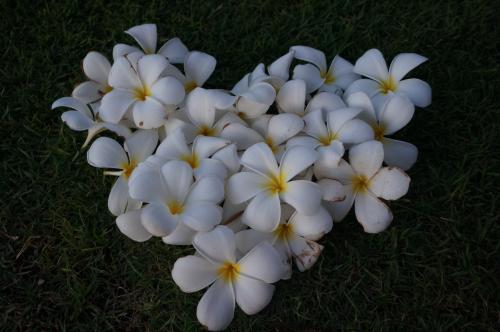
These are the planting methods for plumeria. Isn't it easy to learn? Next, the editor will share with you the care methods and precautions for plumeria.
Plumeria Planting
Plumeria, commonly known as egg-yolk flower, gets its name because its petals are yellow from the inside outward, then show a distinct band of white, alternating white and yellow, white outside and yellow inside, much like a beaten egg, so it is called plumeria. It is mostly found in Southeast Asia and is also called Burmese gardenia. Plumeria flowers are fragrant and generally prefer to grow in clusters. It belongs to the deciduous shrub and small tree family. Its leaves are very large, and it generally blooms in summer. It originated in the Mexico region of the Americas and is a highly ornamental flower.
Plumeria is actually quite famous, especially in Southeast Asia, because plumeria is recorded in Buddhist scriptures and designated as the flower of hope, one of the Five Trees and Six Flowers. Because it is simple yet fresh, it is also called Indian jasmine. It is the city flower of Chongqing.
Plumeria is very suitable for planting in courtyards. Its tree shape is rather unusual, from the perspective of ordinary people. It is very suitable for home planting. So how do you grow plumeria? First, we need to know its habits.
Plumeria originally grew in Mexico, so it prefers warmth, and it grows better when the air is relatively humid. It generally grows in sunlight and is a sun-loving tree species. Generally, plumeria that blooms grows in sunlight. Plumeria grows in acidic soil, and the temperature is generally above 25°C. In places generally below 20°C, it is hard to see plumeria bloom.
How to Care for Plumeria
1. Plumeria does not have very high soil requirements; ordinary soil will do. However, if you want beautiful plumeria to grow, then it needs to be planted in loose soil rich in humus and with good drainage.
2. Dwarf varieties of plumeria are planted in homes, all using the potted method, but plumeria still grows relatively fast, especially the root system, so it is generally recommended to change the pot once a year. For potting soil, you can buy specialized soil.
3. Watering plumeria needs to be appropriate, because it is relatively drought-tolerant and belongs to sun-loving plants. However, if watered too much, it will become waterlogged. The general watering principle is to water again after the soil dries. In summer, you can appropriately sprinkle some water on the leaves and branches.
4. Fertilizing plumeria is not very demanding. During the growth period and flowering period, you can appropriately fertilize about once a week. Remember to use light fertilizer. But do not fertilize in winter, to prevent excessive leggy growth.
5. Plumeria is a sun-loving plant. As long as there is sufficient sunlight, it will grow very quickly. The longer the sunlight duration, the more flowers it will produce.
6. Temperature is very important for plumeria, because plumeria grows in tropical regions and is not cold-tolerant. Once autumn arrives and the temperature drops below 20°C, it begins to shed its leaves. Generally, in winter the temperature needs to be kept above 10°C.
What Is Plumeria? Plumeria Planting Methods and Precautions
What is plumeria? Plumeria, also known as Burmese gardenia, egg-yolk flower, Indian jasmine, and dajihua, is a deciduous shrub or small tree of the genus Plumeria. Plumeria blooms in summer, with an elegant fragrance. The editor has a pot of plumeria at home, and whenever it blooms, the room is filled with a light, elegant fragrance. So how do you grow plumeria? Let me share my experience.
Morphological Characteristics
Deciduous small tree, about 5 m tall, up to 8.2 m at the highest, diameter at breast height 15-20 cm; branches thick and sturdy, somewhat fleshy, with abundant sap, green, hairless. Leaves thickly papery, oblong-obovate or oblong-elliptic, 20-40 cm long, 7-11 cm wide, apex shortly acuminate, base narrowly cuneate, leaf surface dark green, leaf underside light green, both sides hairless; midvein sunken on the leaf surface, slightly raised on the leaf underside, lateral veins flat on both sides, 30-40 on each side, not reaching the leaf margin and anastomosing into a marginal vein; petiole 4-7.5 cm long, with glands at the base on the upper side, hairless.
Cymes terminal, 16-25 cm long, about 15 cm wide, hairless; peduncle trichotomous, 11-18 cm long, fleshy, green; pedicel 2-2.7 cm long, pale red; calyx lobes small, ovate, apex rounded, about 1.5 mm long and wide, not spreading but pressed against the corolla tube; corolla white on the outside, the outside of the corolla tube and the left side of the outside of the lobes slightly with pale red markings, corolla yellow on the inside, 4-5 cm in diameter, corolla tube cylindrical, 1-1.2 cm long, about 4 mm in diameter, hairless outside, densely pubescent inside, throat without scales; corolla lobes broadly obovate, apex rounded, base overlapping to the left, 3-4 cm long, 2-2.5 cm wide; stamens inserted at the base of the corolla tube, filaments very short, anthers oblong, about 3 mm long; carpels 2, free, hairless, style short, stigma oblong, constricted in the middle, apex 2-cleft; each carpel has many ovules.
Follicles paired, widely spreading, cylindrical, tapering toward the apex, about 11 cm long, about 1.5 cm in diameter, green, hairless; seeds obliquely oblong, flat, 2 cm long, 1 cm wide, apex with a membranous wing, wing about 2 cm long. Flowering period May-October; fruiting period under cultivation rarely sets fruit, generally July-December.
Growth Habits
Plumeria is a sun-loving tree species and prefers a high-temperature, humid environment with sufficient sunlight. But it can also grow in semi-shaded environments; however, in shaded environments the branches grow leggy, with few flowers or only leaves and no flowers; while yellow plumeria in a shaded, humid environment will grow aerial roots on the branches.
The soil suitable for planting plumeria is best as deep, fertile, well-aerated, organic-rich acidic sandy loam; plants grown this way are robust, with a large number of flowers and vivid flower color. When the soil is poor, plumeria grows and develops poorly, with small flowers and dull flower color.
Plumeria is drought-tolerant, averse to waterlogging, and has good stress resistance. However, drought is not conducive to plant development, and in severe cases leads to poor growth; waterlogging easily causes root rot.
Plumeria has poor cold tolerance. The most suitable temperature for growth is 20-26°C. During overwintering, being below 8°C for a long time makes it prone to cold damage. In the vast number of towns south of the Tropic of Cancer in China, open-field cultivation can generally overwinter safely; in Central China and North China, it is only suitable for pot cultivation, and in winter it should be moved into a greenhouse to overwinter.
Planting Methods
The propagation method can be layering in the growing season. Cut stem segments about 30 cm long, wait until the cut surface dries, then insert about 1/3 into plain sandy soil, keep the raw soil moist, and roots can form in 20-30 days. After 1-2 months, transplant and set in place. It can also be grown from seed.
Cultivation management: It grows better in fertile sandy raw soil, and in daily care it can be placed in a place with ample sunlight. Watering should follow "water thoroughly when dry," and be careful not to let the raw soil become too wet, to avoid root rot. During the growth period, apply 1 time of decomposed low-concentration liquid fertilizer every 7-10 days, and often loosen the soil to maintain satisfactory air permeability in the raw soil. In cold winter, stop fertilizing and control watering, so that the plant enters a dormant state, and maintain a room temperature of about 10°C. Even if all the leaves fall off, the plant will not die. Wait until the following spring when it warms up and new leaves grow, then change the pot.
Main pests and diseases: Yanling rarely has pests or diseases.
Suitable range: Native to the New World of the Tropic of Cancer. In China, cultivation is mainly south of the Yangtze River, and in Yanling there is more cultivation in Bailiang and Chendian.
Garden uses: In northern regions, plumeria can be used as bonsai, while south of the Yangtze River it can be planted in courtyards and is suitable for planting in lawns. Besides being ornamental, the flowers and bark can also be used medicinally, with the effects of clearing heat and removing toxins, relieving cough, and promoting diuresis. After the trunk or tender branches are broken, a white-colored sap flows out, which is commonly used among the people to treat wounds. After the flowers are dried in the sun, they can be eaten or brewed as tea.