What are the precautions for growing osmanthus trees?
1. Pay attention to the frequency and amount of watering; overwatering can cause water to accumulate around the roots and, in severe cases, may kill the plant.
2. Osmanthus is a typical long-day plant; if it does not receive enough light during the growing season, the plant tends to grow leggy and its flowering period is affected.
3. Potted osmanthus needs to be repotted once every 1-2 years; without repotting, the plant will suffer from insufficient nutrients, and the roots will become pot-bound and unable to spread, affecting flowering.
4. In winter, potted osmanthus should not be kept for long periods in a room with high temperatures; it should be placed in a cool spot so the plant can enter normal dormancy. Otherwise, the osmanthus will sprout and leaf out early, leading to weak, spindly branches and a heavy consumption of nutrients, and it may easily die of drought when spring arrives.
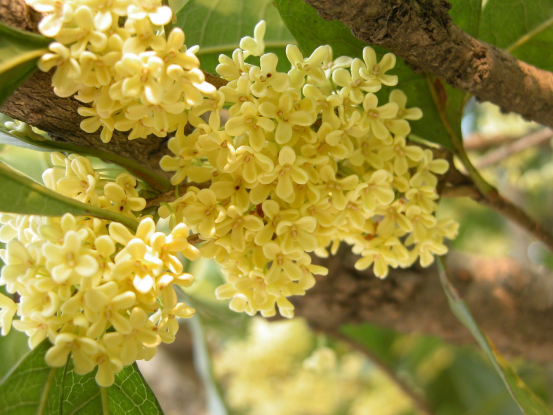
How to grow osmanthus trees: cultivation methods and precautions for osmanthus trees
The osmanthus tree, also called linxi tree, has a cultivation history of 2500 years in China. The osmanthus tree is a long-day plant, suitable for growing under conditions of ample sunlight, fertile soil and good drainage, and has high ornamental value; the flowers of some varieties are edible. This article shares the cultivation methods and precautions for osmanthus trees with you.
Cultivation methods for osmanthus trees
In China, osmanthus trees are mostly seen in garden ornamentation. The more common varieties include Jinguì (golden osmanthus), Yínguì (silver osmanthus), Dānguì (orange osmanthus) and Sìjìguì (four-season osmanthus), among which Jinguì has relatively high economic value. Osmanthus trees are generally propagated by cuttings, layering and grafting, but because the survival rate is not high, the development of osmanthus is limited to a certain extent.
Osmanthus trees are mostly planted in early spring. First dig a large hole in a spot with fertile soil and ample sunlight, and apply some organic fertilizer; at the same time, some plant ash can also be applied. After the tree has established, apply fertilizer water once or twice in July or August, apply decomposed compost before winter arrives, apply a quick-acting nitrogen fertilizer once in March of the following year, apply a quick-acting phosphorus and potassium fertilizer once more in July, and apply organic fertilizer once more in October. During routine care, pay attention to weeding, watering and the prevention and control of pests and diseases. This will keep the osmanthus tree blooming abundantly year after year with a lingering fragrance.
In addition, for potted osmanthus trees, even more attention should be paid to choosing the soil and pot, watering and fertilizing, as well as pruning and preventing and controlling pests and diseases.
Precautions for osmanthus trees
When watering osmanthus trees, note that you should water less before new shoots emerge, water less on cloudy and rainy days, and water more during dry weather in summer and autumn. When osmanthus trees bloom in autumn, you should control the amount of water to keep the pot soil moist; too much moisture will cause the flowers to drop.
Osmanthus trees need sufficient fertilizer; in particular, a lack of phosphorus fertilizer will affect branching and result in fewer flowers with no fragrance. Osmanthus trees have well-developed root systems, and mature osmanthus trees put out new shoots every spring and autumn, so attention should be paid to pruning to maintain a beautiful plant shape, which can also balance the tree's physiological nutrition and promote flower bud growth.
To grow a healthy osmanthus tree, in addition to routine daily management, you also need careful maintenance and attention to the prevention and control of pests and diseases, with timely spraying for control. That is all for the cultivation methods and precautions for osmanthus trees. For more flower cultivation information, please follow the planting encyclopedia of China Agrochemical Investment Network.
Further reading:
Osmanthus tree planting techniques, cultivation methods, osmanthus flower language, uses and effects
Cultivation methods and precautions for osmanthus trees
Common cultivated osmanthus varieties include Dānguì, Jinguì, Yínguì and Sìjìguì. Different varieties of osmanthus bloom at different times, and the colors of their flowers are also different. Jinguì blooms from September to October, and its color is usually golden yellow. Yínguì blooms from September to October, and its color is white or yellowish white. Dānguì blooms in October, and its color is mostly orange-red or orange-yellow. Sìjìguì blooms in all four seasons, with a small number of flowers every month, and its color is white.
The growing environment of osmanthus trees
1. Cuttings: Cuttings are generally taken from June to July or from September to October, and sandy loam is suitable as the cutting medium. Use semi-mature current-year branches as cuttings, with terminal branches being the best. After cutting, shade promptly, water thoroughly, and strengthen water and fertilizer management. Generally, healing begins 20 days after cutting, and roots can form in 30-40 days. Cold protection measures are needed in winter, and the following year the seedlings can grow to about 30 cm tall.
2. Layering: Layering is divided into air layering (high layering) and ground layering, and can be done in all four seasons. Air layering is done in early April, while ground layering is best done in early April or during the plum rain season. When layering, the stem must be wounded or ring-barked, and after 1 year it is separated from the mother plant. For ground layering, the buried part of the branch is about 4-5 cm deep, and the more bent the buried branch, the better.
3. Grafting: Grafting propagation is done from March to April. The rootstock is mostly small-leaf privet or large-leaf privet. The grafting method is branch grafting, and cut grafting, cleft grafting or approach grafting can all be used. During grafting, shade is required and moisture should be maintained. Cut grafting and cleft grafting require the graft union to be as low as possible, generally cutting off the rootstock 3 cm above the ground. After tying, mound soil up to the top of the scion so that it may root from the scion part, improving the survival rate.
4. Sowing: Sow in winter or early spring by drilling, with a row spacing of 15-20 cm, sowing 30-40 seeds per meter of row, and a sowing rate of 8-10 kg per mu, covering with humus soil or burned soil to a thickness of about 1.5 cm, and then covering with straw. Generally, germination begins 40-50 days after sowing and can continue for up to 50-60 days, with very uneven germination. July to September is the period of vigorous seedling growth, so topdressing and drought resistance must be attended to. One-year-old seedlings more than 30 cm tall can be released from the nursery.
5. Nursery stock release: After layered and grafted seedlings have rooted, they can be planted in winter or set out in the nursery to grow into large seedlings. When cutting seedlings reach more than 30 cm in height, sowing seedlings reach more than 25 cm, and the ground diameter reaches more than 0.4 cm, they can be released from the nursery for afforestation or transplanted to a large-seedling cultivation area. When lifting seedlings, keep the root system as intact as possible, and plant them promptly after lifting; if long-distance transport is required, pay attention to moisture retention.
Variety classification of osmanthus trees
1. Sìjìguì variety: Sìjìguì is a clumping shrub with a low tree form, short and dense branches, and a round spherical crown. New leaves are dark red, and mature leaves are green or yellow-green. The leaves are elliptical to broadly ovate, and the angle between the main vein and the lateral veins is very large, approaching a perpendicular state. Flower buds are usually solitary or 2-3 superimposed, blooming in batches from September each year to March of the following year, and the fragrance is not as rich as that of Yínguì, Jinguì or Dānguì. Common varieties include large-leaf Sìjìguì and small-leaf Sìjìguì; varieties that bloom in all four seasons include Yuèyuèguì, Rìxiāngguì, large-leaf Fodingzhu, and toothed-leaf Sìjìguì.
2. Dānguì variety group: Dānguì is dioecious, with a round spherical crown, light gray bark that is relatively smooth, and sparse lenticels. The leaves are leathery, long elliptical or elliptical, with a relatively flat leaf surface, revolute leaf margins, entire margins, occasionally sparse teeth at the apex, a broad cuneate base, an obtuse or shortly pointed apex, 8-10 pairs of lateral veins, obvious reticulate veins on both sides, and a petiole 8-10 mm long. The flower color is orange-red, the corolla is slightly incurved, the fragrance is light, and the flowering period is from late September to early October. Varieties include large-flower Dānguì, toothed Dānguì, cinnabar Dānguì, and broad-leaf red.
3. Jinguì variety group: The Jinguì crown is round spherical, the tree vigor is strong, and the branches are upright and very dense. The bark is gray, the lenticels are round or elliptical, and the spring shoots are relatively thick. The leaves are dark green, elliptical, with an uneven leaf surface and slightly wavy leaf margins. The flower color is yellow, with a rich fragrance, and it does not set fruit. It blooms in autumn, and the flowers range from lemon yellow to pale golden yellow. Varieties include large-flower Jinguì, large-leaf yellow, Huangchuan Jinguì, late Jinguì, round-leaf Jinguì, Xianning late osmanthus, ball osmanthus, round-petal Jinguì, willow-leaf Su guì, Jinshi guì, and wave-leaf Jinguì.
4. Yínguì variety group: The Yínguì crown is round spherical, with spreading large branches, dense branches and leaves, and good growth. The bark is light gray, and the lenticels are numerous and large, shaped like snowflakes and very obvious. The leaves are green or dark green, long elliptical or elliptical, relatively broad and thick, with a relatively flat leaf surface. It blooms in early to mid-September, with flower colors from creamy yellow to lemon yellow, a rich fragrance, and it does not set fruit after flowering. It blooms in autumn. Varieties include broad-leaf seed Yínguì, willow-leaf Yínguì, hard-leaf Yínguì, seed Yínguì, Jiulong guì, early Yínguì, late Yínguì, Baijie, pure white Yínguì, and Qingshan Yínguì.
When does osmanthus bloom
1. Jinguì: flowering period September to October, color golden yellow. Yínguì: flowering period September to October, color white or yellowish white. Dānguì: flowering period October, color orange-red or orange-yellow. Sìjìguì: a small number of flowers every month, color white. In addition, different planting regions of osmanthus will also lead to slight differences in flowering time. In Shanghai, Anhui and Jiangsu it basically blooms in October, in the Northeast region it basically blooms in August, in the Beijing, Tianjin and Hebei area it is September, and in the Sichuan, Guangxi and Shaanxi area it blooms in September.
2. Osmanthus will not bloom before it reaches flowering age. Osmanthus has a long lifespan and can generally live for decades to several hundred years, with some even living for a thousand years, so its flowering age is also relatively late. Seed-grown seedlings take about ten years to bloom, cuttings take four years to bloom, grafted Jinguì and Yínguì have one-fifth blooming the following year, and grafted Sìjìguì bloom in the same year but only very few. Some transplanted large osmanthus trees can bloom in the same year, while others need one or two years to adapt before blooming.
How much does one osmanthus sapling cost
1. Variety: The variety of the osmanthus sapling determines its price. Osmanthus is divided into four major varieties: Jinguì, Yínguì, Dānguì and Sìjìguì. Of course, each major variety contains many minor varieties, but the prices of the minor varieties under the major varieties are all about the same, with Dānguì having the highest price because it bears red flowers.
2. Size: Osmanthus saplings also come in large and small sizes, and large ones are of course more expensive. For small saplings, the industry generally now distinguishes size by sapling height (previously by tree age). At present, the most commonly planted osmanthus saplings are about one meter tall.
3. Place of origin: The place of origin of osmanthus saplings has a great relationship with price, because regional factors first of all lead to different costs of cultivating osmanthus saplings in different places, resulting in slight price differences, and the transportation costs for nursery stock distribution are also greatly related to region.
4. Quantity: The purchase quantity of osmanthus saplings is also closely related to price. As is well known, when anything is bought wholesale, the price will certainly be a bit cheaper.
How to grow osmanthus so it thrives
1. Water at the right time: For potted osmanthus, follow the principle of not watering until the soil is dry, and watering thoroughly when you do, but spray the leaf surface with clean water once a day. After Qingming Festival, move the osmanthus outdoors and water it thoroughly once. In summer, water in the morning and evening, while in winter water around noon so that the water temperature is close to the soil temperature and does not cause sudden cold or heat; be careful not to let water accumulate.
2. Fertilize reasonably: Osmanthus is grown mainly for its flowers, so it should be supplied with sufficient fertilizer. Apply nitrogen fertilizer 1-2 times when shoots emerge, and mainly apply phosphorus fertilizer before flower bud differentiation and flowering. Before fertilizing, the pot soil should be slightly dry, and it is best to loosen the soil first to facilitate fertilizer absorption; water once on the day after fertilizing.
3. Repot and change soil: Osmanthus should be repotted and have its soil changed once every 2-3 years. Cut away some old roots and dead roots, place a layer of river sand or vermiculite at the bottom of the pot to improve aeration and drainage, and place decomposed cake fertilizer as base fertilizer; when filling with soil, be sure to press it firm. The soil ratio is not very strict; usually garden soil, composted manure and river sand can each make up 1/3 of the mix.
4. Pruning and shaping: Osmanthus shaping generally adopts a combination of bending and pruning, preferably carried out after autumn. For plants with a very poor tree shape, the entire top branches can be cut off at 2/3 or 3/4 of the height; plants with overly dense branches should be thinned, and after flowering, leggy branches, dead branches, pest- and disease-damaged branches, and dense weak branches should also be cut off.
5. Overwintering management: The indoor temperature for overwintering osmanthus should be kept at 0-5°C, and the relative humidity should be kept at 50-80%. In winter, the light in a cold room should be good, especially before the buds begin to sprout in early spring, when even more sunlight is required. The following year, after Grain Rain, arrange for potted osmanthus to be moved outdoors. After being moved out, first place them together in a wind-sheltered, sunny spot outdoors so they gradually adapt to the external environment.
6. Disease control: Common diseases of osmanthus include leaf spot, sooty mold, algal leaf spot, root rot and iron deficiency. Leaf spot, sooty mold and algal leaf spot can be controlled by spraying 0.5 Bordeaux mixture or 5% carbendazim 500-1000 times dilution. For root rot, take care to keep the soil loose and breathable and do not let water accumulate.
7. Pest control: Common pests of osmanthus include sawflies, whiteflies, mites, long white scale insects and yellow slug moths. Sawflies, whiteflies and mites can be killed by spraying 40% dimethoate 1500-3000 times dilution. For long white scale insects, besides manual brushing off, during the first and second instar nymph stages they can be killed by spraying 40% omethoate 1000 times dilution or 40% fenitrothion 500 times dilution.
Pruning methods for osmanthus bonsai
1. Pruning during the ornamental period refers to the pruning carried out after the osmanthus bonsai has taken shape, in order to maintain the beautiful form of the shaped osmanthus tree. This kind of pruning is long-term and extensive, and must be done carefully.
2. For osmanthus bonsai cultivated from tree stumps, after shaping and pruning, the trunk and main branches have already been determined. What needs further processing and pruning are the secondary branches and the even finer tertiary branches. The basic points to master when processing and pruning these branches are: a branch should have a certain degree of curvature, and each branch should differ in length and shortness, so as to appear beautiful.
3. When pruning, messy crossing branches, overlapping branches, parallel branches and opposite branches should be adjusted, that is, one of them is cut off or one section is thinned out. The remaining branches can grow thick and strong because nutrients are concentrated. When a cultivated branch grows to a suitable thickness, carry out heavy pruning to shorten it and produce the second section of branch. When the second section of branch grows to a suitable thickness, cut it again. Thereafter, treat the third and fourth sections of branches in the same way. Generally, leave two small branches on each section of branch, one long and one short. After years of pruning, the lower part of the branch becomes short and thick, vigorous and powerful, gradually forming the desired tree shape.
Sowing methods for osmanthus seeds
1. From early February to April of the following year, sowing and seedling raising can be carried out only when the seeds crack open and show white. Drilling is generally used, that is, making horizontal or vertical furrows on the seedbed, with a furrow width of 12 cm and a furrow depth of 3 cm; sow 1 pre-germinated seed every 6-8 cm in the furrow. When sowing, place the seed hilum sideways to avoid bending of the radicle and young stem, which would affect seedling growth. In the Guilin area, wide-row drilling is usually used, with a row spacing of 20-25 cm and a bed width of 10-12 cm, sowing 20 kg per mu, which can produce 25000-30000 seedlings.
2. After sowing, immediately cover with fine soil, with a covering thickness preferably not exceeding 2-3 times the transverse diameter of the seed; after covering with soil, level the bed surface to avoid water accumulation; then cover with a thin layer of rice straw, to the extent that the soil is no longer visible, and stretch ropes to press it down to prevent the covering straw from being blown away by wind; then use a fine-holed watering can to spray water thoroughly until the soil is soaked through. Covering with straw and spraying water can keep the soil moist, avoid soil crusting, and promote early seed germination and early emergence.
How can osmanthus be made to bloom more?
1. Choose good pot soil: Osmanthus likes slightly acidic soil. For potting, you can use a mix of 5 parts mountain soil, 3 parts humus soil and 2 parts sandy soil, or use half leaf mold and half sandy loam as the growing medium. If the soil is too acidic, growth will be slow and the leaves will turn yellow and wither. If alkaline soil is used, after 2-3 months it can cause the leaves to wither and even die.
2. Water at the right time: For watering osmanthus, master the rule of "two less and one more", that is, water less before new shoots appear, water less on cloudy and rainy days, and water more during dry weather in summer and autumn. Usually, watering should keep the pot soil at about 50% moisture content. On cloudy and rainy days, drain promptly to prevent water accumulation in the pot from rotting the roots, otherwise it is easy for the plant to be "drowned".
3. Apply topdressing skillfully: Osmanthus likes pig manure, and there is a saying in flower lore: "If you want fragrant osmanthus, prepare more pig manure vats." If, after the osmanthus is moved outdoors in early spring, you apply decomposed diluted pig manure liquid, applying it about once every 10-15 days from April to May, once every 7-10 days from June to July, and one final time in early August, then the osmanthus will grow luxuriantly, bloom more and smell fragrant. In cities where there is no pig manure, decomposed cake fertilizer liquid can be used. If fertilization is insufficient, there will be few branches and few flowers, and they will not be fragrant.
4. Prune appropriately: Osmanthus has a well-developed root system and strong sprouting ability. Mature osmanthus trees put out new shoots twice a year. Therefore, to make osmanthus bloom abundantly and flourish, appropriate pruning is needed to maintain the physiological balance between reproductive growth and vegetative growth. Generally, leggy branches, thin weak branches and pest- and disease-damaged branches should be cut off to facilitate ventilation and light penetration and concentrate nutrients, prompting the osmanthus to develop more and fuller flower buds, so that it blooms abundantly.