How to sow Japanese iris? Detailed sowing method
1. Obtaining seeds
The fruit of Japanese iris basically matures in mid-January, and the seeds can be taken out of the harvested fruit. They can be sown right after harvesting; if the seeds are to be stored, they must first be dried and kept refrigerated at low temperature in the refrigerator, then sown in March or September of the following year.
2. Sowing
Place loose potting soil level in a repotting container, put the selected seeds evenly on the surface of the soil, try to ensure the seeds have enough space to grow, and cover with a layer of soil, which should not be too thick, so as to better let the plants germinate.
3. Care
Place the flower pot in a semi-shady environment, water it in time, and keep the soil moist; it must not be too dry.
That is all about the flower language of Japanese iris. It carries beautiful faith and hopes, and I hope everyone will like Japanese iris even more.
How to care for Japanese iris
Japanese iris, also known as Yuchanhua, is a perennial herbaceous plant of the genus Iris in the family Iridaceae. Many people think that Japanese iris and calamus are the same plant, but this understanding is wrong. So how should Japanese iris be cultivated and cared for? Let the editor tell you.
Japanese iris
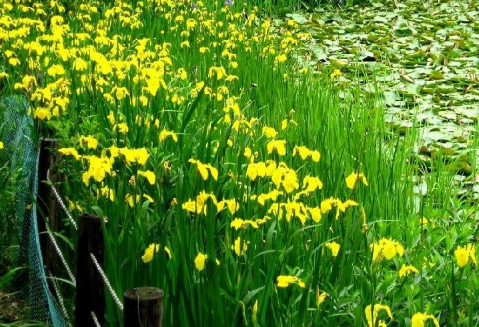
Japanese iris can often be seen planted in water, and some are planted in dry soil above the water surface, but their growth is not as good as those planted in water. No matter which cultivation form is adopted, choose a place with sufficient sunlight as much as possible when cultivating, with at least more than half a day of sunshine every day.
When planting Japanese iris, the placement of the seedlings is quite important. Their outer leaves should all face the wall of the planting container or the outer edge of the planting site. This is conducive to the sprouting and growth of new buds, and the growth of field-planted seedlings will not be crowded, with a neat and beautiful arrangement.
One issue to pay attention to when planting in pots is ensuring moisture. Japanese iris likes moisture more than other perennial plants, especially during the germination and flowering periods when it needs a large amount of water. Therefore, the bottom of a potted Japanese iris should be lined with sand 2 cm to 3 cm thick, and a water level of 1 cm to 2 cm should be maintained above the sand, so that the bottom of the pot is immersed in water.
Before field planting, first consider the issues of water source and water storage. Once this is solved, the prerequisite for planting Japanese iris is in place; in daily management, just pay attention to keeping the field moist regularly. In winter, Japanese iris enters dormancy and can be slightly drier. For field planting, a plant spacing of 25 cm x 30 cm is more suitable. The planting depth should be such that the soil covers the roots of the plant. The water at the initial stage of planting should be as shallow as possible to prevent the seedlings from floating and to help them take root as quickly as possible.
Propagation methods of Japanese iris
Division propagation of Japanese iris
Division can ensure the excellent traits of the variety and reduce variation.
Division time:
Japanese iris can be divided after growing for 3~4 years. Usually choose May in spring, or mid-to-late September in autumn or after flowering. In northern regions, choose a sunny day with sufficient sunlight when transplanting.
Division method:
First, select 3~4-year-old plants, separate the rhizomes with a knife, cut off residual roots and diseased roots, and keep 3~4 buds per plant. When dividing in summer and autumn, cut off part of the leaves. Plant when the stems are about 25-30 cm long.
The rhizomes of Japanese iris will rise year by year over time. When planting, cover the rhizome part with more than 5 cm of soil, and add soil at the right time during care.
After division and planting, water and fertilize appropriately; spring-planted clumps can bloom in the same year.
Seed propagation of Japanese iris
Sowing time:
Propagation by sowing is the main source of new varieties. During the flowering period, through artificial or natural hybridization, the plants bear fruit, and seeds can be harvested in mid-January and sown immediately. Alternatively, place the seeds in an environment of 0~4°C and sow in February~March of the following year. Sowing in mid-September is also acceptable.
Sowing method:
Choose seeds of the current year and soak them in warm water for 6~8 hours to speed up germination.
Keep the temperature controlled at 15~25°C, scatter the seeds evenly in the soil, cover with 2~3 cm of soil, and seedlings will emerge in 30~40 days. When the seedlings grow to more than 10 cm, they can be potted.
Japanese iris grown from sowing in a greenhouse grows slowly, but the seedlings stay green for a long time. Sown in a greenhouse in winter, the plants can overwinter without dormancy and bloom one year earlier.