How to Grow Pomegranate Flowers: A Detailed Guide to Care Precautions
Water management is very important when growing pomegranate flowers. Following the principle of "water promptly in drought and drain promptly in waterlogging," we can spray a little water on the leaves every morning and evening to increase the leaves' water content. When watering and fertilizing pomegranate flowers, aim for moist-then-dry cycles, so either water only after the soil has dried out completely; never let it stay half-dry and half-moist, or overly wet, as this is not good for growing pomegranate flowers. Pomegranate flowers also like a sunny, dry environment, so when growing them in pots, place the pot in a spot with plenty of light.
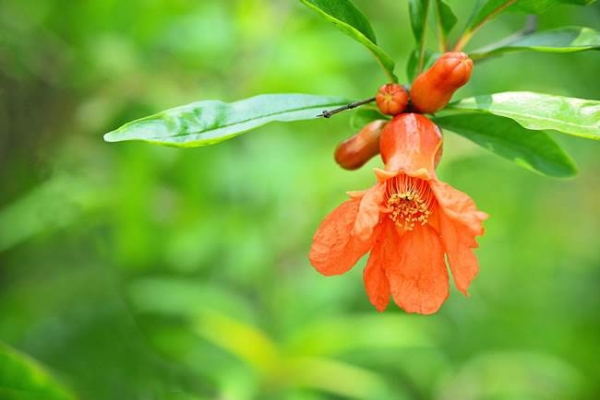
How to Grow Pomegranate Flowers: Precautions for Growing Potted Pomegranate Flowers
I believe everyone has heard of the pomegranate flower. It is the flower of the pomegranate, a deciduous shrub or small tree, and it has high practical and medicinal value, so many people grow it. However, because some people do not know much about how to grow pomegranate flowers, they also fail to pay attention to the care precautions during growing, so their cultivation does not go very smoothly, and they very much want to understand in detail the growing methods and precautions for pomegranate flowers. So let us take a look below at how to grow pomegranate flowers and the precautions for growing potted pomegranate flowers.
Introduction to Pomegranate Flowers
First, let us get to know the pomegranate flower. Pomegranate flower, also called An pomegranate, Jinying, Jinpang, Tulin, Tianjiang, Zhushi, Ruoliu, Danruo and Shanliye, among other names, is the flower of the pomegranate, a deciduous shrub or small tree, and a flower of the genus Punica in the family Lythraceae. This flower actually originated mainly in Iran and Afghanistan in Central Asia, but with the passage of time it is currently the national flower of the North African country Libya, and is also one of the city flowers of Zhaozhuangsi in Shandong Province, Shiyan City, Huangshi City and Jingmen City in Hubei Province, Xinxiang City in Henan Province, Xi'an City in Shaanxi Province, and Hefei City in Anhui Province in China, which shows the high status it holds in people's hearts.
Unlike ordinary flowers, the pomegranate flower is a monoecious bisexual flower, divided according to the degree of pistil development into two types: complete flowers and incomplete flowers. The complete flowers are gourd-shaped or tube-shaped, which people call "big-bottomed fruit flowers," while the incomplete flowers have a trumpet-shaped calyx tube, cannot be fertilized to bear fruit, and so are called bell-shaped flowers or "pointed-bottomed false flowers." Pomegranate flowers have good practical and medicinal value. Their practical value lies mainly in the fact that they can be enjoyed both for their flowers and their fruit, and they are often used as potted decorations, while their medicinal value has a long history; pomegranate flowers could be used as medicine as early as ancient times, and they have good effects such as clearing heat and detoxifying, moistening the lungs and astringing the intestines, and strengthening the stomach and stopping bleeding.
How to Grow Pomegranate Flowers
Usually, the methods for growing pomegranate flowers are mainly the three types of propagation: cuttings, division and layering. Among these, cutting propagation is mainly done in spring, using two-year-old semi-lignified pomegranate flower branches for cuttings. The branches can take root in about half a month after cutting. Division propagation is mainly done in April in spring, when the pomegranate flower is just at the bud-sprouting stage; simply dig up strong root-sucker seedlings and plant them separately. As for layering propagation, it can be done in either spring or autumn; similar to division, at the bud-sprouting stage simply dig up strong root-sucker branches and press them into the soil.
Precautions for Growing Potted Pomegranate Flowers
Of course, more people now prefer to grow pomegranate flowers in pots. Growing pomegranate flowers in pots is relatively simple, but there are still many precautions, including: pomegranate flowers like a sunny, dry environment, so when growing them in pots, place the pot in a spot with plenty of light. During growing, strictly control the amount of water; it is better to keep them dry than wet, and do not water too much at ordinary times. In addition, control the growth of the pomegranate flower well, and during the growing period promptly pinch off the growing tips to promote the formation of flower buds.
Conclusion: The above is a related introduction to how to grow pomegranate flowers and the precautions for growing potted pomegranate flowers, and I believe everyone has some understanding of this now. In summary, the pomegranate flower is still a relatively easy plant to grow, but it still requires everyone to take careful care of it.
Pomegranate Flower Growing Methods and Precautions
Everyone has tasted pomegranate flowers; steeping Gongju in water and drinking it can clear heat and relieve fever, and pomegranate flowers, wild chrysanthemums and Hangbaiju are all very familiar to everyone. Besides improving eyesight, clearing heat and detoxifying, they also have the effect of being ornamental and used in garden landscaping, beautifying the environment. Let us look below at the pomegranate flower growing methods and precautions.
Pomegranate Flower Growing Methods and Precautions1. Pomegranate flower growing methods——Water
Water management is very necessary when growing pomegranate flowers. Following the principle of “water promptly in drought and drain promptly in waterlogging,” water the pomegranate flowers accordingly, and spray a little water on the leaves every morning and evening to increase the leaves' water content. When watering and fertilizing pomegranate flowers, aim for moist-then-dry cycles, so either water only after the soil has dried out completely; never let it stay half-dry and half-moist, or overly wet, as this is not good for growing pomegranate flowers.
2. Pomegranate flower growing methods——Temperature
When growing pomegranate flowers in winter, pay attention to keeping them warm in management. When growing pomegranate flowers in southern regions, after the flowers fade the stems and leaves will gradually wither, and after watering you can wait for them to overwinter. At this time, you should cover the leaves with soil; this practice can promote soil aeration and improve the pomegranate flower's ability to overwinter.
3. Pomegranate flower growing methods——Fertilizing
Pomegranate flowers can be improved in condition through fertilizing, but do not apply fertilizer too early, and applying too much fertilizer can also damage the roots.