How does Monochoria korsakowii reproduce? Detailed explanation of propagation methods
Division propagation
Division propagation is generally carried out in early spring. First take out the mother plant, shake off excess soil, separate the roots with a small knife, dividing into two or more plants, each with a complete root system, and appropriately trim the roots and leaves. Soak the new plants in a solution of carbendazim, then dry them and pot them up, placing them in a shady spot for care. Do not water too much the first time; you can spray a mist of water on the leaves.
Seed propagation
Monochoria korsakowii is mainly sown in autumn. Before sowing, the seeds can be soaked in warm water until they absorb water and swell. Sow the treated seeds on the substrate and cover with a layer of soil, taking care that it is not too thick. After sowing, water without washing the seeds out. In cold weather, the pot can be wrapped in plastic film to keep warm and moist; with adequate sunlight, the seedlings grow better.
Propagation methods of Monochoria korsakowii
Division propagation of Monochoria korsakowii
As the Monochoria korsakowii plant grows and becomes larger, division is needed, which benefits the plant's further development and vigorous growth.
For division propagation of Monochoria korsakowii, the best time is early spring each year, when the soil thaws and division is easier. When dividing, take out the mother plant, remove excess potting soil, separate the roots, and cut the roots apart with a small knife, dividing into two or more plants. Note that each new plant must carry a complete root system. Appropriately trim the leaves and roots to help the plants survive.
Disinfect the small new plants divided from Monochoria korsakowii. Simply soak them in a solution of carbendazim. After soaking, let the small plants dry before potting them up.
Pot up the dried small Monochoria korsakowii plants, water once first, then place them in a shady spot for care. Note that newly potted Monochoria korsakowii have damaged roots, so do not water too much; for nearly a month, water sparingly, and once the roots recover, resume normal watering. However, to ensure normal growth of Monochoria korsakowii, you can mist the leaves every day.
Seed propagation of Monochoria korsakowii
Seed propagation of Monochoria korsakowii is actually similar to that of most plants.
Seed propagation of Monochoria korsakowii is mainly autumn sowing, carried out after mid-to-late September each year. Before sowing, some preparatory work is needed, such as pre-germination treatment and soil disinfection. Sow the treated seeds onto the substrate and cover with a layer of soil; the soil layer must not be too thick. Note that after sowing, it is best to water by sprinkling to avoid washing the seeds out.
Monochoria korsakowii is sown in autumn, and the main issue is overwintering. Do a good job of keeping warm and moist, and let it receive adequate sunlight, so the seedlings of Monochoria korsakowii can grow well.
How to grow Monochoria korsakowii
Monochoria korsakowii, Monochoria korsakowii, family Pontederiaceae, genus Monochoria, is distributed in all provinces north and south of China and in East Asia.
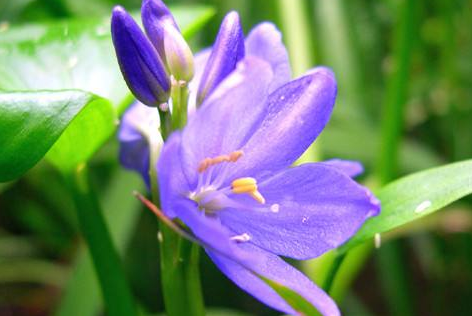
Perennial herb, plant height 30-80 cm, with short creeping rhizomes, aboveground stems upright. Leaves ovate-cordate, with long petioles, sheathing at the base. Flower stems emerge from the base, raceme, tepals 6, blue-purple. Anthers 6, one of which is larger and light blue, the rest yellow. Capsule ovoid.
Robust, cold-tolerant, mostly growing in swamps, ditches and at the edges of ponds.
Cultivation: sowing and root division are both fine, and it survives very easily.
Sowing and root division are both fine, and it survives very easily. Plant in ponds, or in pots as well; no special management is needed.
Both flowers and leaves are excellent, and placing it at a waterside pond is very distinctive.