How to Grow Cherry Blossoms and Key Points for Daily Care
When growing cherry blossoms in pots, nutrients must be replenished in time, with fertilizer applied about twice a year, once after the flowers fall and once as winter fertilizer. The soil should also be kept moist with frequent watering, roughly once every 8 to 10 days, but make sure there is no standing water at the bottom. A layer of grass can be spread over the soil surface to reduce water evaporation.
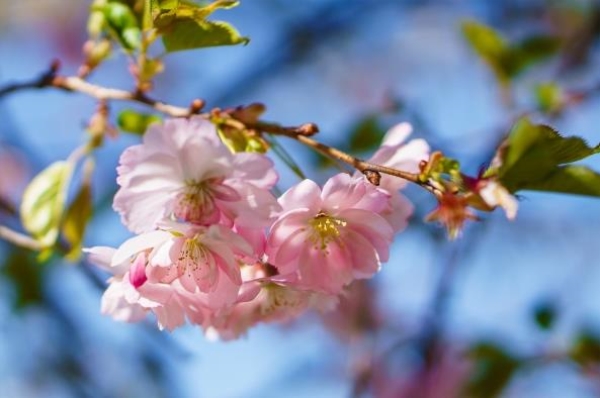
Have you all learned about the flower language of cherry blossoms? Plant a pot at home right away!
How to Grow Primroses
Primroses, also known as primrose, cowslip, and evening primrose, are perennial herbaceous flowers of the genus Primula in the family Primulaceae. The leaves are all basal, forming a rosette. The flowers come in red, yellow, orange, blue, purple, white and other colors, arranged on the scape in umbels, racemes, or heads, or borne singly among the leaf rosette, with a funnel-shaped or salverform corolla. They are often grown for ornamental purposes. Let's take a look below at how to grow primroses!
Growth Habits of Primroses
Primroses prefer well-drained soil rich in humus and are relatively moisture-loving. However, they need dryness, and seedlings should avoid strong sunlight and high temperatures; they like a warm, well-ventilated environment. They grow well in sandy loam and clay loam rich in humus (pH 5.5 to 6.5). In southern areas where the soil is heavy clay, it is generally mixed with homemade leaf mold (soil made by composting collected leaves, acidic soil, chicken manure and charcoal powder). Before mixing, all existing clay clods must be broken up, otherwise the soil improvement will not work.
Propagation Methods for Primroses
Primroses are mostly propagated by seed, but their seeds have a short lifespan and quickly lose viability. Seeds harvested in spring and sown in autumn will have their germination rate drop by half. Therefore, harvested seeds should be dried and refrigerated to lower their metabolic activity and extend their lifespan. The sowing time should be determined by the desired flowering period: for winter flowering, sow in late spring; for spring flowering, sow in early autumn. Seedlings sown in late spring quickly enter the hot summer, so cooling measures are needed, otherwise the seedlings can easily die in the scorching weather. For small-scale planting, sow in April; by the time summer arrives the seedlings have grown larger and have stronger heat resistance, and can safely pass the summer if placed in a shaded, ventilated spot.
How to Grow Primroses
1. Soil: Primroses prefer humus-rich clay soil and sandy soil, with the pH value kept at around 5.5 to 6.5.
2. Environment: Primroses like warm, airy and moist environments and can receive appropriate indirect light; they are not suited to direct sunlight.
3. Watering: Primroses like moist environments, but they themselves must not come into contact with too much water, otherwise root rot will occur.
4. Diseases: Primroses mainly suffer from leaf and stem diseases. In the early stages of disease, use a 600 to 700 times water dilution of 75% chlorothalonil wettable powder, spraying once every 5 to 7 days; several consecutive sprays can control the development of the disease.
5. Pests: The main pests of primroses are red spider mites, aphids and other insects. Prevention should be the priority, with spraying 3 to 4 times a year: the first before flowering, the second after flowering, and the third in July to August.
How to Grow Cherry Blossoms
Cherry blossom, scientific name Prunus serrulata, English name Flowering Cherry, also known as mountain cherry, Fukushima cherry, and smooth-skinned cherry, belongs to the family Rosaceae.
Origin and Habits
Cherry blossoms originate in the temperate zones of the Northern Hemisphere, with the richest variety found in the mountainous areas of southwest China, and among cultivated cherry blossoms the Japanese cherry is the most famous. They are mostly deciduous shrubs. They have a fairly wide tolerance for climate and soil. They like light, tolerate cold and drought, and grow well in well-drained soil. The flowering period is April.
Morphological Characteristics
The crown is ovate to round. The leaves are alternate and simple, with glandular serrations. The flowers are borne singly at the tips of branches or in clusters of 3-6 in umbels or corymbs, appearing together with the leaves or after the leaves; the calyx tube is bell-shaped or tubular; most cultivated varieties are double-flowered. The fruit is red or black and ripens in May to June.
Common cultivated species include:
1. Cherry blossom (P. serrulata) is a deciduous tree, 15-25 m tall, with smooth dark chestnut-brown bark. The leaves are ovate or ovate-elliptic, with awned semi-mature teeth along the margin; the flowers are white or pink, 2.5-4 cm in diameter, and the flowering period is April.
2. Japanese late cherry (P. lannesiana) is about 10 m tall, with light gray bark. The leaves are obovate, with long awn-like teeth along the margin; the flowers are single or double, drooping, pink or nearly white, fragrant, borne in clusters of 2-5, and the flowering period is April.
3. Japanese early cherry (P. subhirtella) is a small tree, about 5 m tall, with horizontally striped bark and braided bark on old trees. The branchlets are brown, and the leaves are obovate to ovate-lanceolate. The flowers are pink, 2-2.5 cm in diameter, borne in umbels of 2-5, flowering before the leaves in spring.
4. Sargent cherry (P. sargentii) is 12-20 m tall, with brown bark and purple-brown branchlets, and elliptic-ovate leaves. The flowers are pink, borne in clusters of 2-4, 3-5 cm in diameter, and the flowering period is March to April.
5. Yunnan cherry (P. cerosoides) is about 10 m tall, with brown bark and purple-brown branchlets; the leaves are elliptic-ovate or obovate, with double serrations along the margin. The flowers are pink to deep red, borne in clusters of 2-5, and the flowering period is February to March.
6. Majestic cherry (P. majestica) is about 25 m tall, with light brown bark and green branchlets; the leaves are long elliptic to lanceolate, and the flowers are pink, with a flowering period from January to January of the following year.
Growing and Cultivation
Propagate by sowing, grafting, cuttings and other methods. When propagating cherry blossoms by sowing, be careful not to let the seed embryo dry out; sow immediately after harvesting or stratify in wet sand and sow in spring of the following year.
Cherry blossom is a deciduous tree that likes sunlight, tolerates cold and drought, and avoids saline-alkaline soil. It is suitable for growing in loose, fertile, well-drained plots. It fears wind during the flowering period, and has strong sprouting ability and rapid growth.
I. Soil Requirements and Improvement Measures
Cherry blossoms grow well in sandy loam and clay loam rich in humus (pH 5.5 to 6.5). In southern areas where the soil is heavy clay, it is generally mixed with homemade leaf mold (soil made by composting collected leaves, acidic soil, chicken manure and charcoal powder). Note that before mixing, all existing clay clods must be broken up, otherwise the soil improvement will not work. In places where the groundwater level is less than 1 m, use the raised planting method, that is, level the entire planting pit first and then pile soil on top to plant the seedling. For northern alkaline soil, sulfur powder or ferrous sulfate etc. needs to be applied to adjust the pH value to about 6. Apply 2 grams of sulfur powder per square meter, with a valid period of 1 to 2 years, and measure every year to keep the pH value not exceeding 7. Varieties such as mountain cherry and Somei Yoshino have straight trunks and larger tree bodies; they are strongly heliophilous species and require a wind-sheltered, sunny location with good ventilation and light. When planting in groups, every tree must be able to receive sunlight.
II. Planting Measures
The planting time is immediately after the soil thaws in early spring, generally February to March. Planting method: carefully prepare the ground before planting. For planting on flat ground, dig a hole 1 m in diameter and 0.8 m deep. First fill about half the depth of the hole with improved soil, place the seedling in the center of the hole, and spread the roots in all directions. After filling in a small amount of soil, lift the seedling slightly upward so the root system spreads fully, then press down lightly. The planting depth should place the uppermost roots 5 cm from the ground. After planting, make a water-catching basin and water thoroughly, and finally support it with bamboo strips about as tall as the seedling to prevent it from being blown over by wind.
III. Management Measures
Drought prevention: after planting, seedlings are prone to drought damage. In addition to thorough watering at planting, water once every 8 to 10 days thereafter, keeping the soil moist but without standing water. Loosen the soil promptly after watering, and preferably cover the ground surface with a thin layer of grass to reduce water evaporation. Within 2 to 3 years after planting, straw can be used to wrap the trunk to prevent it from drying out. But after 2 to 3 years, when the sapling has grown new roots and its adaptability to the environment gradually increases, there is no need to wrap with straw anymore. Growing season management: cherry blossoms are fertilized twice a year, preferably with acidic fertilizer. One is winter fertilizer, applying organic fertilizers such as bean cake, chicken manure and decomposed fertilizer in winter or early spring; the other is after the flowers fall, applying quick-acting fertilizers such as ammonium sulfate, ferrous sulfate and superphosphate. Generally, for fertilizing large cherry trees, the hole application method can be used, that is, at the edge of the vertical projection line of the crown, dig a ring-shaped trench about 10 cm deep and apply the fertilizer into it. This method is both simple and conducive to root absorption; as the tree grows, the diameter and depth of the fertilizing ring trench also increase accordingly. The cherry blossom root system is shallow and requires good drainage and aeration, so around the tree, especially within the root distribution range, people, livestock and vehicles must never compact the soil. Trampling by pedestrians will weaken the tree, shorten its lifespan, and even cause root rot and death. Pruning and care: pruning mainly involves cutting off withered branches, water sprouts, overlapping branches and diseased or pest-infested branches. In addition, when many branches grow on the trunk of a large cherry tree, several robust branches should be retained and the rest all cut off from the base to facilitate ventilation and light penetration. After pruning, disinfect the wounds promptly with medication to prevent pathogens from invading after rain and causing rot. After long periods of sun exposure, the bark of cherry blossoms is prone to aging and damage, causing rot; it should be removed promptly and disinfected. Afterwards, wrap the rotten area with leaf mold and charcoal powder to help it return to normal physiological function.
IV. Pest and Disease Control
Gummosis is caused by moths boring into the trunk to lay eggs; you can dig out the eggs with a sharp knife, while also improving the soil and strengthening water and fertilizer management. Crown gall disease: the roots of such diseased trees cannot grow normally, and no matter how much fertilizer is applied, the tree remains unhealthy. Remove the tumors promptly, disinfect the soil, and improve the soil with leaf mold, charcoal powder and microorganisms. Aphids, red spider mites and scale insects: these pests and diseases should be prevented first. Spray 3 to 4 times a year: the first before flowering, the second after flowering, and the third in July to August.
Applications
Cherry blossom is an important ornamental flowering tree species and can be planted in large numbers to create a “sea of flowers” landscape. Planted in clusters of three to five among green spaces, they form brocade-like masses, or they can be planted singly to create the pictorial effect of “a single red among a vast expanse of green.” Cherry blossoms can also be used as street trees, hedges or made into bonsai.