What are the care precautions for magnolia?
Magnolia loves light. Compared with other flowers and trees, magnolia is cold-tolerant, but we should note that magnolia is not drought-tolerant, so take care to keep the soil moist. Usually ensure a supply of water, and frequently spray water on the leaves to increase air humidity, so as to avoid yellowing and leaf drop. It requires fertile soil to ensure its nutrient supply. Magnolia likes fertilizer and needs soil with good permeability; in winter, dig holes and apply organic fertilizer, such as bone meal and cake fertilizer.
At this point, our introduction to magnolia comes to an end. We hope readers can gain a better understanding of magnolia. Thank you for your support of TheNaturePlanet!
How to grow magnolia: 6 care methods and precautions
When magnolia blooms, its ornamental value is very high. So how do you grow magnolia? First you need to know magnolia's growing requirements. Below is a summary of magnolia's cultivation methods and precautions.
How to grow magnolia 1. Soil requirementsMagnolia likes fertile, moist, well-drained sandy soil. Magnolia is not drought-tolerant and dislikes alkaline soil, so it grows poorly in dry, alkaline or clay soil.
2. Light requirementsMagnolia likes ample light and is slightly shade-tolerant. Generally, during routine care, pay attention to light, and in the care environment try to let magnolia fully receive sunlight.
3. Watering requirementsYou should know that magnolia dislikes both drought and waterlogging. When watering normally, just ensure an adequate supply of water. It is recommended to frequently spray water on magnolia leaves to increase air humidity, so as to avoid yellow leaves and leaf drop.
4. Fertilizing requirementsMagnolia is a flowering plant that likes fertilizer. Routine care requires timely fertilization to supplement nutrients. Generally, fertilize magnolia once before and once after the flowering period, mainly with phosphorus and potassium fertilizer. In addition, apply rotted manure or barnyard manure as a base fertilizer each year in October to November. After flowering, during the period of budding and shoot growth, top-dress with fast-acting nitrogen fertilizer 2 to 3 times.
5. Temperature controlMagnolia likes a warm and humid climate environment and can also tolerate cold, but if the temperature is relatively low in winter, it is still recommended that growers move magnolia indoors for insulated cultivation to avoid frost damage.
6. Pruning requirementsGenerally, if magnolia is to form a tree shape, it is necessary to remove tillers and sprouts and to train the branches; this pruning is mainly to facilitate better growth of magnolia's tree form.
Magnolia cultivation methods and precautions
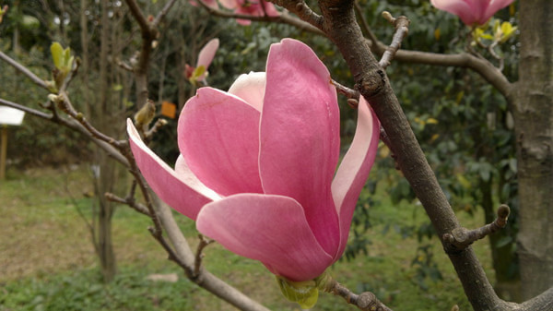
Chinese scientific name: MagnoliaFamily: MagnoliaceaeGenus: MagnoliaScientific name: Magnolia liliflora Desr.Aliases: Mulan, Xinyi, purple magnolia, MubiEnglish name: mangnoliaDeciduous small tree, up to 5 m tall. The wood is fragrant, the branchlets are purplish brown, and the buds are finely hairy. Leaves simple, alternate, obovate-elliptic; with stipular scars. Flowers bisexual, solitary, terminal; sepals 3, yellow-green, lanceolate, about 1/3 the length of the petals; petals 6, purplish red outside and nearly white inside; stamens and pistils numerous, the gynoecium sessile. Fruit oblong. Roots fleshy.1. Morphological characteristics
The magnolia tree can reach 5 m in height. When the flowers open, they stand proudly on the branches, pure white and holy. Because magnolia flowers first and only grows leaves after the flowers fade, when magnolia blooms the whole tree is pure white without any mixed color, giving people a sudden feeling of reverence. Therefore, the flower meaning of magnolia is a noble soul.Every year on Teachers' Day, children nowadays all like to give their teachers gifts. Sending a card is not eco-friendly and is somewhat out of fashion, and sending an expensive gift does not suit a child's status. It would be better to give a magnolia in full bloom to express respect and praise for the teacher's noble soul.
The Tang Dynasty poet Bai Juyi once wrote a poem specifically praising magnolia, which says: "The purple chamber splits like rouge under the sun, the plain and lovely blooms open in the wind like rich powder. No wonder it alone is so full of a powdered charm; Mulan once came as a maiden." Here, Mulan borrows from the ancient legend of the heroine Hua Mulan.
Deciduous small tree or shrub, 1.5-3 m tall or taller. Bark light grayish brown; branchlets slender, sparsely covered with fine long hairs, young branches densely covered with short soft hairs. Winter buds elliptic or oblong, covered with brown glossy short hairs. Leaves simple, alternate; petiole 1-4 cm long; stipular scar half the length of the petiole; leaf blade lanceolate-elliptic or obovate-elliptic, 6-14 cm long, 4-10 cm wide, apex acute or shortly acuminate, base cuneate, dark green above, glabrous, grayish green beneath, sparsely hairy along the veins and otherwise glabrous. Flowers open at the same time as the leaves, solitary at the branch tips, fragrant, cup-shaped, about 6 cm in diameter; perianth in 9 parts, fleshy, milky white or pale pink to pink, oblanceolate or nearly spatulate; stamens numerous, about 1 cm long, filaments about 4 mm long, purplish red, connective apex of the anther pointed and yellow; gynoecium elliptic. Gynophore about 5 mm long. Style slender and curved. The pistils mature earlier than the stamens, natural seed set is low, and tillering ability is strong. Magnolia morphological characteristics.
2. Species distribution
Magnolia is a plant native to mixed forests and mountain forests in the central mountainous areas of China, in mixed wood forests on slopes at an altitude of 700-1800 m, and is mainly cultivated in Fujian, Jiangsu, Jiangxi, Zhejiang and Anhui.3. Cultivation techniques
It is mostly propagated by layering and division. Sometimes sowing is also used. Division can be done in spring or autumn; dig out the mother plant with dense branches and plant them separately, and prune the root system and shorten the branches. For layering, choose one- or two-year-old branches, and in early spring use the mound layering method or the trench layering method for propagation. For sowing, collect seeds in September, store them in sand in winter, and sow in the next spring; germination occurs 20-30 days after sowing. Cultivation and management are simple; pay attention to preventing drought and waterlogging and fertilize in time. Transplanting can be carried out in autumn or before flowering in early spring. Small seedlings can be dipped in mud slurry, and large seedlings must be moved with a soil ball. Fertilize once before and once after the flowering period, mainly with phosphorus and potassium fertilizer. In summer high temperatures and in the dry autumn season, maintain soil moisture. After flowering and before new shoots sprout, cut off dead branches and dense branches and shorten excessive long branches.Magnolia likes light and is slightly shade-tolerant. It likes a warm and humid climate and can also tolerate cold. It likes fertile, moist, well-drained sandy soil, is not drought-tolerant, and dislikes alkaline soil; it grows poorly on dry, alkaline or clay soil. The roots are fleshy and afraid of flooding; wound healing ability is poor, and transplanting is not easy to survive. Tillering ability is strong. Magnolia is propagated by division, layering, cuttings and so on.
Magnolia transplanting is carried out in spring before flowering or in autumn after leaf drop. Small and medium seedlings need native soil, and large seedlings should be moved with a soil ball. Magnolia likes fertilizer. Apply rotted manure or barnyard manure as a base fertilizer each year from October to November. After flowering, during the period of budding and shoot growth, top-dress with fast-acting nitrogen fertilizer 2 to 3 times. In the dry season, mulch around the roots and water appropriately. The next year it can be expected to have abundant flowers and lush leaves.
If magnolia is to form a tree shape, it is necessary to remove tillers and sprouts and to train the branches. Magnolia root rot, red spider mites, stem borers and so on should be controlled in time.
Care
Likes light, relatively cold-tolerant, but not drought-tolerant. Requires fertile sandy soil and is not tolerant of alkaline soil. Afraid of flooding. Magnolia likes a humid, semi-shaded climate and likes fertilizer; in winter, dig holes in soil with good permeability and apply organic fertilizer, such as bone meal and cake fertilizer. Magnolia has relatively strong cold tolerance, but dislikes drought and waterlogging. Usually ensure a supply of water and frequently spray water on the leaves to increase air humidity, so as to avoid yellowing and leaf drop.Pest and disease control
The pittosporum cottony cushion scale mainly harms flowers and trees, has a very wide range of hosts, and causes widespread damage. Female adults and larvae often gather on tender buds, leaves, branches and trunks to suck sap. In severe cases they can cover entire branches, causing leaves to turn yellow, shoot tips to shorten, deform, leaves to drop, branches to wither, and even the whole plant to die. They also easily induce sooty mold, which turns leaf surfaces black, hinders photosynthesis, affects tree vigor, and thereby reduces ornamental value. When first- and second-instar nymphs feed on sap, they secrete large amounts of honeydew, which is the main cause of sooty mold. After female adults mature, they often remain fixed and no longer move.Control methods:
1. Silvicultural measures: remove pest-infested plants in the field and prune insect-bearing branches, and promptly carry them out of the field for burning.
2. Biological control: protect and introduce the Australian ladybird beetle and the large and small red ladybird beetles.
3. Chemical control: during the dormant period, spray 1-3 degrees Baume lime sulfur mixture; during the nymph hatching period, use 40% omethoate emulsifiable concentrate at 1000 times plus 10% imidacloprid wettable powder at 1500 times; when adults occur, use Kuangshajie at 800-1000 times or 40% Supusha emulsifiable concentrate at 1500 times for uniform spraying. Adding an appropriate amount of diesel oil when spraying can increase its permeability, and the spray liquid must be sprayed thoroughly and evenly. Kuangshajie has a special effect on scale insects.