A Complete Guide to Flowering-Period Care Techniques for the Lampranthus
To make the lampranthus bloom into more beautiful flowers, you need to give it careful care during its flowering period.
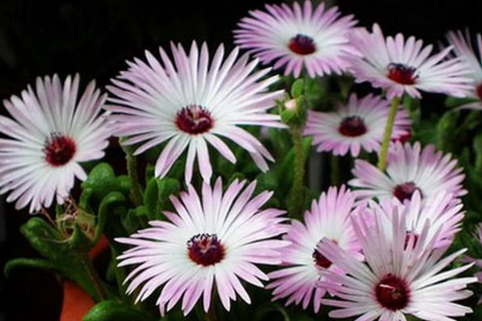
During the peak growth period of the lampranthus, water it with an appropriate amount of water and apply sufficient fertilizer, so that the lampranthus absorbs enough nutrients and can grow robustly and bloom more beautifully, but be careful not to water too much or apply too much fertilizer, otherwise the lampranthus may grow leggy, and the plant will then bloom less or not bloom at all.
The lampranthus loves sunlight very much, so during its peak growth period you should give it plenty of sunlight, with at least 6 hours of light exposure every day, so that the flowers it produces can be more vivid and beautiful. Also, during the early growth stage of the lampranthus, pinch off the growing tips so it can have multiple branches. Because too many nutrients were given during the early flowering period, the nutrients for the whole plant can be maintained, but after the flowers fade, the nutrients given are reduced and can no longer maintain the nutrients for the whole plant, so it needs to be pruned, which can both reduce nutrient consumption and keep the plant shape attractive.
That is all for today's content. Such a beautiful lampranthus, go and grow a pot of it right away!
When does the lampranthus bloom? Lampranthus flowering time
When does the lampranthus bloom?Lampranthus flowering time: April to May every year
The flowering period of the lampranthus is mainly from April——May, and when the flowers bloom they are generally mainly purple and pink, with colors such as white, yellow and red also appearing. The leaves of the lampranthus somewhat resemble pine needles, and the flowers resemble chrysanthemums, hence the name lampranthus.
The ornamental use of the lampranthus1. The main role of the lampranthus is ornamental, with flower viewing as the main form of appreciation. The flowers of the lampranthus are beautiful, with rather bright colors and full of luster, looking as if they have a velvety feel, giving people a bright and vivid impression.
2. The lampranthus is generally grown mainly as a small potted plant, and the indoor ornamental effect is quite good; it can also be used as a flowerbed cultivation material, and the ornamental effect is also very good.
Flower shape of the lampranthusThe flowers of the lampranthus are solitary at the ends of branches, 4-7.5 cm in diameter; the bracts are leaf-like and opposite; the calyx is divided deeply into 5 lobes, and the lobes are unequal in size; the petals are numerous, glossy and brightly colored, purplish red to white, linear, 2-3 cm long, slightly united at the base; the stamens are numerous and united at the base; the ovary is inferior and 5-loculed; there is no style, and there are 5 linear stigmas.
The capsule is fleshy and splits open in a star-shaped 5-valved manner; the seeds are numerous. The flowering period is in spring or summer and autumn. The fruit does not ripen easily, and collecting seeds is rather difficult.
Flowering-period care of the lampranthusTo make the lampranthus bloom beautifully, you need to manage it well during the flowering period.
1. Generally, during the growth period of the lampranthus, doing a good job of watering and fertilizing can make the lampranthus plant grow robustly and bloom continuously, but be careful that water and fertilizer are not excessive; excessive water and fertilizer may cause the lampranthus plant to grow leggy, blooming little or not at all.
2. During the growth process of the lampranthus, give it sufficient light, at least 6 hours of light every day, which can make its flowers bloom gorgeously. In the early growth stage of the lampranthus, pinch off the growing tips so it can branch more. After the flowers fade, you can prune the flowering branches, which can reduce nutrient consumption and keep the plant shape attractive.
What to do if the lampranthus does not bloom? Lampranthus propagation method (cuttings)
Succulent plants can generally bloom, but they are often very shy and reserved, and many plants that have been grown for many years and have lush branches and leaves simply do not bloom. So for such a situation, what measures can we take to stimulate them to bloom?
What to do if the lampranthus does not bloom
The lampranthus likes sufficient sunlight. Apart from the high-temperature weather in summer, at other times you can let the lampranthus receive as much light as possible. A long light duration can make the lampranthus bloom more and make the flowers gorgeous.
Lampranthus propagation method
The lampranthus is propagated more often by cuttings, and cutting propagation is generally carried out in spring and autumn.
When taking cuttings of the lampranthus, you need to choose relatively plump branches as cuttings; generally you need to cut branches of about 5 cm, keeping 3——4 leaves.
The cut cuttings need to be treated first; you can soak them in sugar water or rooting powder solution to promote rooting, then insert the cuttings into prepared sandy soil and maintain a certain rooting temperature, but it must not be too wet. Generally, they can take root in about one month.
After the lampranthus cuttings survive as small seedlings, they can be transplanted into flower pots. Add sandy soil to the pot as the growing medium, and you can add some decomposed cake fertilizer as base fertilizer. When the seedlings grow to about 20 cm, you can pinch off the growing tips, and after that carry out reasonable care.
How to grow the lampranthus
1. Pot and soil selection
For potted lampranthus, you can choose a small flower pot at the seedling stage and put in loose, fertile, well-drained sandy soil, and you can add a little base fertilizer. During the growth process of the lampranthus, the plant keeps growing, the nutrients in the soil become insufficient, and a pot that is too small will also restrict root growth, so you can repot and change the pot every spring.
2. Water and fertilizer management
The lampranthus is rather afraid of waterlogging and has drought tolerance. Therefore, when watering, the amount of water should be moderate to keep the pot soil moist; it is better to water less than to water too much, so as to avoid water accumulating in the pot soil. In the growing seasons of spring and autumn, the lampranthus can be given a decomposed dilute liquid fertilizer once every half month to ensure sufficient nutrients, make the plant grow vigorously and promote flowering. But be careful that fertilizer and water are not excessive, otherwise the plant will grow leggy and bloom less. In summer and winter, because the temperature is too high or too low, you need to stop fertilizing and reduce the amount of watering.
3. Light and temperature
The lampranthus likes a moderate environment that is warm and sunny. The suitable temperature for growth is between 18°C and 25°C. It is not cold-tolerant, and it fears high temperatures. Spring and autumn are the growing seasons of the lampranthus, and the temperature and light are also relatively suitable, so it can be exposed to more sunlight. In summer, the sunlight is strong and the temperature is high, so it needs shading and should be kept in a cool, ventilated place. In winter, the temperature is relatively low, so it can be kept indoors in a place with relatively strong sunlight, and the temperature should be kept within a certain range.
The difference between the lampranthus and the moss rose
The lampranthus is a perennial evergreen herbaceous plant belonging to the Aizoaceae family, in the genus Lampranthus. The flowers of the lampranthus resemble chrysanthemums, with dense petals, growing singly at the ends of branches. The flower colors include white, pink, red, yellow, purple and several others, while its leaves resemble pine needles and are fleshy, three-angled and linear. Combining these forms is why it is called the lampranthus. The stem of the lampranthus: it has many branches growing upward, and its stems creep along the ground, slender and reddish brown.
The moss rose belongs to the Portulacaceae family and is an annual herbaceous plant in the genus Portulaca. The flowers of the moss rose: the flowers grow singly at the ends of branches or several are clustered at the ends of branches, with double-flowered and single-flowered forms, mostly in colors such as purplish red, white, snow blue, pale yellow and deep yellow. The flowers bloom as soon as they see sunlight and close on cloudy and rainy days, hence the name moss rose. The leaves of the moss rose are alternate, and the leaf blades are cylindrical-linear or subulate narrowly lanceolate in shape, mostly densely clustered at the ends of branches, and more sparsely spaced lower down. The stem of the moss rose is prostrate or ascending, purplish red in color, with many branches, and hairs clustered at the nodes, growing rather densely.
Among the many propagation methods for succulent plants, cuttings are a very effective one. Once the cutting succeeds, we can obtain a small plant. Especially for some succulents that are not suitable for leaf cuttings, compared with sowing, cuttings are faster and simpler.