How to grow Aptenia cordifolia? Detailed care instructions
Light
Aptenia cordifolia is very fond of sunlight. Throughout the year, apart from summer when the sunlight is too intense and some shading is needed, no shading is required in the other seasons, and it can be placed outside for full-day sun. Especially when temperatures are low in winter, not only should the temperature of its surroundings be maintained, but it should also receive as much light as possible. If light is insufficient for a long time, it will be detrimental to the plant's growth.
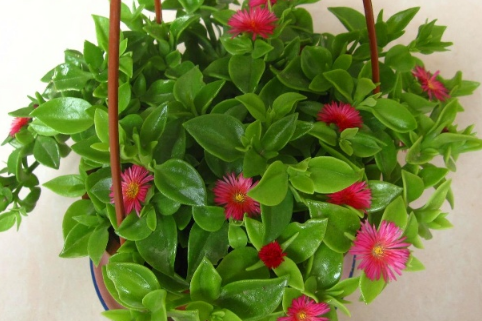
So it is best to place it outdoors starting in spring, letting it receive ample light, so that it can produce more and brighter flowers and grow more robustly.
Temperature
Aptenia cordifolia needs a warm and dry growing environment. It fears high temperatures in spring and the cold of winter. The most suitable temperature for it is generally between 15-25 degrees. In summer, because the temperature is too high, attention should be paid to ventilating and cooling the plant, and to providing appropriate shade. In winter, when the temperature is too low, Aptenia cordifolia needs to be moved indoors for care, otherwise the plant may suffer frost damage.
Water and fertilizer
Like most succulents, Aptenia cordifolia prefers a dry environment, so do not water it too much. Each year Aptenia cordifolia enters its growth period from March to September. During this time it needs more watering, especially in summer when temperatures are relatively high, but note that it is best not to let water accumulate in the pot when watering the plant, otherwise excessive water accumulation in the pot may cause its roots to rot.
After September, Aptenia cordifolia's growth slows down. At this point the amount of watering should begin to be reduced, because winter is approaching, and to prevent the plant from frost damage, it should be moved indoors for care.
The above is an introduction to the question of how to grow Aptenia cordifolia. Below let us explore what to pay attention to when growing Aptenia cordifolia!
How to grow Aptenia cordifolia: Care methods and precautions for Aptenia cordifolia
Although Aptenia cordifolia is a relatively hardy, easy-to-grow and popular succulent variety, wanting to grow it well is far from achievable by simply letting it be. So while understanding Aptenia cordifolia's growth habits, it is very necessary to learn care techniques for Aptenia cordifolia.
How to grow Aptenia cordifolia
1. Light control
Aptenia cordifolia is a plant that quite likes sunlight. To produce more flowers, it must be given ample light, at least more than 6 hours of light per day. It is best grown on a south-facing or west-facing windowsill, and in winter it can receive light through the window. (Appropriate shading is needed in summer)
2. Watering considerations
Aptenia cordifolia likes a warm and moist environment, and its water needs are quite high. Of course, watering should be appropriately reduced in winter. In summer, keep the potting soil appropriately slightly moist, as long as the potting soil does not become waterlogged.
After autumn turns cool, begin to reduce watering frequency and keep the soil slightly dry. If your Aptenia cordifolia's leaves grow especially lush but it produces no flowers instead, then you should appropriately control water and let the potting soil dry out a bit, so that it can develop flower buds.
3. Fertilizing techniques
Aptenia cordifolia likes light fertilizer. Applying light fertilizer frequently can make the plant more robust. Combined with appropriate pinching of the tips, it can grow with lush branches and leaves, which is more conducive to developing flower buds.
Generally, fertilize more in spring and autumn, and do not fertilize in winter. In spring and autumn, you can give light fertilizer twice a month. Ordinary compound fertilizer or decomposed cake fertilizer is fine. If you want it to bloom more easily, you can water once a month with monopotassium phosphate, which can promote the development of more flower buds.
4. Overwintering care
Winter care should of course pay attention to cold protection and reduce watering frequency. You can cut off some crossing branches, and use them for cuttings propagation as well. Pay attention to maintaining a certain air humidity indoors, and keep the temperature above 5 degrees. Appropriate pruning can be done, cutting off some overly long or overly dense branches to preserve nutrients, so that more flowers can bloom next year.
5. Soil and repotting
Aptenia cordifolia likes loose humus soil. Choose a mix of leaf mold, garden soil and river sand, or simply use peat soil paired with perlite. Its root system is fleshy, so drainage must be guaranteed.
Potted Aptenia cordifolia is generally repotted once every 1~2 years. When repotting, you can appropriately cut off dead and old roots. After potting, first care for it in a shaded place for two weeks, then gradually expose it to light.
Precautions for growing Aptenia cordifolia
Aptenia cordifolia is relatively easy to grow and popular also because under normal circumstances, few pests or diseases bother it. Sometimes root rot occurs, and the triggering factor is very likely water accumulation in the pot.
What is the reason for Aptenia cordifolia's leaves turning yellow
1. Natural metabolism
If Aptenia cordifolia has been grown for a long time, the leaves at the bottom will naturally wither and turn yellow. This is a very normal phenomenon, and growers need not worry. Even if there are many withered yellow leaves at the bottom, it does not matter, as long as the top leaves are normal.
2. Intense sun exposure, or no light for a long time
If Aptenia cordifolia is exposed to the sun, its leaves will turn yellow from the sun. If it is cared for in an environment without light for a long time, chlorophyll will decrease, and leaf yellowing will also occur.
3. Lack of fertilizer or excessive fertilizing
Some growers' Aptenia cordifolia has been grown for a long time without repotting or changing the soil. The various nutrient elements contained in the potting soil have been exhausted, and the three elements nitrogen, phosphorus and potassium have not been replenished in time. The plant lacks nutrients, and the leaves show yellowing and thinning. At this time, it should be promptly repotted with fertile loam and watered with alum fertilizer water.
Excessive fertilizing is relatively easy to judge. Mainly look at whether fertilizer has been applied recently. If the fertilizer exceeds the plant's needs, the leaves will appear glossy and uneven, then the root system will rot, and the leaves will turn yellow. Fertilizing should be stopped, more clear water should be watered, or the pot should be repotted, the roots cleaned, and new soil replaced.
4. Water accumulation
Some growers' Aptenia cordifolia potting soil has poor air permeability, and watering is frequent, which causes the potting soil to remain waterlogged and not dry for a long time. The root system has difficulty breathing, causing the leaves to turn yellow. At this time, the soil should be loosened promptly and water controlled.
The uses of Aptenia cordifolia
The main use of Aptenia cordifolia is ornamental. Using Aptenia cordifolia as a potted plant or hanging basket can embellish indoor spaces. In garden applications, Aptenia cordifolia can be used for arranging desert landscapes.
Aptenia cordifolia also has an edible use and can be served as a cold dressed dish.
When growing Aptenia cordifolia, phenomena such as leaf yellowing and leaf drop may occur. There is no need to be too anxious. Simply by comparing starting from Aptenia cordifolia's normal growth needs, you can discover where the problem lies, and then take targeted measures to smoothly solve the problem.
How to grow Aptenia cordifolia: Care methods and precautions for Aptenia cordifolia
Aptenia cordifolia is also called dew plant (flower vine grass, heart-leaf ice flower, heart-leaf noon flower, horned antelope hanging orchid). It is a flower that is very easy to survive and grow. How do you grow Aptenia cordifolia? Below we will share the care methods and precautions for Aptenia cordifolia.
Care methods for Aptenia cordifolia:
1. Soil: Aptenia cordifolia is native to South Africa. It likes a sunny, dry and ventilated growing environment, avoids high temperature and excessive moisture, and likes well-drained sandy soil. Care is relatively simple.
2. Sunlight: Aptenia cordifolia likes light. Throughout the year, apart from appropriate shading at noon in midsummer, it should be given ample light at other times, especially in winter. While ensuring temperature, it can be placed in a sunny spot to receive as much sunlight as possible. Those who have the conditions can place it outdoors starting in spring. Plants that have received ample light have abundant flowers, bright colors, and leaves that are less prone to leggy growth.
3. Temperature: Aptenia cordifolia likes a warm and comfortable living environment, avoids high temperatures and cold, and the most suitable growth temperature is 15~25 degrees Celsius. In summer, when the temperature is too high, pay attention to cooling the plant. It can be moved to a well-ventilated semi-shaded place for care; Aptenia cordifolia is not cold-tolerant, so after autumn begins you need to be attentive. After the weather turns cool, attention should be paid to keeping it warm. Those placed outdoors should be promptly moved indoors to avoid the cold, so as not to freeze the plant.
4. Watering: Aptenia cordifolia likes a dry environment, and watering should not be excessive. Every year from March to September is Aptenia cordifolia's peak growth period. During this period its water demand is relatively large, especially during the high-temperature summer season. While increasing the amount of watering, also note that the pot must not become waterlogged. Follow the principle of watering when dry and stopping when wet, and water thoroughly only after the potting soil is dry. Too much water easily causes root rot, and in severe cases can lead to death; after September, Aptenia cordifolia enters a slow growth period. At this time, gradually reduce the amount of watering to prepare for moving it indoors to overwinter.
5. Fertilizing: Aptenia cordifolia does not have high requirements for fertilizer and water. During the growing season, applying cake fertilizer water about once every half month is enough, and it can be changed according to Aptenia cordifolia's specific growth conditions.
6. Pests: Aptenia cordifolia grows extensively and is not prone to pests and diseases. However, if the potting soil is waterlogged and ventilation is poor, besides causing root rot, root rot disease may also occur, and attention should be paid to spraying medicine for prevention and control.
7. Pruning: When winter arrives, Aptenia cordifolia's leaves stop growing, entering the dormant period. Diseased and pest-damaged branches, overlapping branches, twin branches, thin and weak branches, aged branches, inward-growing branches and leggy branches must be cut off in time. Through thinning, heading back and removing tillers, the lifespan of the peony is extended. Let the peony have ventilation and light, making it less prone to pests and diseases, ensuring the tree's vigor does not decline and the branches are thick and the leaves lush.
Precautions for growing Aptenia cordifolia:
1. If Aptenia cordifolia is placed in a place with insufficient light for a long time, the leaf color easily becomes pale, lacking vitality, and the leaves may even drop, losing ornamental value.
2. Watering Aptenia cordifolia too much will cause root rot, and in severe cases can lead to death. The amount of watering must be well controlled.
3. Aptenia cordifolia does not have high requirements for fertilizer and water. During the growing season, note to apply cake fertilizer water once about every half month. If too little fertilizer is applied, it will cause slow growth.