How to Care for Variegated String of Hearts (Aptenia cordifolia) After Cuttings and Key Points to Note
1. Watering
1. Watering After successful cuttings of the variegated string of hearts, there will be a period of acclimatization. During these 10 to 15 days, the amount of water must be kept low; simply water a little to keep the soil moist after it dries out. Only after the acclimatization period does watering return to normal, with watering once every 2 to 3 days in spring, reduced appropriately to once every 3 to 4 days in autumn, once every morning in summer, once every 7 days in winter, and stopped entirely during the plant's dormancy period.
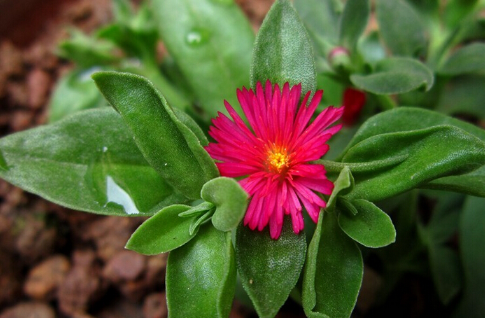
2. Light
During the acclimatization period, the variegated string of hearts does not need extra light; simply keep it in a cool, ventilated environment. Only after it has passed the acclimatization period can light be gradually increased. In summer, apart from moderate light from 8 to 10 am and 5 to 8 pm, it must be shaded at all other times. In spring and autumn, place it indoors in filtered light; in winter, full sun is best.
3. Temperature
When taking cuttings of the variegated string of hearts, the temperature must be kept between 18 and 22°C; it should not be too high or too low, as either will affect the success rate of the cuttings. Even if the cutting barely succeeds, the plant will grow poorly and look sparse. In winter, keep the temperature above 10°C; in summer, keep it below 35°C, otherwise the plant will go dormant.
From the introduction in this article, I believe everyone now understands how to take cuttings of the variegated string of hearts. Simply follow the steps above strictly, and the cuttings will quickly take root and survive.
What are the key points to note when propagating variegated string of hearts by cuttings? Is variegated string of hearts toxic? Can it be eaten?
When it comes to spider plants, I believe everyone is familiar with them; the variegated string of hearts is a common variety of spider plant. It is often used for propagation by cuttings, and many flower lovers have experience growing variegated string of hearts. So, do you know what the key points are when propagating variegated string of hearts by cuttings? Is variegated string of hearts toxic? Can it be eaten? Let's find out together with the editor.
Propagating variegated string of hearts by cuttings:
Propagating variegated string of hearts is very simple; generally the cutting method is used, carried out in spring and autumn, and it roots very easily. The specific procedure is to cut a mature branch, let it dry for a moment, then insert it into prepared potting soil, place it in a cool, ventilated spot, and keep the soil slightly moist. After a few days, you will see the branch standing upright, which indicates that the new branch has begun to root.
There are no requirements for the soil; whatever soil you have at home will do. Insert the branch into the soil, then water thoroughly, place it in a cool spot, and keep the soil moist afterward. Since the variegated string of hearts likes water and light, once it has survived it can be placed in the sun, and there is no need to worry about watering, as long as the potting soil does not become waterlogged.
Is variegated string of hearts toxic? Can it be eaten?
Spider plant-type flowers all have air-improving functions, especially for improving air quality in newly decorated interiors and absorbing toxins, so the variegated string of hearts is not toxic, and it is also beneficial for purifying and improving indoor air.
The variegated string of hearts is not only non-toxic but also contains many nutritional elements. Its antioxidant, lutein, has good health benefits for the various organs of the human body. If eaten in spring, it is very suitable, and lutein is also very good for the eyes. As a vegetable, the variegated string of hearts tastes bitter but has a clear heat-clearing effect.
That is all I have learned about the variegated string of hearts today. I hope flower lovers will find this article helpful. If you want to learn more about the variegated string of hearts, please continue to follow Duorou Huapu, and we will provide you with more related knowledge!
How to Grow Variegated String of Hearts: Cultivation Methods and Key Points to Note
Although the variegated string of hearts is a relatively hardy, easy-to-grow, and popular succulent variety, simply letting it grow wild is far from enough if you want to grow it well. Therefore, while understanding its growth habits, it is very necessary to learn cultivation techniques for the variegated string of hearts.
How to grow variegated string of hearts
1. Light control
The variegated string of hearts is a plant that quite likes sunlight. If you want more flowers, you must provide sufficient light, at least more than 6 hours of light per day. It is best grown on a south-facing or west-facing windowsill, and in winter it can receive light through the window. (Appropriate shading is needed in summer.)
2. Watering considerations
The variegated string of hearts likes a warm, moist environment and has fairly high water needs; of course, watering should be reduced appropriately in winter. In summer, keep the potting soil appropriately slightly moist, as long as the potting soil is not waterlogged.
After autumn turns cooler, begin reducing the watering frequency and keep the soil slightly dry. If your variegated string of hearts has particularly lush leaves but no flowers, then you should control water appropriately and let the potting soil dry out a bit so that flower buds can form.
3. Fertilizing techniques
The variegated string of hearts likes light fertilizer. Applying light fertilizer frequently can make the plant stronger. Combined with appropriate pinching of the tips, it can grow lush branches and leaves, which is more conducive to forming flower buds.
Generally, fertilize more in spring and autumn, and do not fertilize in winter. In spring and autumn, you can give light fertilizer twice a month; ordinary compound fertilizer or decomposed cake fertilizer will both work. If you want it to bloom more easily, you can apply monopotassium phosphate once a month, which can promote the formation of more flower buds.
4. Winter care
Winter care should of course focus on cold protection and reducing the watering frequency. You can cut off some crossing side branches and use them for propagation by cuttings as well. Be careful to maintain a certain indoor air humidity, and keep the temperature above 5°C. Appropriate pruning can be done, cutting off some overly long or dense branches to preserve nutrients so that more flowers can bloom the following year.
5. Soil and repotting
The variegated string of hearts likes loose humus soil. Choose a mix of leaf mold, garden soil, and river sand, or simply use peat soil with perlite. Its root system is fleshy, so drainage must be guaranteed.
Potted variegated string of hearts is generally repotted once every 1 to 2 years. When repotting, you can appropriately cut off old, dead roots. After potting, first care for it in a shaded place for two weeks, then gradually expose it to light.
Key points to note when growing variegated string of hearts
The reason the variegated string of hearts is relatively easy to grow and popular is also because, under normal circumstances, few pests or diseases bother it. Sometimes root rot occurs, and the likely triggering factor is water accumulation in the pot.
Why do variegated string of hearts leaves turn yellow?
1. Natural metabolism
If the variegated string of hearts has been grown for a long time, the leaves at the bottom will naturally wither and turn yellow. This is a very normal phenomenon, and flower lovers need not worry. Even if there are many withered yellow leaves at the bottom, it does not matter, as long as the leaves at the top are normal.
2. Strong sun exposure, or no light for a long time
If the variegated string of hearts is exposed to strong sunlight, the leaves will be scorched yellow. If it is cared for in an environment without light for a long time, chlorophyll will decrease, and leaf yellowing will also occur.
3. Lack of fertilizer or excessive fertilizing
Some flower lovers have grown their variegated string of hearts for a long time without repotting or changing the soil. The various nutrient elements contained in the potting soil have been exhausted, and the three key elements of nitrogen, phosphorus, and potassium have not been replenished in time. The plant lacks nutrients, and the leaves become yellow and thin. At this point, it should be repotted in time with fertile loam and watered with alum fertilizer water.
Excessive fertilizing is relatively easy to judge; mainly check whether fertilizer has been applied recently. If the fertilizer exceeds the plant's needs, the leaves will appear glossy but uneven, and later the root system will rot and the leaves will turn yellow. Fertilizing should be stopped, more clear water should be poured, or the plant should be repotted, the roots cleaned, and new soil replaced.
4. Water accumulation
Some flower lovers' variegated string of hearts has potting soil with poor aeration, and watering is frequent, which causes long-term water accumulation in the potting soil that does not dry out. Root respiration becomes difficult, causing the leaves to turn yellow. At this point, loosen the soil in time and control moisture.
The role of variegated string of hearts
The main role of the variegated string of hearts is ornamental. Used as a potted plant or hanging basket, it can accent indoor spaces. In garden applications, the variegated string of hearts can be used in desert landscape arrangements.
The variegated string of hearts also has an edible use and can be served as a cold dressed dish.
When growing the variegated string of hearts, phenomena such as yellowing and dropping leaves may occur. There is no need to be too anxious; simply compare starting from the normal growth needs of the variegated string of hearts to identify the problem, and then take targeted measures to solve it smoothly.