What are the key points to note when growing fuchsia?
(1) Increase fertilizer and water supply
Fuchsia grows quickly and blooms abundantly. Apart from not fertilizing during the hot summer, apply fertilizer once every 10-15 days at other times. In summer, place the plant under a shaded shed, frequently spray water on the leaves or sprinkle water on the ground, and improve ventilation.
(2) Pay attention to temperature
Fuchsia is afraid of cold. Cold damage occurs when the temperature drops below 5°C. In winter, the balcony should ideally be kept above 10°C, and the plant can be placed in a closed balcony with light for cultivation.
(3) Appropriate fertilization is needed
Normal fertilization should be applied once every 10-15 days in spring and autumn with dilute decomposed cake fertilizer water or compound fertilizer. Stop fertilizing during high summer temperatures. After fertilizing, spray water once to prevent the liquid fertilizer from sticking to the leaves and causing rot.
(4) Pay attention to the potting soil
The potting soil should not be too dry or too wet, otherwise it easily causes leaf drop, bud drop, and flower drop. Keep the soil moist in spring and autumn, control watering in summer, and also control watering after pinching and heavy pruning. Resume normal watering once new branches sprout.
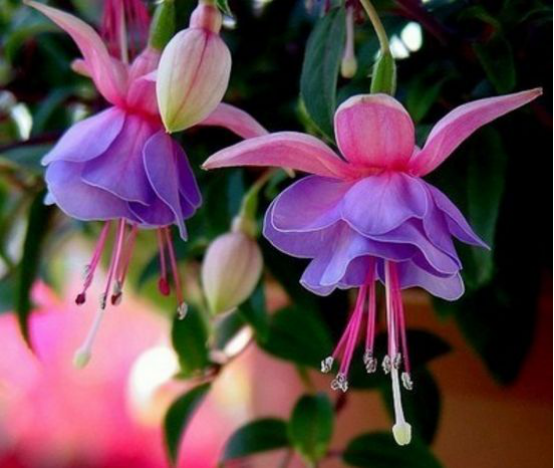
Now that we have introduced fuchsia, everyone should have gained some understanding of fuchsia growing methods and key points to note. Such a beautiful flower naturally has a beautiful flower meaning. Do you know what the flower meaning of fuchsia is? Let us take a look at the flower meaning of fuchsia below!
III. Key points to note when growing fuchsia
1. Purifying the air
Growing a potted fuchsia indoors not only decorates the indoor environment and makes it full of vitality, but can also remove some harmful substances and play a role in purifying indoor air.
2. Medicinal value
Fuchsia is a very good traditional Chinese medicinal material, with significant effects on treating pain, redness, and swelling caused by rheumatoid arthritis and traumatic injuries.
Fuchsia growing methods, key points to note when growing fuchsia [
Fuchsia prefers a moist, cool environment and is best suited to fertile, loose, slightly acidic soil. It is afraid of high temperatures and strong light. In summer it needs dry, cool, semi-shaded conditions; in winter it needs warmth and moisture, plenty of sunlight, and circulating air. The fuchsia flower shape is unique and extremely elegant. Potted plants are used to decorate balconies, windowsills, studies, and the like, and can also be hung on security nets, corridor frames, and other places for appreciation. Below we introduce the growing methods and key points to note for fuchsia.
Fuchsia growing methodsTo make fuchsia lush with leaves and abundant flowers, pay attention to the following in routine care and management:
Fuchsia growing: soil selectionThe potting soil is prepared by mixing sandy garden soil, humus soil, and farmyard manure at 1/3 each. Before the growth peak period begins each spring, the pot and soil need to be changed: remove part of the potting soil, prune away some old roots, switch to a slightly larger pot according to the plant size, and then replenish with the prepared potting soil. The soil should be loose, fertile, and well-drained. If water accumulates, the plant easily dies from root rot. Loosen the soil appropriately in spring and autumn.
Fuchsia growing: changing and repottingSeedlings that have survived cuttings or have been sown all need to go through several pot changes, from small pots to medium pots to large pots. The plant needs to be repotted once each spring or autumn before sprouting. The substrate should be fertile, loose, well-drained culture soil. Generally, leaf mold soil plus sandy loam plus decomposed organic fertilizer and phosphate fertilizer can be evenly mixed, and no base fertilizer needs to be applied, so as to avoid root rot.
Fuchsia growing: fertilizingFuchsia likes fertilizer. For pot cultivation, it is best to mix culture soil from 4 parts leaf mold soil, 3 parts garden soil, 2 parts river sand, and 1 part decomposed cake fertilizer powder. No separate base fertilizer is needed, so as to avoid root rot; repot and change soil once each spring. Because fuchsia grows quickly and blooms many times, during the growth period you should apply thin fertilizer frequently, about once every 10 days with dilute cake fertilizer or compound fertilizer. During the flowering period, also apply a liquid fertilizer mainly of phosphorus and potassium once a month, but stop fertilizing in high-temperature seasons. Before fertilizing, the potting soil should be on the dry side; after fertilizing, spray water once with a fine nozzle to prevent the leaves from being stained by fertilizer water and rotting.
Fuchsia growing: temperatureThe growing temperature for fuchsia is 10-28°C. The summer temperature cannot exceed 30°C, so cooling work should be done well in summer; in winter, plenty of sunlight is required, and the cultivation temperature cannot be lower than 5°C, otherwise cold damage will occur, and insulation measures must be taken. In addition, attention should be paid to ventilation in both winter and summer.
Fuchsia growing: wateringWater when the soil is dry, and water thoroughly, never allowing water to accumulate. In summer, the potting soil is better kept on the drier side, but pay attention to spraying water on the leaves and ground. Long-term overly wet potting soil can also easily lead to root rot and yellow leaves, and even cause plant death. When the winter room temperature is below 10°C, watering must be controlled even more strictly, and fertilizing should be stopped to prevent root rot
Fuchsia growing: placementTo keep the fuchsia plant full in shape, change its position frequently during the growth period so that the plant receives light evenly, avoiding leaning to one side and ruining the plant shape. However, during the flowering period it should be moved as little as possible, otherwise it will cause bud drop and flower drop.
Fuchsia growing: pinching methodPinching at the right time is an important measure to make fuchsia have lush branches and abundant flowers. In spring and autumn, top and pinch the plant to encourage branching, make the plant shape full, and increase the number of flowers. Pinching should start from the seedling stage. Generally, when the seedling grows to about 10 cm, carry out the first pinching to encourage branching. About 30 days after the first pinching, when the new branches grow 6-8 leaves, carry out the second pinching, keeping about 5 side branches per plant and removing excess side buds.
Fuchsia propagation methodsFuchsia is commonly propagated by cuttings and sowing.
1. Cutting methodThis can be done throughout the year except during the summer dormancy period, and spring cuttings are best, with a high and fast rooting and survival rate. Select healthy tender tip branches for cuttings, 7-8 cm long, with 2-3 nodes, cut off the basal leaves, insert into a sand bed, and often mist to keep it moist. Roots can form in about 10 days, and after 1 month they can be potted.
2. Sowing methodThis can be done in both spring and autumn. In autumn, at a temperature of 15-20°C, germination can occur in 15 days. Seedlings sown in spring will only bloom the following year.
Key points to note when growing fuchsia1. Fuchsia grows quickly and blooms abundantly, so fertilizer and water supply should be strengthened during the growth period. Apart from not fertilizing during the hot summer, apply fertilizer once every 10-15 days at other times. Fuchsia likes a cool environment and enters a semi-dormant state above 30%. In summer, place the plant under a shaded shed, frequently spray water on the leaves or sprinkle water on the ground, and improve ventilation. Control watering so it goes through summer in dormancy.
2. When the autumn temperature drops below 10°C, move it indoors, keep the temperature within the range of 10-20°C, and strengthen fertilizer and water management. At the same time, pay attention to pruning. Stop pinching and pruning about 20 days before the intended flowering period. If the temperature is controlled appropriately, it can bloom by then.
3. Fuchsia is afraid of cold. Cold damage occurs when the temperature drops below 5°C. In winter, the balcony should ideally be kept above 10°C. It can be placed in a closed balcony with light for cultivation, ensuring sufficient light. During management, pay attention to the relationship between water and fertilizer supply and temperature. If the indoor temperature is above 15°C, flowering plants will keep blooming. If the temperature is below 5°C, they will die.
4. Fuchsia grows relatively quickly and has the characteristic of continuous blooming. Insufficient fertilization or fertilizing during the dormant period can easily lead to fewer flowers. Normal fertilization should be applied once every 10-15 days in spring and autumn with dilute decomposed cake fertilizer water or compound fertilizer. Stop fertilizing during high summer temperatures. After fertilizing, spray water once to prevent the liquid fertilizer from sticking to the leaves and causing rot
5. The potting soil should not be too dry or too wet, otherwise it easily causes leaf drop, bud drop, and flower drop. Keep the soil moist in spring and autumn, and control watering in summer. After pinching and heavy pruning, watering should also be controlled. Resume normal watering once new branches sprout.
Key points to note for fuchsia getting through summer1. Cool down and increase humidity. For home pot cultivation, the flowerpot can be moved to a cool, ventilated, rain-sheltered place, such as a north-facing balcony or under the eaves where a little scattered light can be seen, or it can be placed indoors in a cool, ventilated spot with a little sunlight. At the same time, when the temperature exceeds 25°C, spray water on the leaves 1-2 times a day; when the temperature exceeds 30°C, spray water 3-4 times, and water the ground around the flowerpot 2-3 times, so as to lower the temperature and increase air humidity.
2. Control fertilizer and water. During the high-temperature period of July-August, fertilizing should be stopped continuously, watering should be controlled, and the potting soil should preferably be kept slightly on the dry side.
4. Prevent rain exposure. After being exposed to rain, it easily causes root rot and leaf drop.
5. Cultivate new seedlings. Old perennial fuchsia plants are sensitive to high temperatures, while seedlings have stronger heat resistance and mostly do not drop leaves in the hot summer. Therefore, propagating new seedlings by cuttings every year helps them safely pass the summer. This is a more flexible method.