Detailed guide to the cultivation methods of the kapok flower
1. Seed collection and processing
When the kapok fruit ripens it turns grayish-black, and the seeds scatter easily along with the cotton wool, so if you want to collect seeds you must do so in good time; after collecting them, spread them out in the sun and shake out the seeds. One thousand seeds weigh about 47.5 grams, with a germination rate between 70% and 80%. If stored too long, the germination rate drops or the seeds may even lose their ability to germinate. So it is best to sow them as soon as they are collected; if sowing must be delayed, they can be stored short-term in damp sand.
Before sowing, disinfect the seeds with a 0.3% potassium permanganate solution, then rinse them clean with water, dry them in the sun and sow.
2. Land preparation and sowing
Choose as the sowing site a slightly acidic sandy loam with good drainage, deep soil layers, loose texture, good structure, ample sunlight and strong water retention. Before sowing, it is best to prepare the land carefully. Broadcast the seeds, then cover with 2 cm of soil, press down lightly so the seeds and soil are firmly in contact, then water thoroughly; afterward water once or twice a day to keep the soil moist.
3. Seedling management
Kapok seeds generally begin to germinate 4 days after sowing, and germination is basically complete within 3 days. After the seedlings emerge, keep the soil moist to meet the kapok's water needs during growth; when the sun is strong and the temperature is high, shade them with a shade net to prevent damage from high temperatures and sunscald.
Detailed guide to the cultivation methods of the kapok flower
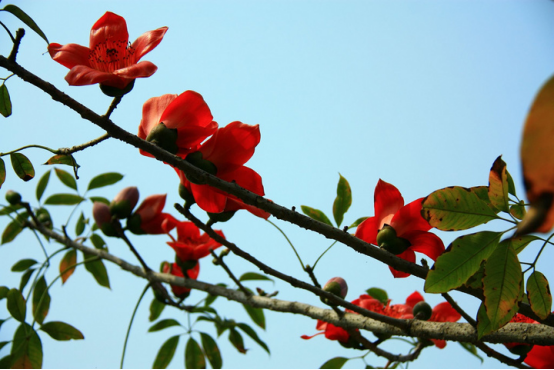
The kapok flower, also known as pansihua, red cotton and hero tree, comes from the dried flowers of the kapok plant of the family Bombacaceae. The kapok tree is tall and imposing, sturdy and broad, with spreading branches; its flowers are red as blood and as large as cups, and when it blooms the leaves have almost all fallen, so from a distance it looks like clusters of flames burning freely and leaping joyfully on the branches, full of grandeur. For this reason it has always been regarded as a symbol of heroes. Amid the green of the mountains it is like a beacon fire burning. It is an "indicator plant" of the climate, and locally there is a saying: "When the red cotton blooms, spring warmth arrives." In Dai love songs, girls often praise their beloved young men as tall kapok trees. The kapok is a beautiful ornamental flower; it grows leaves and blooms in spring, with large red flowers that are gorgeous and pleasing to the eye. Those brilliant flowers dye half the sky red. The Song dynasty poet Liu Kezhuang wrote: "Several trees half the sky red as if dyed, the locals say it is the kapok flower." Chen Gongyin of the Qing dynasty wrote in his Kapok Flower Song: "In the second and third months in the Cantonese river lands, thousands upon thousands of trees bloom with vermilion flowers. Like Yao shooting ten suns out of the sea, more like the ten thousand torches of the Wei palace circling the high terrace..." describing the beautiful scene of kapok flowers in bloom. Kapok is mostly distributed in the southern provinces such as Guangdong, Guangxi, Fujian and Taiwan, China; it grows wild and can also be cultivated. It likes dry heat and tolerates high temperatures, and mostly grows in tropical and subtropical jungles and river valleys. From ancient times to the present, the Dai people of Xishuangbanna have made clever and full use of kapok: ancient Chinese texts mention many times the Dai brocade made from kapok fruit floss, called "tong brocade," which was famous in the Central Plains; kapok flower clusters or fibers are used as stuffing for pillows and bed mattresses, very soft and comfortable; on the dining table, dishes cooked with kapok petals also appear from time to time; the flowers, bark and roots of kapok all have medicinal value. The kapok flower has the effects of clearing heat and promoting urination, detoxifying and relieving summer heat, and stopping bleeding.
Cultivation methods
The kapok tree likes high temperatures and dryness, has strong drought tolerance, and is best planted in fertile soil. Its main propagation methods are seeds and cuttings; the rainy seasons of spring and autumn are good times for sowing, and once it is growing, only a little fertilizer is needed. Because the kapok tree is tall, it is most suitable as a street tree. If you want to grow it in a pot, you can sow and raise seedlings, starting from young plants. The growing site must have ample sunlight, good ventilation and good drainage, and only needs a complete fertilizer once or twice a year. Kapok is a deciduous large tree that is highly adaptable and easy to grow and manage, mostly growing in the south; the trunk and branches of young trees are covered with thorns, giving strong self-defense that can prevent damage by wild animals and livestock, and the survival rate of afforestation is over 80%. It generally flowers and fruits after five or six years, enters full bloom after ten years, and can be harvested for seed continuously for about 100 years.
Harvesting and processing
In spring, harvest the flowers in full bloom, and dry them in the sun or in the shade for later use. When drying, spread the calyx thinly with the corolla facing down; after drying, turn them over and dry quickly until completely dry. The best quality is dry, brilliantly red in color, strongly fragrant, with no loose or broken petals. When storing, take care not to crush the flowers, and also guard against moisture, light and mold.
Cultivation methods and precautions for the kapok flower
Chinese scientific name: kapok flowerLatin scientific name: Bombax ceibaLinnaeus; Bombax malabaricumDC.Other names: panzhishu, hero tree, pansihua, jibei, beacon fireBinomial name: Bombax ceiba Linnaeus; Bombax malabaricumDC.Kingdom: PlantaeDivision: AngiospermsClass: DicotyledonsOrder: MalvalesFamily: BombacaceaeGenus: BombaxSpecies: Bombax ceiba B. ceibaEnglish name: KapokThe kapok flower (kapok) is a specialty of the south and is the city flower of Guangzhou, Kaohsiung and Panzhihua. Five petals with strong curves surround a cluster of dense yellow stamens, gathered at a firm receptacle; each flower is as big as a rice bowl, spreading downward from the top of the tree to meet the spring. The kapok flower is also called the hero flower, and even its fall is extraordinarily heroic: when it drops from the tree it still keeps its original form in the air, spinning all the way down, then lands on the ground with a "smack." Under the tree the fallen blossoms lie scattered; the flowers do not fade or wilt, bidding farewell to the world in a very heroic way. Why is the kapok flower called the "hero flower"? Because it blooms brilliantly red yet is not vulgar; its sturdy trunk, its indomitable posture, its heroic magnificence, the red of its blossoms like the strength of a brave warrior, a color like the blood of heroes dyeing the treetops red.1. Morphological characteristics
Deciduous large tree, up to 25 m tall. The trunk is upright with obvious knobby thorns; palmately compound leaves alternate, with very long petioles; it flowers before leafing out in early spring, the flowers clustered at the branch tips, corolla red or orange-red, about 12 cm in diameter, with 5 fleshy petals, elliptic-obovate, about 9 cm long, curved outward, margins rolled inward, both surfaces covered with stellate pubescence; stamens numerous, fused into a tube, arranged in 3 whorls, the outermost whorl gathered into 5 bundles; the capsule is very large, woody, oblong, up to 15 cm, splitting open automatically when mature and filled with cotton floss; the cotton wool can be used as filling material for pillows, quilts, cross-stitch cotton and so on. Seeds numerous, obovate, black, smooth, hidden within the white hairs. The kapok's appearance varies greatly: in spring a tree of orange-red; in summer shade of green leaves; in autumn sparse branches and leaves; in winter bare branches and cold trees, showing different charms through the four seasons, which is admirable. The flowers are orange-red; each year after the leaves fall completely in February to March it enters the flowering period, and then grows leaves.2. Growth habits
It is a tropical tree species that likes a high-temperature, high-humidity climate and has low cold tolerance; with prolonged low temperatures of 5-8°C the branches suffer cold damage, and it is averse to frost. In southern South China places such as Guangzhou and Nanning, in normal years it can overwinter safely in the open ground, while in cold years there is frost damage; in the vast areas from northern South China to North China it can only be grown in pots, moved into a warm shed or indoors in winter, with room temperature preferably not below 10°C. It likes light and does not tolerate shade; it tolerates scorching sun and high temperatures, and is best planted in a sunny spot.Its soil requirements are not strict; sandy soil or heavy clay soil are both suitable, and it likes acidic soil. It is fairly drought-tolerant and also slightly tolerant of wet conditions, and its fertilizer requirements are not very high. Generally, soil of medium fertility with relatively high phosphorus and potassium gives abundant flowering and also brighter color; soil with ample water and relatively high nitrogen gives luxuriant branches and leaves and also more flowers, but the color is less bright. When planting, it is advisable to apply rotted cake fertilizer or garbage as base fertilizer, and before flowering and at full bloom, apply additional phosphorus and potassium fertilizer. The tree shape is not very attractive, but it has sprouting ability, so in management you can cut the trunk or prune and shape it to encourage a full crown, or plant 3-5 trees in one place to improve the ornamental effect.
3. Species distribution
The place of origin of the tree is unknown, but it very likely originated in India. It was widely planted with migrants in South China, Taiwan, China, Indochina and the South Sea Islands. According to ancient Chinese records, Zhao Tuo, King of Nanyue, once presented a kapok tree to the Han imperial court in the 2nd century BC. Kapok flowers are also divided into white kapok flowers and red kapok flowers.In China it is planted in places such as Guangzhou, Zhuhai, Kunming, Shenzhen, Quanzhou, Fuzhou and Xiamen. In particular, in Guangzhou and Xiamen kapok is planted as a street tree all along the streets. Each year just after the Lantern Festival, the kapok tree begins to bloom.
4. Cultivation techniques
Cultivation methods
Propagate by sowing, cuttings and division. Collect the capsules before they split open; the seeds' germination ability is short-lived, so they are mostly sown as soon as collected, or they can be stored short-term in damp sand. Drill sowing, covering with 2 cm of soil; at an average temperature above 20°C, generally all seedlings emerge in 4-5 d; cuttings are mostly done in February to March or the rainy season, using large branches 80-100 cm long and 1-2 cm in diameter; insert them 10-15 cm deep into the seedbed, keeping the bed moist regularly; division is done from root suckers of the mother plant, cutting off a section of mother root and fibrous roots and planting separately, which makes it easier to survive.
Cultivation of rootstock
In the Panzhihua area, kapok seeds mature in April to May and can then be harvested. Because the seeds are high in oil, they spoil easily and lose germinating power, so it is generally required to sow them promptly in the same year they are collected. For seedbed raising, use drill sowing or broadcast sowing; for drill sowing the row spacing is 20 cm and the depth 5 cm, sowing the seeds in the furrows. Cover with 2 cm of soil and cover the surface soil with grass; germination begins 6-7 d after sowing, and emergence is basically complete in 13-15 d. After the seedlings emerge, loosen the soil and weed promptly, thin the seedlings and weed appropriately, and pay attention to pest and disease control. When the seedlings are 4-5 cm tall with more than 2 primary leaves, they can be moved into nutrient bags; when about 40 cm tall they can be transplanted to grow large seedlings. When the seedling diameter at breast height is 1 m-115 cm, grafting can be done.Grafting time
In the Panzhihua area, it is best to graft kapok in February to March and June to July. In February to March the temperature rises quickly and the kapok begins to sprout and send out shoots, so grafting at this time survives easily. In April to May the temperature is high, which easily causes the scion to dry out. June to July is the period when the rainy season is more concentrated in the Panzhihua area, and the temperature drops somewhat, so grafting should avoid rainy days.