Detailed Explanation of Aseptic Sowing and Tissue Culture Techniques for Cattleya
Fruit Cultivation
At flowering time select a well-grown mother plant for self-pollination and cross-pollination; 4-5 months after pollination, mature fruits will develop.
Aseptic Sowing
Select mature fruits, soak them in 75% alcohol for half a minute, place them in a 0.1% mercuric chloride solution and soak for 20 minutes, then rinse 4 or 5 times with sterile water before cutting the fruit open. Inoculate the white powdery seeds into liquid culture medium and culture with shaking on a 150 rpm shaker. After one week the embryos germinate, and after 20 days green protocorms form.
Culturing into Seedlings
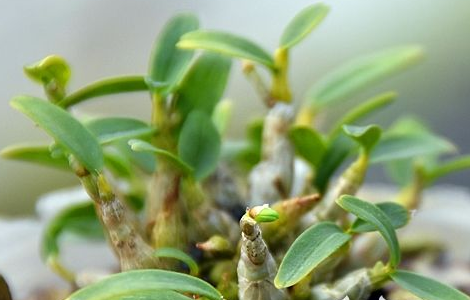
Use a pipette to place the protocorms onto seedling culture medium for culture; after one month they can become complete small plantlets.
Test-tube Transplanting
When the seedlings grow to 3-4 cm tall, move them into natural light to harden off for 1-2 weeks, allowing the plants to form a cuticle. Wash off the culture medium from the roots, mix them into the substrate and cultivate normally.
The Price of Cattleya
Cattleya is evergreen; the pseudobulbs are club-shaped or cylindrical, the pseudobulbs are spindle-shaped, and the plant height is over 25 cm; each stem has 2 to 3 leaves, and the leaves are thick and oblong-ovate. It generally blooms once in autumn, some can bloom twice, and different varieties bloom throughout all four seasons. The flower stalk is 20 cm long, bearing 5 to 10 flowers; the flowers are large, about 10 cm in diameter, with a special fragrance, and each flower can remain open continuously for a very long time; apart from black and blue, it comes in almost every color, with gorgeous appearance and color, and has the title of “King of Orchids”.
In cultivation, Cattleya is divided into unifoliate and bifoliate types. Propagation is by division, tissue culture or aseptic sowing. Winter temperature is 15-20°C. It blooms 1-2 times a year, and the ornamental flowering period is generally about 3-4 weeks.
Plants of the genus Cattleya are perennial herbaceous plants, belonging to the epiphytic orchids, and are evergreen year-round. The plant has 1-3 thick leathery leaves, which are tissues for storing water and nutrients.
You can use 6 parts crushed fern roots, 1 part vermiculite, plus charcoal and crushed stone, etc. Transplanting is best carried out after the dormancy period ends.
Brief Introduction to Cattleya
Cattleya is a horticultural hybrid of the genus Cattleya and is one of the most famous orchids internationally. The pseudobulbs are club-shaped or cylindrical, with 1-3 leaves growing at the top; the leaves are thick and hard, with the midrib sunken; the flowers are single or several, borne at the top of the pseudobulbs, large and beautiful, with bright and rich colors. It originates from tropical America and is the national flower of countries such as Brazil, Argentina and Colombia.
There are more than several thousand varieties. Colors include white, yellow, green, red-purple, etc. Propagation is by division, tissue culture or aseptic sowing. It likes warmth, moisture and sufficient light. It is usually potted with fern roots, moss, bark chunks, etc. During the growing period it needs relatively high air humidity, appropriate fertilizing and ventilation.
Cattleya's flowers are large, elegant and magnificent, with delicate and varied colors and rich fragrance, and it enjoys the fine names of “King of Foreign Orchids” and “Queen of Orchids” internationally.
Three sepals with pointed tips, extending vertically, are the greatest distinguishing feature of this flower.
The cultivation of Cattleya in our country has not been long, and large-scale production only began after the 1980s. However, it enjoys a very high status in the flower market. It is highly favored by urban residents. It has become one of the important flowers for festivals and holidays and for giving to relatives and friends.