Octopus Orchid Division Propagation Methods and Steps Explained
Division Time
Octopus Orchid is generally divided in summer; spring is the vigorous growth period of the plant, making division easier to survive.
Division Method
Take the vigorously growing plant out of the pot, being careful to protect the roots. You can shake off some of the soil, cut off aged or dead root hairs, and trim the leaves. Divide the plant into clumps. When cutting, avoid damaging the buds and roots, and make sure each clump has at least 3 pseudobulbs, which is better for the survival of the new plants.
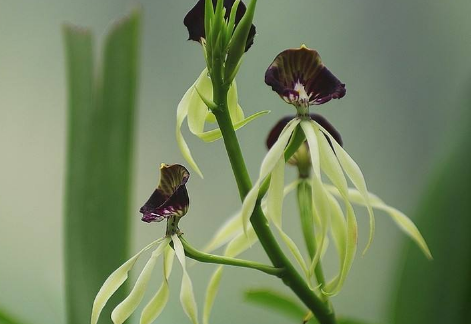
After dividing, plant them in time. Note that the side with new buds should face the edge of the pot. Do not plant the pseudobulbs too deep or too shallow; they can be slightly about two cm below the soil surface. After division, place them in a cool place for care. Do not water for the first 5 days to avoid root rot. You can sprinkle a small amount of water on the leaves to keep them moist.
The above are the cultivation methods for Octopus Orchid. I believe that with scientific care and management, you will certainly be able to grow beautiful Octopus Orchids.
Propagation Methods for Octopus Orchid
Mental Preparation
Octopus Orchid varieties are precious. It is already not easy for you to keep one pot alive. Before dividing, you must be prepared: do not be lazy, do not pamper them, do not play favorites, and wholeheartedly grow several pots of Octopus Orchid well.
Material Preparation
A mother Octopus Orchid that has already filled its pot, sharp scissors, new soil, and flower pots. These are essential. Of course, if you are very experienced, you can also have your own clever little tools; choose tools according to personal habits.
Division Time
Once all kinds of tools are ready, all that is left is to wait. Division is generally chosen in spring, but before flowering.
Division Method
First take the plant out of the pot, being careful not to damage the roots. To make handling easier, generally start withholding water one week before division to ensure the soil is loose and soft, making it easier to remove from the pot.
Handle the plant, shake off the old soil around the roots, and trim the roots. Cut off root hairs that have aged and died, then cut off dry and withered leaves.
Divide into clumps. Divide the plant into clumps depending on how many pots you want. Try not to divide too few; generally, a full pot of Octopus Orchid can simply be divided into two pots. Be careful not to damage the buds and roots during the cutting process. Each clump should retain at least 3 pseudobulbs, as this gives a relatively high survival rate.
Pot placement: when planting, note that the side with new buds should face the edge of the pot, leaving enough space for its growth. When planting, the pseudobulbs should not be too deep or too shallow; slightly 1~2 cm below the soil surface.
After division, place it in a cool place and do not water for 3~5 days, so that any wounds from the division process do not fail to heal in time and cause rot. Just spray a small amount of water on the leaves to keep the plant from shrinking.
After about a week, new roots and buds will grow normally, and then they can be cared for normally together with the other plants.
White-flowered Octopus Claw Guide: How to Grow White-flowered Octopus Claw / How to Propagate White-flowered Octopus Claw Aizoaceae, Octopus Claw Genus
Chinese Scientific Name: White-flowered Octopus ClawLatin Name: Ebracteola wilmaniae
Family and Genus: Aizoaceae, Octopus Claw Genus
Introduction: White-flowered Octopus Claw is a perennial herb, very succulent, and clump-forming. The bases of the opposite leaves are united into a fleshy sheath, and the entire pair of opposite leaves closely resembles a slender pair of pincers. The front of the leaf is flat, the back is rounded and convex, with ridges. The leaf epidermis is thin and has many translucent tiny dots. The leaves are 4-8 cm tall, united at the base. Young plants are solitary, while old plants grow densely in clumps.
White-flowered Octopus Claw is a perennial herb, very succulent, and clump-forming. The bases of the opposite leaves are united into a fleshy sheath, and the entire pair of opposite leaves closely resembles a slender pair of pincers. The front of the leaf is flat, the back is rounded and convex, with ridges. The leaf epidermis is thin and has many translucent tiny dots. The leaves are 4-8 cm tall, united at the base. Young plants are solitary, while old plants grow densely in clumps. The leaf color is green to gray-green. Flowers emerge from the middle slit between the two leaves. The flowers are white, about 3-5 cm in diameter, with short flower stalks. Generally each plant only opens one to 2 flowers, and when grown in groups the flowering is very spectacular. They open on sunny afternoons from late autumn to early spring and close at night. This opening by day and closing by night lasts about 7 days. If there is cloudy and rainy weather or insufficient light in the cultivation site, they are difficult to open. The plant is cross-pollinated.
White-flowered Octopus Claw is relatively easy to grow into clumps. Two years after sowing, each year it will split from 1 into 2~3 heads. If grown into a very large clump, the number of heads produced by splitting during the next year's skin-shedding will decrease, becoming 1 split into 1. At this time the plant can be divided, separating it into small clumps one after another, so that nutrients can be supplied adequately again, and head splitting will gradually return to normal. The plant goes dormant in summer and grows in the other seasons. Its skin-shedding period is similar to that of Lithops, but the skin-shedding period is relatively long. During skin shedding, give more sun and less water. In White-flowered Octopus Claw, skin shedding means the old outer skin gradually dries up and provides nutrients to the new plant. The new plant's leaves grow at the same time as the old leaves, and sometimes there are many layers stacked one upon another. The growing medium uses coal cinder mixed with a small amount of peat, with granular river sand spread on the soil surface. The growing medium should mainly be permeable to water and air. This variety is not very tolerant of strong sun, so shade is essential in summer. Spring is the skin-shedding growth period, and full sun is possible. During skin shedding, appropriate supplemental water can be given. This variety can generally be watered once the medium dries out, otherwise the new leaves are prone to sunburn or drooping and withering. Generally, water when dry; water from above rather than soaking the pot. Shade throughout summer and place in a bright, ventilated spot with scattered light. In summer, give only a small amount of water; too much will cause rot. After temperatures drop in autumn, watering can be resumed, progressing step by step. From late winter to early spring, they will produce brilliant flowers. If the plant is plump, it does not need supplemental water; if the opposite leaves are found to be somewhat wilted, water immediately. In winter, avoid frost damage from temperatures that are too low. When the potting soil is dry, minus 3 degrees is no problem at all. There are relatively large differences between north and south, so flower enthusiasts should cultivate according to their own environment. Propagation can be by sowing or division. Conophytums are only beautiful when grown in clumps.
[/td][/tr][/table]