What are the propagation methods for Paphiopedilum? This article gives you a detailed introduction
Division propagation
Division propagation is the main propagation method for Paphiopedilum. Potted Paphiopedilum can be divided once every two to three years. Generally, after Paphiopedilum blooms it enters a short dormant period, and this is when division can be carried out.
First take the plant out of the pot, clear away the soil from the roots, and be careful not to damage the young shoots. Separate the plant into portions, each with two or three shoots; a thicker, sturdier shoot can be divided into a plant on its own. Plant the divisions in pots and place them in a cool, shaded spot, and the roots will soon recover.
Seed propagation
Paphiopedilum seeds are very small, so sowing is relatively difficult. First the embryo of the Paphiopedilum seed must be cultured on a medium in a sterile test tube. After the seeds germinate in the test tube, they still need two or three rounds of seedling separation and transplanting. When the Paphiopedilum seedlings grow to about 3 cm, they can be removed from the test tubes and cultivated. Paphiopedilum grown from seed generally takes 4-5 years to bloom.
That is all we have to share about Paphiopedilum growing methods and propagation methods. Paphiopedilum is an excellent potted orchid, so be sure not to miss it.
Growing methods for Paphiopedilum
1. Soil
For potted Paphiopedilum, leaf mold, peat and the like can be used in the mix. When potting, first place a layer of crushed brick and tile granules at the bottom of the pot to keep good aeration and benefit the growth of the plant's root system.
2. Temperature
Paphiopedilum likes a warm environment, and different varieties are suited to different temperatures. Green-leaved varieties are suited to a temperature of 12-18°C, mottled-leaved varieties grow well at 15-25°C, the suitable temperature in winter is 10-15°C, and in summer the temperature must not be higher than 30°C. When the winter temperature is below 10°C, move it indoors promptly.
3. Light
Paphiopedilum is shade-loving, and during growth it needs a moderate amount of light. In spring, a semi-shaded environment is best; summer is hot, so it needs heavy shading, and can be given light in the early morning and evening; in winter it must be given plenty of sun.
4. Water
Paphiopedilum likes a moist environment and cannot tolerate dryness, so the potting soil should be kept moist; water as soon as it is slightly dry. In summer, also sprinkle water around the plant to increase air humidity. During the plum rain season, pay attention to ventilation and control water appropriately.
Growing methods for Paphiopedilum
Paphiopedilum is an evergreen perennial herb. It is native to tropical regions of Asia through to the Solomon Islands. About 10 species are found in China, mainly distributed in Yunnan, Guangxi, Guizhou and other areas, and there are about 50 species in nature.
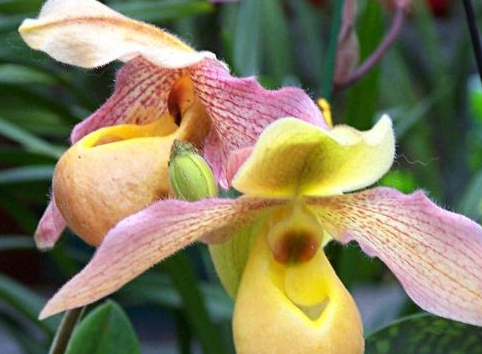
Morphological characteristics: no pseudobulbs, and the aerial stem emerges from the rhizome. Leaves are strap-shaped, leathery, with grooves on the surface, dark green or with patches. Flowers are terminal, usually solitary, with a few species having several. The lateral sepals are fused, often hidden behind the lip, and the dorsal sepal is large and upright above; the lateral petals are often narrow and long, or twisted, the lip is large and pouch-shaped, and the column is thick and short, with 2 lateral stamens and one large degenerated stamen.
The native species of Paphiopedilum are also all beautiful and easy to cultivate, and most of those commonly seen at present are native species. The main famous native species are introduced below:
Paphiopedilum insigne: native to India, potted in all parts of China, and also an excellent cut flower cultivar.
Paphiopedilum philippinense: native to the Philippines. Each inflorescence has several flowers, likes high temperatures, and can often be grown into a clump bearing more than 10 flower stems.
Paphiopedilum hirsutissimum: found in Guangxi, Yunnan and Guizhou in China, and also distributed in India. Terrestrial or lithophytic, with leaves up to 40 cm and a solitary flower.
Paphiopedilum victoria-regina: a variety of ^5. cm1667^^>^711^. Its greatest advantage is that one stem bears many flowers and it blooms continuously year-round, and a large clump in one pot can bloom all year. The flowers are pure green, and the lip is nearly white.
Paphiopedilum armeniacum: a newly discovered new species, native to Bijiang, Yunnan. In its place of origin it grows attached to rock walls, the leaf underside has keel-like protrusions and dense purple spots, and the flowers are apricot yellow.
Paphiopedilum purpuratum: native to South China. The flowering period is June〜September. It is suitable for cultivation in a intermediate-temperature greenhouse.
Paphiopedilum niveum: flowers white, flowering period April〜August. It is suitable for cultivation in a high-temperature greenhouse.
Growth habits: in its ecological habits, the native species of Paphiopedilum mostly grow in humus-rich soil under forests in temperate climates, or under shrub thickets, or in moss on rocks, and occasionally as epiphytes. It likes a shaded and moist environment and dislikes waterlogging. It has no dormant period.
Propagation methods: Paphiopedilum is commonly propagated by division, and generally division should be done only when the mother plant has grown large enough; vigorous growers are divided once every 2〜3 years. When dividing, the new plants should
have 3 shoots each. It is often done in spring when new shoots first appear, together with repotting.
Cultivation and care: the root system of Paphiopedilum is not well developed, and it has neither aerial roots nor pseudobulbs, so its growing medium needs good water retention, and generally mixing 50% peat soil into a bark-based medium works well. Paphiopedilum has no dormant period, so it needs a continuous small amount of watering year-round to keep the medium sufficiently moist; too much water, or water remaining for a long time on the leaf rosette or flower buds, easily causes rot. In summer it must be shaded, and strong light should be avoided. Different species require different temperatures when cultivated; some species native to India and China can survive at a minimum temperature of about 101; species native to the Philippines and elsewhere require a minimum temperature of 14〜181; modern hybrid cultivars require even higher temperatures. During the growing period, apply a diluted fermented cake fertilizer water once a month. After fertilizing, if the leaves are tender green and glossy, fertilizing can continue; if the leaves turn yellow, it indicates poor root growth, and fertilizing should be stopped, otherwise the roots will rot and the plant will die.
Horticultural uses: when used for indoor display arrangements in winter, it should be placed in a well-lit and ventilated spot.
Paphiopedilum has peculiar flower shapes, graceful flower forms, and rich, vivid colors, and is one of the world's famous flowers and one of the earliest cultivated and most popular "foreign orchids" in the world. Its flowering period can last as long as 4 months, making it an ideal high-grade potted flower for indoor studies, living rooms and bedrooms. In recent years it has also often been paired with cut foliage such as Dracaena sanderiana, asparagus fern and ferns as elegant vase arrangements to decorate the home.