How to grow Cymbidium faberi? Keep these cultivation tips in mind
1. Cymbidium faberi originally grows on mountains at high altitudes and has high requirements for ventilation, so it should be kept in a shaded place.
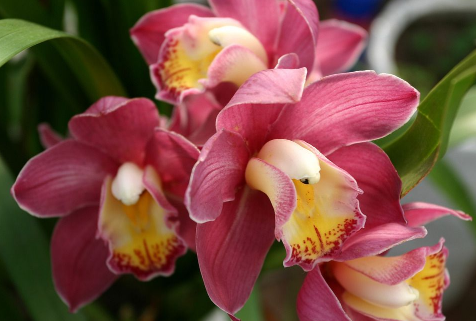
2. Cymbidium faberi should not be watered too frequently; the soil can be kept appropriately on the dry side. When watering the flowers and leaves, be sure to use only a small amount, or let the water dry off quickly. Too much water flowing into the leaf core will affect the plant's growth.
3. The root system of Cymbidium faberi is relatively robust, so it generally does not need frequent repotting; only then can Cymbidium faberi have a stable growing environment.
Tips for growing large-flowered cymbidium
Large-flowered cymbidium is the most fertilizer-loving among all orchids, so when it comes to applying fertilizer, you must not be careless. The flower bud differentiation period of large-flowered cymbidium is from August to September. At this time, there must be an obvious temperature difference to promote flower bud differentiation, that is, around 25°C during the day and around 12-15°C at night. During this period, pay attention to temperature and also to fertilizing.
The sprouting of large-flowered cymbidium has relatively high temperature requirements. If the nighttime temperature exceeds 15°C when the flower buds sprout, the flower buds will wither. There is another point that also needs attention: good ventilation is a favorable condition affecting the growth and development of large-flowered cymbidium. If ventilation cannot be provided in time, especially in summer, it is not conducive to the normal growth and development of large-flowered cymbidium, affects flower bud differentiation, and causes the phenomenon of only growing leaves without blooming, which is very sad.
It is still necessary to learn the tips for growing large-flowered cymbidium, especially for those who grow large-flowered cymbidium at home. If your plant does not bloom, it may be that there is a problem with your cultivation method. Previously, a friend asked the editor whether it was because the large-flowered cymbidium did not bloom; now perhaps the reason has been found. That is all for today's content. Thank you all for reading!
Growing large-flowered cymbidium and tips to note
Large-flowered cymbidium is a type of flower. Large-flowered cymbidium is an artificially hybridized species in the genus Cymbidium. The flower language of large-flowered cymbidium: abundance and peace, noble and elegant. What is the cultivation method for large-flowered cymbidium? What are the tips for growing large-flowered cymbidium? Below, the editor will take everyone to learn some cultivation knowledge about large-flowered cymbidium. Let's take a look together, and I hope it will be helpful to everyone.
Growing large-flowered cymbidium
Potting and repotting methods for growing large-flowered cymbidiumAs a general rule, when the plant becomes too large, it should be repotted or divided and potted to promote growth and flowering. Potting or repotting should preferably be done after flowering or in early spring when new shoots have just sprouted. Repotting method: take the plant out of the old pot, cut off rotten roots and yellow leaves, and remove the old medium; place a layer of broken tiles or broken bricks at the bottom of the new pot to facilitate drainage and aeration; place the plant into the pot, fill in new medium, press it firmly with your hands, and water thoroughly.
Watering methods for growing large-flowered cymbidium
Large-flowered cymbidium is a flower that needs a relatively large amount of water, especially in summer; not only should the watering amount be sufficient, but the leaves should also be sprayed to lower the temperature and raise humidity. The swollen pseudobulbs of large-flowered cymbidium have a water-storing function, so it has a certain drought tolerance. However, if watering is insufficient, the swollen pseudobulbs will shrink and normal growth will be affected. In addition, watering should be reduced during the flowering period, otherwise the flowers will develop brown spots.
Temperature requirements for growing large-flowered cymbidium
Large-flowered cymbidium likes warm, cool, humid, and semi-shaded environmental conditions. The suitable growth temperature is 15-25°C. Below 10°C or above 35°C, it enters a dormant state. The overwintering temperature should preferably not be lower than 10°C. For most varieties, when the day-night temperature difference is below 10-15°C, flower bud differentiation can proceed smoothly.
Tips for growing large-flowered cymbidium
Tips for growing large-flowered cymbidium1. Propagation: division propagation is often used. The division time is mostly after the plant flowers and before the new shoots have grown large, during this short dormant period. Before division, the plant should be dried appropriately, and the operation should be carried out when the roots are slightly whitish and soft. Vigorous plants are usually divided once every 2-3 years. After division, each clump of orchid seedlings should carry 2-3 pseudobulbs, one of which must have been newly formed in the previous year.
2. Temperature: it likes strong light, and the suitable growth temperature is 10°C-25°C. In winter, it should be moved to a low-temperature greenhouse for cultivation.
3. Humidity: it likes humidity very much, but ventilation must be noted, otherwise it is prone to anthracnose. The humidity for small seedlings should be 80%-90%, and the humidity for medium and large seedlings should be 60% to 85%.
4. Fertilizing: during the growth period, the ratio of nitrogen, phosphorus, and potassium is 1:1:1; during the flowering promotion period, the ratio is 1:2:2 to 3. A fertilizer solution pH of 5.8-6.2 is suitable.
5. Watering: in production, sprinkler irrigation is usually used. Water once a day in May and September, twice a day in July-August, and once every 2 to 3 days from October to April of the following year. The number of waterings should be adjusted at any time according to seedling size and weather conditions.